


You have full access to this article via your institution.
Hello Nature readers, would you like to get this Briefing in your inbox free every day? Sign up here.

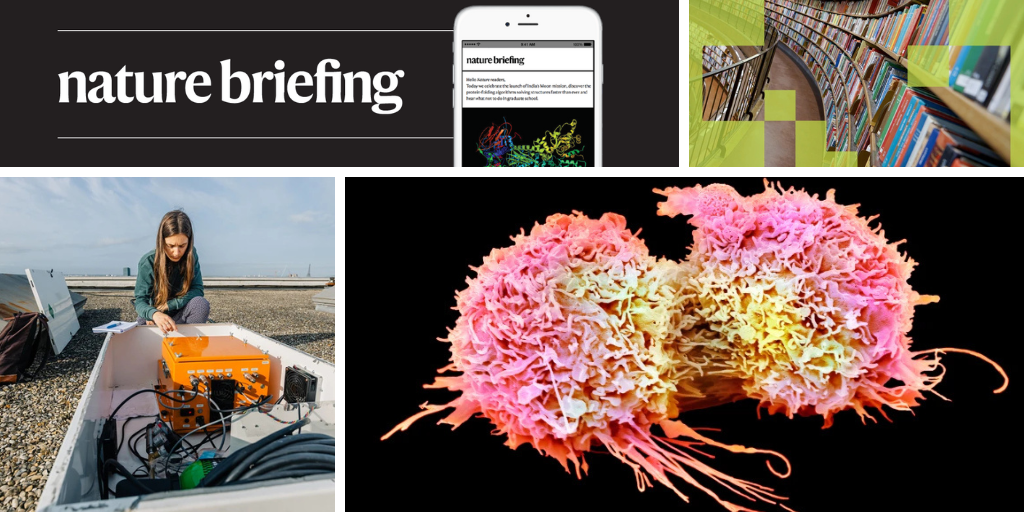
Lung cancer cells (shown) in mice can connect with nearby neurons to send a ‘shutdown’ signal to the brain that suppresses tumour-killing immune cells.Credit: Steve Gschmeissner/SPL
Tumours lure and then hijack nearby sensory neurons to boost their own growth. The cancer cells use these neurons to send a signal to the brain that subdues the activity of immune cells around the tumour, which allows it to grow unchecked. When researchers deactivated these neurons in mice with lung cancer, they saw “a huge, dramatic reduction” in tumour growth — more than 50% — says cancer immunologist and study co-author Chengcheng Jin.
Snakes don’t have genes to make the ‘hunger hormone’ ghrelin, which could explain how they can go for months between meals. In most other vertebrates, ghrelin stimulates the appetite, and plays a role in breaking down fat to use as energy. Researchers found that other reptiles such as chameleons also lack ghrelin genes, which might help these animals preserve their fat stores for longer without needing to eat. Studying how these animals process food without ghrelin could help researchers understand how the hormone works in humans, says genomicist Todd Castoe.
Reference: Royal Society Open Biology paper
An open-source artificial intelligence model called OpenScholar can outperform some major large language models (LLMs) at reviewing scientific literature, and gets the citations correct more often. OpenScholar combines an LLM with a database of 45 million open-access articles and links the information it sources directly back to the literature to stop the system from ‘hallucinating’ citations. The model is limited by the scope of its database, say the team who developed it. But running it is much cheaper than running a major model such as GPT-5, says computer scientist Hannaneh Hajishirzi.
A cohort of PhD candidates in China have become the first in the country to be assessed on the basis of practical achievements instead of theses. This new class of PhDs is part of the Chinese government’s broader education reforms to cultivate ‘elite engineers’ that can help boost the country’s innovation. As part of their PhD defence, candidates have to make prototypes and prove that their inventions can be used at scale in the real world. Examples so far include the equipment for a new welding technique and a fire-fighting system for a large seaplane.
Features & opinion
To capture the complexity of urban ecosystems, some scientists are turning to remote sensors to collect data without intrusive experimental set-ups. Rooftop instruments can be deployed across several locations to build a comprehensive picture of a city’s greenhouse-gas emissions, and simple camera traps can capture the comings and goings of urban wildlife. Wearable sensors also play a part too: in cities facing rising temperatures, researchers can assess the impacts of cooling interventions by gathering health data from residents’ smart watches.
This article is part of Nature Spotlight: Sensors, an editorially independent supplement.
In 2025, for the first year since 1994, health workers in central Cameroon were unable to go door-to-door with deliveries of ivermectin, a drug that kills the parasites that cause onchocerciasis, or ‘river blindness’. The annual effort had been funded by the United States Agency for International Development, or USAID, which was shut down by the administration of US President Donald Trump. Without foreign support, onchocerciasis, once on the cusp of eradication in the area, can spread unchecked. It’s just one of several ‘biblical’ diseases — so named because they were described in ancient texts — resurfacing as Cameroon’s government funnels resources into HIV- and malaria-control programmes, which also suffered funding cuts.
The New York Times | 9 min read
Sure, we’re all excited about the James Webb Space Telescope (JWST) — and rightly so, its contributions to astronomy have been breathtaking. But “JWST was never intended to supplant Hubble, and in fact can’t, given that it was designed for very different observations”, notes astronomer Phil Plait. Hubble still shines in the area where it is strongest: observing the universe in the spectrum of visible light (JWST specialises in much longer infrared wavelengths). So, despite being launched in 1990, Hubble is far from obsolete.
Scientific American | 9 min read (intermittent paywall)
Today I’m pondering my next haircut. I know there isn’t an exact science to getting the right do, but I want to avoid a bad one at all costs. Luckily, three expert stylists are on hand to offer their advice in this self-help comic.
Next time you hear from me, I might have been transformed by the power of a good haircut. (Or, more likely, I’ll have asked for exactly the same cut as usual).
Help us shape this newsletter to your liking by sending your feedback to [email protected].
Thanks for reading,
Jacob Smith, associate editor, Nature Briefing
With contributions by Flora Graham
• Nature Briefing: Careers — insights, advice and award-winning journalism to help you optimize your working life
• Nature Briefing: Microbiology — the most abundant living entities on our planet — microorganisms — and the role they play in health, the environment and food systems
• Nature Briefing: Anthropocene — climate change, biodiversity, sustainability and geoengineering
• Nature Briefing: AI & Robotics — 100% written by humans, of course
• Nature Briefing: Cancer — a weekly newsletter written with cancer researchers in mind
• Nature Briefing: Translational Research — covers biotechnology, drug discovery and pharma

