


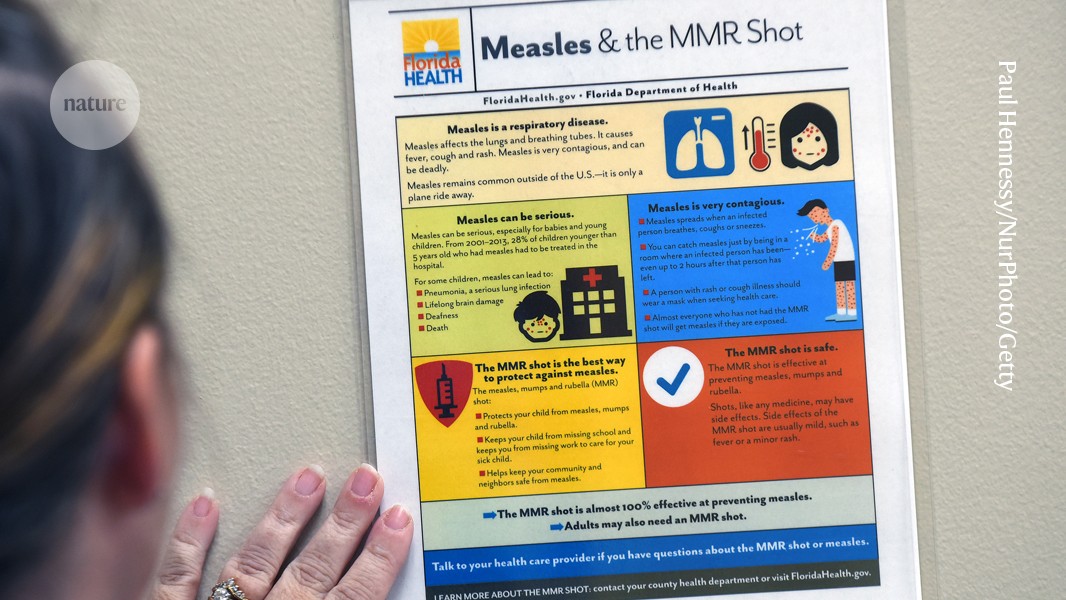

Health-care workers who have never treated someone with measles are having to become familiar with signs of the disease. Credit: Paul Hennessy/NurPhoto/Getty
Measles has been so rare in many countries that some physicians have never seen a case — but that is changing.
The United States recorded more than 2,000 cases last year, more than in any other year in three decades, and could surpass the 2025 total in 2026 (see ‘US measles surges’). The United Kingdom, Spain, Austria and three other nations all lost their official ‘measles free’ label in January. Canada lost its measles-free status in November, and the United States is projected to follow suit in April.
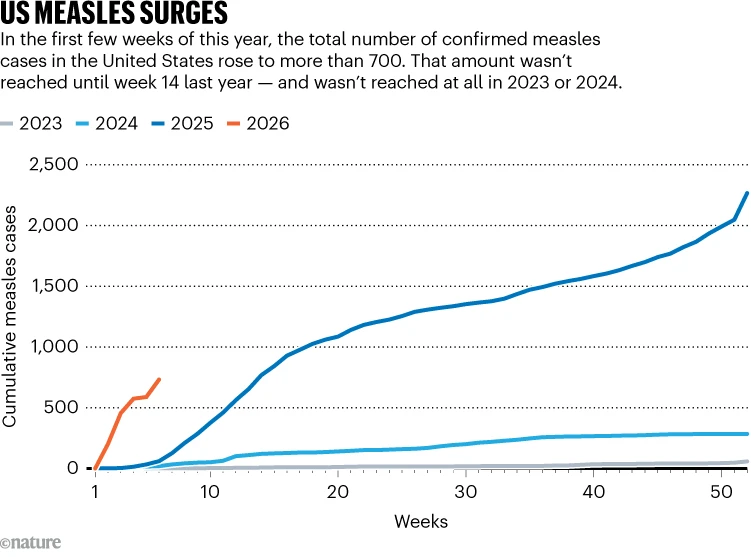
Source: US Centers for Disease Control and Prevention
The measles virus is highly contagious and can cause a fever, cough and rash, and even lead to death. Estimates show that each person with measles would infect, on average, 12–18 other people if everyone around them were susceptible to the disease. Up to 90% of people who are not immune will get measles if they encounter an infected person.
So how worried should vaccinated people be?
How protective are vaccines?
The measles vaccine is highly effective. After one dose, 93% of people will be protected from infection if they are exposed to the virus. Protection rises to 97% after two doses. For most people, this protection lasts for a lifetime.
When 92–94% of the population has immunity to measles, either through vaccination or previous infections, the virus can no longer spread, a phenomenon known as herd immunity. “You may see a very small outbreak or sporadic cases, but you won’t see sustained transmission,” says Nathan Lo, an infectious-disease physician-scientist at Stanford University in California. That is why the measles vaccination coverage target is set at 95%, he adds. In the United States, vaccination coverage among kindergarteners, who are generally aged between 5 and 6, dropped from 95.2% in the 2019–20 school year to 92.5% in the 2024–25, opening the door for outbreaks.
Are vaccinated people also at risk?
Because the vaccine is not 100% effective, people who are fully vaccinated can still get infected. An analysis1 found that 12% of the 4,056 measles cases confirmed in the United States between 2001 and 2022 were ‘breakthrough’ infections in vaccinated people.
“Of course, you only have that risk if you come into contact with someone with measles,” Lo says. That might happen, for example, if there’s a local outbreak or if you travel to an affected area.
Measles is surging in the US: how bad could it get?
In South Carolina, 876 people have been infected in an outbreak that began in October, 838 of them were either unvaccinated or unsure of their vaccination status. Only 38 people had been vaccinated, and 16 of those had received just one of the two recommended doses. A manuscript2 posted to the preprint server medRxiv in January uses modelling to suggest that there is a higher risk of breakthrough cases in scenarios involving greater interaction between unvaccinated and vaccinated people.
The good news for people who are vaccinated and still get infected is that the symptoms tend to be mild, says Lo, a co-author of the manuscript, which has not yet been peer-reviewed. “It’s pretty rare to see the typical complications you might expect” from measles, he says.
Are travellers particularly at risk?
In May, a person with measles boarded an 11-hour international flight to Denver, Colorado. The traveller, who was unvaccinated, had caught measles in another US state before their overseas trip. They had a fever and cough during the long flight to Denver. In the following weeks, nine other cases were identified among Colorado residents who were exposed to this traveller.
“In general, it is uncommon for measles cases to occur from exposure during air travel, whether that’s on a flight or [at] an airport,” says Rachel Herlihy, an epidemiologist at the Colorado Department of Public Health and Environment in Denver. In this case, the level of infectiousness of the passenger might have contributed to the spread of the virus. “We believe that this individual was very actively ill with measles while they were travelling,” she says. The long duration of the flight meant that other passengers were exposed to the virus for a prolonged period of time, which might have aided the infections.

