


You have full access to this article via your institution.
Hello Nature readers, would you like to get this Briefing in your inbox free every day? Sign up here.

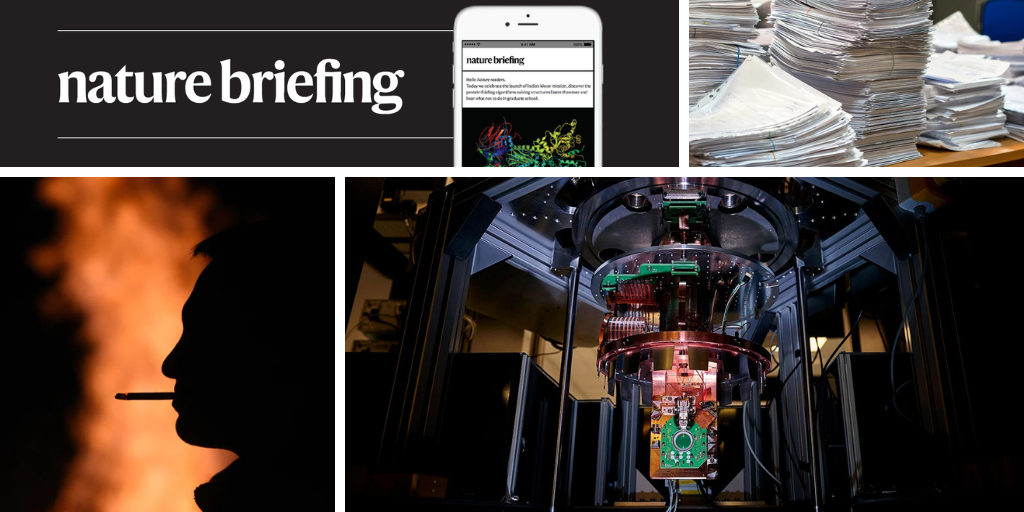
Tobacco smoking is a leading cause of preventable cancer cases.Credit: Jorge Sanz/SOPA Images/LightRocket/Getty
Nearly 40% of new cancer cases worldwide are potentially preventable, according to a new analysis. The study found that in 2022, smoking tobacco was the leading contributor to cancer cases, followed by infections and drinking alcohol. Reducing such risk factors is “one of the most powerful ways that we can potentially reduce the future cancer burden”, says cancer epidemiologist and study co-author Hanna Fink.
Reference: Nature Medicine paper
Cuts to global development funding could lead to 9.4 million additional deaths in the next four years, with about 2.5 million of those deaths in children under 5, compared to if funding had been maintained at 2023 levels. The modelling study comes roughly one year after the US Agency for International Development (USAID) was wiped out by the administration of US President Donald Trump, compounded by cuts made by other top funders such as the United Kingdom, Germany and Canada. “We should take the precise numbers with caution, but I think the overall conclusion is likely correct,” says global-development researcher Lee Crawfurd. “People will die in large numbers.”
Reference: The Lancet Global Health paper
The US National Institutes of Health (NIH) will free some research from the heavy bureaucratic requirements that are designed for clinical trials but are sometimes ill-suited to other fields, such as basic psychology and behavioural studies. Many researchers say they are relieved by the change. But others question how the laudable goals of the requirements — to increase the transparency of research on human participants and prevent negative results from ending up unpublished — can still be achieved.
Aletheia-Probe (named after the Greek word for truth) offers scientists a one-stop-shop for checking the validity of journals and conferences, so they can better avoid scams, poor-quality papers and predatory publishers. The software collects data from a dozen databases that list legitimate and questionable publications and events. “My idea of this is something like having a virus scanner,” says cloud-computing architect Andreas Florath, who first built the tool for himself while evaluating hundreds of papers for a review.
Try it: Users can download Aletheia-Probe from cloud-based repository GitHub and run it on a command-line interface.
Features & opinion
A string of advances in quantum computing have brought about a “vibe shift” in the field, says experimental quantum physicist Nathalie de Leon. In the past two years, researchers have found ways to drastically reduce the error sizes of quantum devices, and theorists have gotten a firmer grasp of how to use these machines more efficiently. These leaps forward have some researchers hopeful that quantum computers with real-world applications could be just years away, not decades. “We’ve entered a new era,” says computer scientist Dorit Aharonov.
When Essex University opened a campus in the downtrodden coastal town of Southend, in the United Kingdom, it was a beacon of hope for aspiring young students at a time when the government was focused on clearing the path for more people to attend university. Now it’s closing — an example of the country’s increasingly cash-strapped university sector. Some students will not receive their degrees and the ripple effects — on local business, and on workers including cleaners and catering staff — are spreading.
As we slide into the winter Olympics, ice skating might seem as natural and inevitable as jumping on a sledge travelling a hundred kilometres per hour down an icy track. But early bone skates didn’t work well on rough ice and were too slidey to propel the user forwards. Even with sticks for assistance, “it’s almost impossible to stop or turn”, says skate-scholar Bev Thurber, who says they were probably toys rather than tools. Enter metal blades, which do all of the above, and so well that — other than the hinged ‘clap skates’ used for speed-skating — skates have changed little over the past century.
When I want to torture my children, I regale them with my attempts at Gen Z slang. Thank goodness I have 77-year-old curator Alison Luchs to school me in the fine art of aura farming. Her videos highlighting the treasures of the US National Gallery of Art are delighting viewers — and I can confirm that even my kids love them.
Help keep this newsletter’s finger on the pulse — send your feedback to [email protected].
Thanks for reading,
Flora Graham, senior editor, Nature Briefing
With contributions by Jacob Smith
• Nature Briefing: Careers — insights, advice and award-winning journalism to help you optimize your working life
• Nature Briefing: Microbiology — the most abundant living entities on our planet — microorganisms — and the role they play in health, the environment and food systems
• Nature Briefing: Anthropocene — climate change, biodiversity, sustainability and geoengineering
• Nature Briefing: AI & Robotics — 100% written by humans, of course
• Nature Briefing: Cancer — a weekly newsletter written with cancer researchers in mind
• Nature Briefing: Translational Research — covers biotechnology, drug discovery and pharma

