


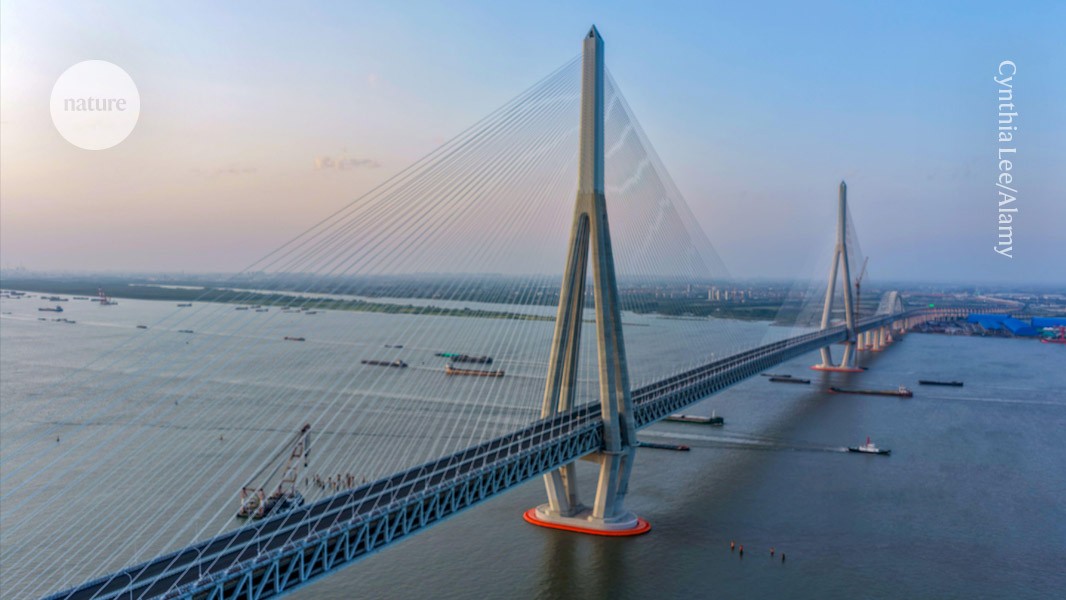

Civil engineer Zheng Hehui invented Lego-like blocks, used in the Changtai Yangtze River Bridge pylons, as part of his practical PhD.Credit: Cynthia Lee/Alamy
Last month, Zheng Hehui gave an oral defence of his PhD in civil engineering at Southeast University in Nanjing, China. But Zheng had not written a thesis. Instead, he talked about a product he had developed: a set of Lego-like blocks, made with reinforced steel, that fit together to form a bridge pylon.
Zheng is among the first cohort of Chinese doctoral students to be assessed on the basis of practical achievements that lead to new products, techniques, projects and installations. His invention is being used in a huge cable-stayed rail and road bridge built across the Yangtze River.
Since September, at least 11 such ‘practical PhD’ students, all engineers, have obtained their doctoral degrees through this route. Their work includes the development and application of a welding technique and its equipment, and the creation of a fire-fighting system for a large seaplane. Universities in other countries offer ‘industrial PhDs’, where students work closely with a company, but many of these degrees still require a written thesis.
Practical PhDs are part of the Chinese government’s broader education reforms, which started in 2010, to cultivate ‘elite engineers’ that can help boost innovation in the country. In 2022, the government instructed top-tier universities to team up with major companies to set up graduate colleges for engineers.
A law passed in 2024 allows universities to let master’s and PhD students graduate on the basis of practical achievements. At present, only students in engineering-related subjects are eligible for this no-thesis arrangement.
Real-world problems
This alternative degree-granting model is important and urgently needed, says Guo Tong, a civil engineer at Southeast University. “[It] can guide students to carry out real research that can solve real-life problems in those industries that carry strategic importance or have technological choke points in China.”
For Li Jiang, an information scientist at Nanjing University, the new evaluation model addresses a problem that has dogged the education of engineers: “There is a big gap between the theoretical knowledge they learn from books and the hands-on ability our society needs from them.”
Candidates for the practical PhDs have to make prototypes and prove that their inventions can be used in real-life and at scale, according to Sun Yutao, who researches innovation policy at Dalian University of Technology in Dalian, China.
Future talent
The programme is part of China’s effort to build a talent pool for key and emerging industries, such as artificial intelligence and semiconductors, to drive innovation, Zhu Xiumei, a deputy director at the Chinese Ministry of Industry and Information Technology, said at a press conference in December.
Over the past three years, 50 graduate colleges for engineers have been established in China to bring the policy into practice. Students at these colleges work with two supervisors simultaneously: one with an academic background, the other with solid practical experience. During oral examinations, they are evaluated by a panel comprising both scholars and practising engineers.
“Many engineering professors in Chinese universities have always been academics and never worked in the industry. That is why it is important to pair them up with experts from the industry to teach those PhDs,” Li says.
Tsinghua University, for example, has partnered with 56 companies in 14 key sectors over the past three years, its vice-president Wu Huaqiang said at the press conference. Under the programme, the university has recruited 1,430 graduate students, who have solved many industrial problems and received more than 100 patents, Wu said.
Some of the universities offering the programme have courses with strong links to national defence. One, Northwestern Polytechnical University in Xi’an, is working with 16 major Chinese groups, including China North Industries Group, which makes weapons and military equipment.

