


Warwick, N., Griffiths, P., Keeble, J., Archibald, A., & Pyle, J. Atmospheric implications of increased Hydrogen use. GOV.UK https://www.gov.uk/government/publications/atmospheric-implications-of-increased-hydrogen-use (2022).
Derwent, R. G. et al. Global modelling studies of hydrogen and its isotopomers using STOCHEM-CRI: likely radiative forcing consequences of a future hydrogen economy. Int. J. Hydrog. Energy 45, 9211–9221 (2020).
Paulot, F. et al. Global modeling of hydrogen using GFDL-AM4.1: sensitivity of soil removal and radiative forcing. Int. J. Hydrog. Energy 46, 13446–13460 (2021).
Sand, M. et al. A multi-model assessment of the Global Warming Potential of hydrogen. Commun. Earth Environ. 4, 203 (2023).
Prather, M. J. An environmental experiment with H2? Science 302, 581–582 (2003).
Warwick, N. J. et al. Atmospheric composition and climate impacts of a future hydrogen economy. Atmos. Chem. Phys. 23, 13451–13467 (2023).
Ehhalt, D. H. & Rohrer, F. The tropospheric cycle of H2: a critical review. Tellus B Chem. Phys. Meteorol. 61, 500–535 (2009).
Patterson, J. D. & Saltzman, E. S. Diffusivity and solubility of H2 in ice Ih: implications for the behavior of H2 in polar ice. J. Geophys. Res. Atmos. 126, e2020JD033840 (2021).
Haan, D. Teneurs en monoxyde de carbone de l’air contenu dans la glace de l’Antarctique et du Groenland. Thesis, Université Joseph-Fourier (1996).
Solomon, S. et al. Contributions of stratospheric water vapor to decadal changes in the rate of global warming. Science 327, 1219–1223 (2010).
Novelli, P. C. et al. Molecular hydrogen in the troposphere: global distribution and budget. J. Geophys. Res. Atmos. 104, 30427–30444 (1999).
Paulot, F., Pétron, G., Crotwell, A. M. & Bertagni, M. B. Reanalysis of NOAA H2 observations: implications for the H2 budget. Atmos. Chem. Phys. 24, 4217–4229 (2024).
Zgonnik, V. The occurrence and geoscience of natural hydrogen: a comprehensive review. Earth-Sci. Rev. 203, 103140 (2020).
Esquivel-Elizondo, S. et al. Wide range in estimates of hydrogen emissions from infrastructure. Front. Energy Res. 11, 1207208 (2023).
Derwent, R. G., Simmonds, P. G., O’Doherty, S., Manning, A. J. & Spain, T. G. High-frequency, continuous hydrogen observations at Mace Head, Ireland from 1994 to 2022: baselines, pollution events and ‘missing’ sources. Atmos. Environ. 312, 120029 (2023).
Pétron, G. et al. Atmospheric H2 observations from the NOAA Cooperative Global Air Sampling Network. Atmos. Meas. Tech. 17, 4803–4823 (2024).
Prinn, R. G. et al. History of chemically and radiatively important atmospheric gases from the Advanced Global Atmospheric Gases Experiment (AGAGE). Earth Syst. Sci. Data 10, 985–1018 (2018).
Patterson, J. D. et al. Reconstructing atmospheric H2 over the past century from bi-polar firn air records. Clim. Past 19, 2535–2550 (2023).
Patterson, J. D., Saltzman, E. S. & Paulot, F. Emerging constraints on the H2 budget from polar firn air reconstructions. J. Geophys. Res. Atmos. 130, e2025JD043662 (2025).
Mitchell, L., Brook, E., Lee, J. E., Buizert, C. & Sowers, T. Constraints on the late Holocene anthropogenic contribution to the atmospheric methane budget. Science 33422, 964–966 (2013).
Rhodes, R. H. et al. Continuous methane measurements from a late Holocene Greenland ice core: atmospheric and in-situ signals. Earth Planet. Sci. Lett. 368, 9–19 (2013).
Mann, M. E. et al. Global signatures and dynamical origins of the Little Ice Age and medieval climate anomaly. Science 326, 1256–1260 (2009).
Mann, M. E., Bradley, R. S. & Hughes, M. K. Northern hemisphere temperatures during the past millennium: inferences, uncertainties, and limitations. Geophys. Res. Lett. 26, 759–762 (1999).
Meinshausen, M. et al. Historical greenhouse gas concentrations for climate modelling (CMIP6). Geosci. Model Dev. 10, 2057–2116 (2017).
Nicewonger, M. R., Aydin, M., Prather, M. J. & Saltzman, E. S. Extracting a history of global fire emissions for the past millennium from ice core records of acetylene, ethane, and methane. J. Geophys. Res. Atmos. 125, e2020JD032932 (2020).
Nicewonger, M. R., Aydin, M., Prather, M. J. & Saltzman, E. S. Reconstruction of paleofire emissions over the past millennium from measurements of ice core acetylene. Geophys. Res. Lett. 47, e2019GL085101 (2020).
Faïn, X. et al. Southern Hemisphere atmospheric history of carbon monoxide over the late Holocene reconstructed from multiple Antarctic ice archives. Clim. Past 19, 2287–2311 (2023).
Ferretti, D. F. et al. Unexpected changes to the global methane budget over the past 2000 years. Science 309, 1714–1717 (2005).
Mischler, J. A. et al. Carbon and hydrogen isotopic composition of methane over the last 1000 years. Glob. Biogeochem. Cycles 23, GB4024 (2009).
Hantson, S., Knorr, W., Schurgers, G., Pugh, T. A. M. & Arneth, A. Global isoprene and monoterpene emissions under changing climate, vegetation, CO2 and land use. Atmos. Environ. 155, 35–45 (2017).
Do, N. T. N. et al. Historical trends and controlling factors of isoprene emissions in CMIP6 Earth system models. Geosci. Model Dev. 18, 2079–2109 (2025).
Acosta Navarro, J. C. et al. Global emissions of terpenoid VOCs from terrestrial vegetation in the last millennium. J. Geophys. Res. Atmos. 119, 6867–6885 (2014).
Brown, M. A. J., Warwick, N. J. & Archibald, A. T. Multi-model assessment of future hydrogen soil deposition and lifetime using CMIP6 data. Geophys. Res. Lett. 52, e2024GL113653 (2025).
Bertagni, M. B., Paulot, F. & Porporato, A. Moisture fluctuations modulate abiotic and biotic limitations of H2 soil uptake. Glob. Biogeochem. Cycles 35, e2021GB006987 (2021).
Hersbach, H. et al. The ERA5 global reanalysis. Q. J. R. Meteorol. Soc. 146, 1999–2049 (2020).
Intergovernmental Panel on Climate Change (IPCC). Summary for Policymakers. In Climate Change 2021: The Physical Science Basis. Contribution of Working Group I to the Sixth Assessment Report of the Intergovernmental Panel on Climate Change (eds Masson-Delmotte, V. et al.) 3–32 (Cambridge Univ. Press, 2021).
Neukom, R., Steiger, N., Gómez-Navarro, J. J., Wang, J. & Werner, J. P. No evidence for globally coherent warm and cold periods over the preindustrial Common Era. Nature 571, 550–554 (2019).
Petron, G. et al. Atmospheric hydrogen dry air mole fractions from the NOAA GML Global Greenhouse Gas Reference Network, Carbon Cycle Cooperative Global Air Sampling Network: 2009 – present, version: 2025-09-30. NOAA https://doi.org/10.15138/WP0W-EZ08 (2025).
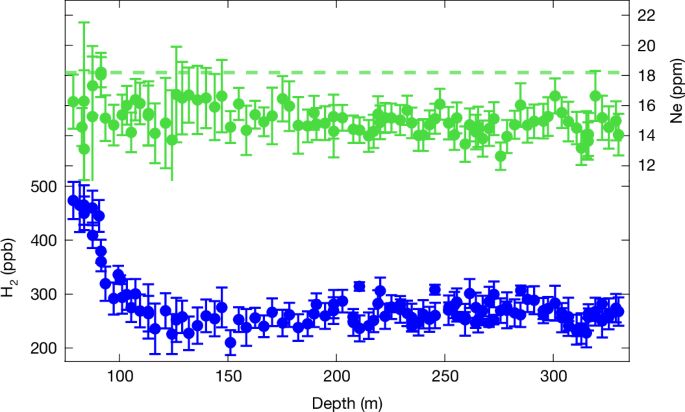
Saltzman, E. S., Miranda, M. H., Patterson, J. D. & Aydin, M. A system for analysis of H2 and Ne in polar ice core samples. Atmos. Meas. Tech. 18, 7865–7873 (2025).
Riddell-Young, B. et al. Atmospheric methane variability through the Last Glacial Maximum and deglaciation mainly controlled by tropical sources. Nat. Geosci. 16, 1174–1180 (2023).
Craig, H., Horibe, Y. & Sowers, T. Gravitational separation of gases and isotopes in polar ice caps. Science 242, 1675–1678 (1988).
Severinghaus, J. P. & Battle, M. O. Fractionation of gases in polar ice during bubble close-off: new constraints from firn air Ne, Kr and Xe observations. Earth Planet. Sci. Lett. 244, 474–500 (2006).
Harris Stuart, R. et al. On the relationship between δO2/N2 variability and ice sheet surface conditions in Antarctica. Cryosphere 18, 3741–3763 (2024).
Oyabu, I. et al. Fractionation of O2/N2 and Ar/N2 in the Antarctic ice sheet during bubble formation and bubble–clathrate hydrate transition from precise gas measurements of the Dome Fuji ice core. Cryosphere 15, 5529–5555 (2021).
Suwa, M. & Bender, M. L. O2/N2 ratios of occluded air in the GISP2 ice core. J. Geophys. Res. Atmos. 113, D11119 (2008).
Bender, M. L. Orbital tuning chronology for the Vostok climate record supported by trapped gas composition. Earth Planet. Sci. Lett. 204, 275–289 (2002).
Gluckauf, E. A micro-analysis of the helium and neon contents of air. Proc. R. Soc. A Math. Phys. Sci. 62, 98–119 (1944).
Neftel, A., Oeschger, H., Schwander, J. & Stauffer, B. Carbon dioxide concentration in bubbles of natural cold ice. J. Phys. Chem. 87, 4116–4120 (1983).
Paulot, F. fabienpaulot/H2_firn_air_box_model: v1.0.0. Zenodo https://doi.org/10.5281/zenodo.15359713 (2025).
Horowitz, L. W. et al. The GFDL global atmospheric chemistry-climate model AM4.1: model description and simulation characteristics. J. Adv. Model. Earth Syst. 12, e2019MS002032 (2020).
Guenther, A. B. et al. The Model of Emissions of Gases and Aerosols from Nature version 2.1 (MEGAN2.1): an extended and updated framework for modeling biogenic emissions. Geosci. Model Dev. 5, 1471–1492 (2012).
Hoesly, R. M. et al. Historical (1750–2014) anthropogenic emissions of reactive gases and aerosols from the Community Emissions Data System (CEDS). Geosci. Model Dev. 11, 369–408 (2018).
O’Rourke, P. et al. CEDS v_2021_04_21 gridded emissions data. Pacific Northwest National Laboratory https://doi.org/10.25584/PNNLDataHub/1779095 (2021).
van Marle, M. J. E. et al. Historic global biomass burning emissions for CMIP6 (BB4CMIP) based on merging satellite observations with proxies and fire models (1750–2015). Geosci. Model Dev. 10, 3329–3357 (2017).
Akagi, S. K. et al. Emission factors for open and domestic biomass burning for use in atmospheric models. Atmos. Chem. Phys. 11, 4039–4072 (2011).
Andreae, M. O. Emission of trace gases and aerosols from biomass burning – an updated assessment. Atmos. Chem. Phys. 19, 8523–8546 (2019).
Liu, P. et al. Improved estimates of preindustrial biomass burning reduce the magnitude of aerosol climate forcing in the Southern Hemisphere. Sci. Adv. 7, eabc1379 (2021).
Pfeiffer, M., Spessa, A. & Kaplan, J. O. A model for global biomass burning in preindustrial time: LPJ-LMfire (v1.0). Geosci. Model Dev. 6, 643–685 (2013).
Zhang, B. et al. Improved biomass burning emissions from 1750 to 2010 using ice core records and inverse modeling. Nat. Commun. 15, 3651 (2024).
Strawson, I. et al. Historical Southern Hemisphere biomass burning variability inferred from ice core carbon monoxide records. Proc. Natl Acad. Sci. 121, e2402868121 (2024).
Nicewonger, M. R., Aydin, M., Prather, M. J. & Saltzman, E. S. Large changes in biomass burning over the last millennium inferred from paleoatmospheric ethane in polar ice cores. Proc. Natl Acad. Sci. 115, 12413–12418 (2018).
Sapart, C. J. et al. Natural and anthropogenic variations in methane sources during the past two millennia. Nature 490, 85–88 (2012).
Konecky, B. L. et al. Globally coherent water cycle response to temperature change during the past two millennia. Nat. Geosci. 16, 997–1004 (2023).
Bader, J. et al. Global temperature modes shed light on the Holocene temperature conundrum. Nat. Commun. 11, 4726 (2020).
Ehhalt, D. H. & Rohrer, F. Deposition velocity of H2: a new algorithm for its dependence on soil moisture and temperature. Tellus B Chem. Phys. Meteorol. 65, 19904 (2013).

