


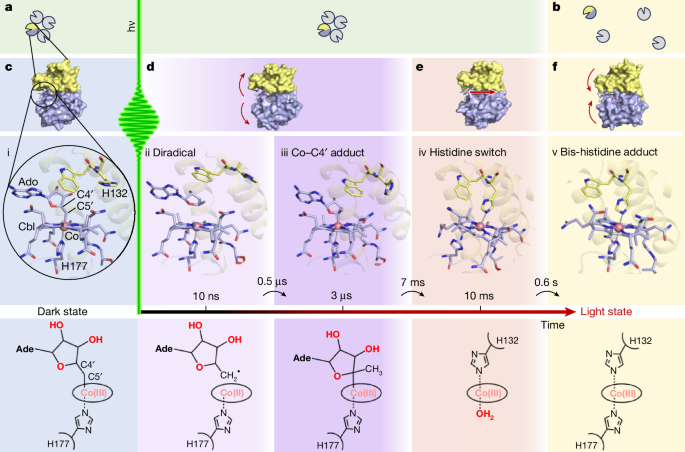
Kottke, T., Xie, A., Larsen, D. S. & Hoff, W. D. Photoreceptors take charge: emerging principles for light sensing. Annu. Rev. Biophys. 47, 291–313 (2018).
Padmanabhan, S., Pérez-Castaño, R., Osete-Alcaraz, L., Polanco, M. C. & Elías-Arnanz, M. Vitamin B12 photoreceptors. Vitam. Horm. 119, 149–184 (2022).
Banerjee, R. & Ragsdale, S. W. The many faces of vitamin B12: catalysis by cobalamin-dependent enzymes. Annu. Rev. Biochem. 72, 209–247 (2003).
Ortiz-Guerrero, J. M., Polanco, M. C., Murillo, F. J., Padmanabhan, S. & Elias-Arnanz, M. Light-dependent gene regulation by a coenzyme B12-based photoreceptor. Proc. Natl Acad. Sci. USA 108, 7565–7570 (2011).
Jost, M. et al. Structural basis for gene regulation by a B12-dependent photoreceptor. Nature 526, 536–541 (2015).
Poddar, H. et al. A guide to time-resolved structural analysis of light-activated proteins. FEBS J. 289, 576–595 (2022).
Miller, R. J. D., Paré-Labrosse, O., Sarracini, A. & Besaw, J. E. Three-dimensional view of ultrafast dynamics in photoexcited bacteriorhodopsin in the multiphoton regime and biological relevance. Nat. Commun. 11, 1240 (2020).
Allen, L. H. Vitamin b-12. Adv. Nutr. 3, 54–55 (2012).
Cheng, Z., Yamamoto, H. & Bauer, C. E. Cobalamin’s (Vitamin B12) surprising function as a photoreceptor. Trends Biochem. Sci. 41, 647–650 (2016).
Yu, Y. et al. SignatureFinder enables sequence mining to identify cobalamin-dependent photoreceptor proteins. FEBS J. 292, 635–652 (2025).
Zhang, S. et al. Photocobilins integrate B12 and bilin photochemistry for enzyme control. Nat. Commun. 15, 2740 (2024).
Zheng, Y., Chen, F., Frank, S., Quispe Haro, J. J. & Wegner, S. V. Three-color protein photolithography with green, red, and far-red light. Small 20, 2405687 (2024).
Fok, H. K. F. et al. Red-shifting B12-dependent photoreceptor protein via optical coupling for inducible living materials. Angew. Chem. Int. Ed. 63, e202411105 (2024).
Kainrath, S., Stadler, M., Reichhart, E., Distel, M. & Janovjak, H. Green-light-induced inactivation of receptor signaling using cobalamin-binding domains. Angew. Chem. Int. Ed. Engl. 56, 4608–4611 (2017).
Chatelle, C. et al. A green-light-responsive system for the control of transgene expression in mammalian and plant cells. ACS Synth. Biol. 7, 1349–1358 (2018).
Mansouri, M. et al. Smart-watch-programmed green-light-operated percutaneous control of therapeutic transgenes. Nat. Commun. 12, 3388 (2021).
Wang, R., Yang, Z., Luo, J., Hsing, I. M. & Sun, F. B12-dependent photoresponsive protein hydrogels for controlled stem cell/protein release. Proc. Natl Acad. Sci. USA 114, 5912–5917 (2017).
Narayan, O. P., Mu, X., Hasturk, O. & Kaplan, D. L. Dynamically tunable light responsive silk-elastin-like proteins. Acta Biomater. 121, 214–223 (2021).
Xu, D., Ricken, J. & Wegner, S. V. Turning cell adhesions ON or OFF with high spatiotemporal precision using the green light responsive protein CarH. Chemistry 26, 9859–9863 (2020).
Jost, M., Simpson, J. H. & Drennan, C. L. The transcription factor CarH safeguards use of adenosylcobalamin as a light sensor by altering the photolysis products. Biochemistry 54, 3231–3234 (2015).
Bridwell-Rabb, J. & Drennan, C. L. Vitamin B12 in the spotlight again. Curr. Opin. Chem. Biol. 37, 63–70 (2017).
Poddar, H. et al. Redox driven B12-ligand switch drives CarH photoresponse. Nat. Commun. 14, 5082 (2023).
Kutta, R. J. et al. The photochemical mechanism of a B12-dependent photoreceptor protein. Nat. Commun. 6, 7907 (2015).
Miller, N. A. et al. The photoactive excited state of the B12-based photoreceptor CarH. J. Phys. Chem. B 124, 10732–10738 (2020).
Branden, G. & Neutze, R. Advances and challenges in time-resolved macromolecular crystallography. Science 373, eaba0954 (2021).
Weik, M. & Domratcheva, T. Insight into the structural dynamics of light sensitive proteins from time-resolved crystallography and quantum chemical calculations. Curr. Opin. Struct. Biol. 77, 102496 (2022).
Yabashi, M., Tanaka, H. & Ishikawa, T. Overview of the SACLA facility. J. Synchrotron Radiat. 22, 477–484 (2015).
Milne, J. C. et al. SwissFEL: the Swiss X-ray free electron laser. Appl. Sci. 7, 720–777 (2017).
Barends, T. R. M. et al. Influence of pump laser fluence on ultrafast myoglobin structural dynamics. Nature 626, 905–911 (2024).
Pounot, K., Schiro, G. & Levantino, M. Tracking the structural dynamics of proteins with time-resolved X-ray solution scattering. Curr. Opin. Struct. Biol. 82, 102661 (2023).
Toda, M. J., Lodowski, P., Mamun, A. A. & Kozlowski, P. M. Photoproduct formation in coenzyme B12-dependent CarH via a singlet pathway. J. Photochem. Photobiol. B 232, 112471 (2022).
Weik, M. & Colletier, J.-P. Temperature-dependent macromolecular X-ray crystallography. Acta Crystallogr. D 66, 437–446 (2010).
Caramello, N. & Royant, A. From femtoseconds to minutes: time-resolved macromolecular crystallography at XFELs and synchrotrons. Acta Crystallogr. D 80, 60–79 (2024).
von Stetten, D. et al. In crystallo optical spectroscopy (icOS) as a complementary tool on the macromolecular crystallography beamlines of the ESRF. Acta Crystallogr. D 71, 15–26 (2015).
Henry, E. R. & Hofrichter, J. in Methods in Enzymology (eds Brand, L. & Johnson, M. L.) Vol. 210, 129–192 (Academic Press, 1992).
Toda, M. J., Mamun, A. A., Lodowski, P. & Kozlowski, P. M. Why is CarH photolytically active in comparison to other B12-dependent enzymes? J. Photochem. Photobiol. B 209, 111919 (2020).
Kuta, J., Wuerges, J., Randaccio, L. & Kozlowski, P. M. Axial bonding in alkylcobalamins: DFT analysis of the inverse versus normal trans influence. J. Phys. Chem. A 113, 11604–11612 (2009).
Poddar, H. et al. An unusual light-sensing function for coenzyme B12 in bacterial transcription regulator CarH. Methods Enzymol. 668, 349–372 (2022).
Shoeman, R. L., Hartmann, E. & Schlichting, I. Growing and making nano- and microcrystals. Nat. Protoc. 18, 854–882 (2023).
Stoll, S. & Schweiger, A. EasySpin, a comprehensive software package for spectral simulation and analysis in EPR. J. Magn. Reson. 178, 42–55 (2006).
Tono, K. et al. Diverse application platform for hard X-ray diffraction in SACLA (DAPHNIS): application to serial protein crystallography using an X-ray free-electron laser. J. Synchrotron Radiat. 22, 532–537 (2015).
Botha, S. et al. Room-temperature serial crystallography at synchrotron X-ray sources using slowly flowing free-standing high-viscosity microstreams. Acta Crystallogr. D 71, 387–397 (2015).
Shimazu, Y. et al. High-viscosity sample-injection device for serial femtosecond crystallography at atmospheric pressure. J. Appl. Crystallogr. 52, 1280–1288 (2019).
Carrillo, M. et al. Micro-structured polymer fixed targets for serial crystallography at synchrotrons and XFELs. IUCrJ 10, 678–693 (2023).
White, T. Processing serial crystallography data with CrystFEL: a step-by-step guide. Acta Crystallogr. D 75, 219–233 (2019).
McCoy, A. J. et al. Phaser crystallographic software. J. Appl. Crystallogr. 40, 658–674 (2007).
Murshudov, G. N. et al. REFMAC5 for the refinement of macromolecular crystal structures. Acta Crystallogr. D 67, 355–367 (2011).
Agirre, J. et al. The CCP4 suite: integrative software for macromolecular crystallography. Acta Crystallogr. D 79, 449–461 (2023).
Emsley, P., Lohkamp, B., Scott, W. G. & Cowtan, K. Features and development of Coot. Acta Crystallogr. D 66, 486–501 (2010).
Ursby, T. & Bourgeois, D. Improved estimation of structure-factor difference amplitudesfrom poorly accurate data. Acta Crystallogr. A 53, 564–575 (1997).
Genick, U. Structure-factor extrapolation using the scalar approximation: theory, applications and limitations. Acta Crystallogr. D 63, 1029–1041 (2007).
De Zitter, E., Coquelle, N., Oeser, P., Barends, T. R. M. & Colletier, J. P. Xtrapol8 enables automatic elucidation of low-occupancy intermediate-states in crystallographic studies. Commun. Biol. 5, 640 (2022).
Liebschner, D. et al. Macromolecular structure determination using X-rays, neutrons and electrons: recent developments in Phenix. Acta Crystallogr. D 75, 861–877 (2019).
Gorel, A., Schlichting, I. & Barends, T. R. M. Discerning best practices in XFEL-based biological crystallography — standards for nonstandard experiments. IUCrJ 8, 532–543 (2021).
Horrell, S. et al. Fixed target serial data collection at diamond light source. J. Vis. Exp. 168, e62200 (2021).
McCarthy, A. A. et al. Current and future perspectives for structural biology at the Grenoble EPN campus: a comprehensive overview. J. Synchrotron Radiat. 32, 577–594 (2025).
Wulff, M. et al. The realization of sub-nanosecond pump and probe experiments at the ESRF. Faraday Discuss. 122, 13–26 (2003).
Cammarata, M. et al. Chopper system for time resolved experiments with synchrotron radiation. Rev. Sci. Instrum. 80, 015101 (2009).
Gaussian 16 Rev. A.03 (Wallingford, CT, 2016).
Becke, A. D. Density-functional thermochemistry. III. The role of exact exchange. J. Chem. Phys. 98, 5648–5652 (1993).
Kornobis, K. et al. Electronically excited states of vitamin B12: benchmark calculations including time-dependent density functional theory and correlated ab initio methods. J. Phys. Chem. A 115, 1280–1292 (2011).
Hirao, H. Which DFT functional performs well in the calculation of methylcobalamin? Comparison of the B3LYP and BP86 functionals and evaluation of the impact of empirical dispersion correction. J. Phys. Chem A 115, 9308–9313 (2011).
Grimme, S., Ehrlich, S. & Goerigk, L. Effect of the damping function in dispersion corrected density functional theory. J. Comput. Chem. 32, 1456–1465 (2011).
Grimme, S., Antony, J., Ehrlich, S. & Krieg, H. A consistent and accurate ab initio parametrization of density functional dispersion correction (DFT-D) for the 94 elements H-Pu. J. Chem. Phys. 132, 154104 (2010).
Maier, J. A. et al. ff14SB: improving the accuracy of protein side chain and backbone parameters from ff99SB. J. Chem. Theory Comput. 11, 3696–3713 (2015).
Case, D. A. et al. AmberTools. J. Chem. Inf. Model. 63, 6183–6191 (2023).
Marques, H. M., Ngoma, B., Egan, T. J. & Brown, K. L. Parameters for the amber force field for the molecular mechanics modeling of the cobalt corrinoids. J. Mol. Struct. 561, 71–91 (2001).
Perdew, J. P. Density-functional approximation for the correlation energy of the inhomogeneous electron gas. Phys. Rev. B 33, 8822–8824 (1986).
Runge, E. & Gross, E. K. U. Density-functional theory for time-dependent systems. Phys. Rev. Lett. 52, 997–1000 (1984).
Becke, A. D. Density-functional exchange-energy approximation with correct asymptotic behavior. Phys. Rev. A 38, 3098–3100 (1988).
Weigend, F., Häser, M., Patzelt, H. & Ahlrichs, R. RI-MP2: optimized auxiliary basis sets and demonstration of efficiency. Chem. Phys. Lett. 294, 143–152 (1998).
Eichkorn, K., Weigend, F., Treutler, O. & Ahlrichs, R. Auxiliary basis sets for main row atoms and transition metals and their use to approximate Coulomb potentials. Theor. Chem. Acc. 97, 119–124 (1997).
Frisch, M. J. et al. Gaussian 09, revision B.01. (2010).

