


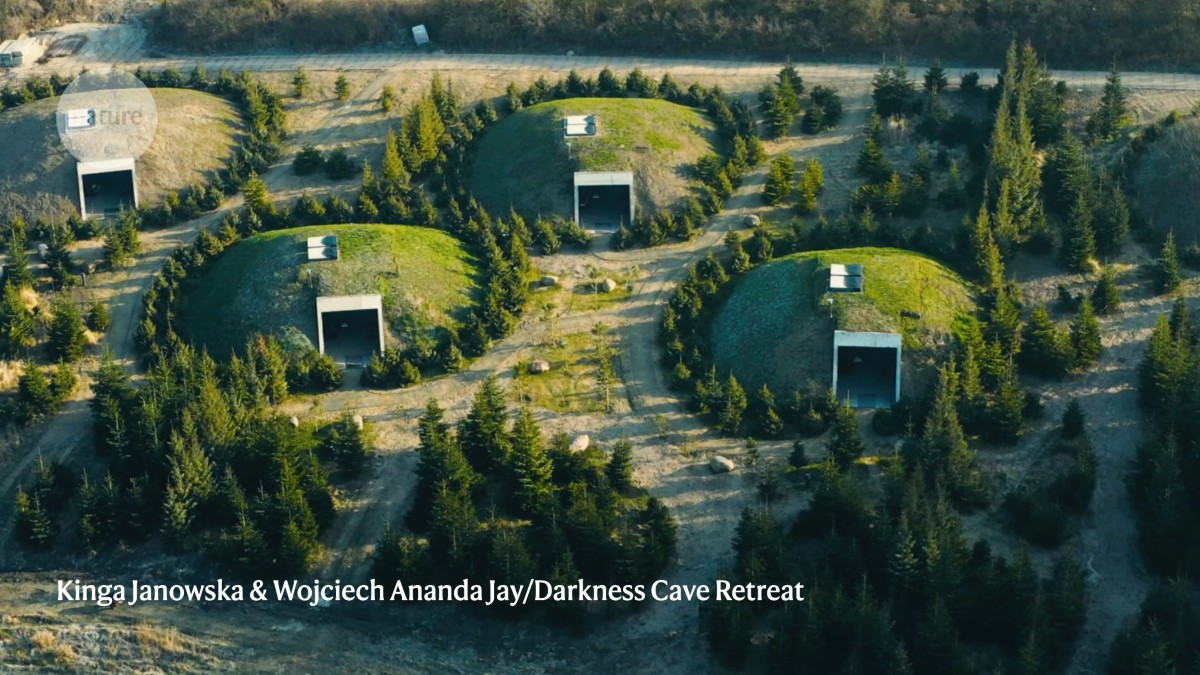

Kiana Aran spent five days in one of several cave-like chambers built into hills in western Poland.Credit: Kinga Janowska and Wojciech Ananda Jay founders of Darkness Cave Retreat
In the cold of November, in a quiet corner of Poland, I entered a cave with nothing but myself and a suite of biosensors.
As a scientist and engineer at the University of California, San Diego, my goal has always been to create technologies that can seamlessly translate the hidden language of our biology — data that are often messy, high-dimensional and difficult to interpret — into precise, reliable signals that can be used for health monitoring.
Nature Spotlight: Sensors
When the opportunity arose in November 2024 to take part in a prolonged sensory-deprivation experience in a darkness retreat cave in rural Wróblewo, west central Poland, I saw it as a chance to experiment. I had long been curious about how my daily routines, food choices and stress levels influenced my biology and had casually tracked myself with sensors such as a glucose monitor and the Oura Ring, which measures factors such as sleep quality and body temperature. But the cave offered something different: the total removal of external stimuli.
Five days in complete darkness and silence where no light, sound or time cues could reach me. I was physically alone and my activities became a series of improvized rituals: eating slowly so I could savour the only sensory input I had, stretching to release tension, reviewing memories and sometimes simply sitting and listening to my own heartbeat.
To capture the biological impact of this extreme environment, I used a comprehensive suite of sensors and biomarker analyses. I wore a wireless electroencephalograph (EEG) system to monitor brain activity, sleep stages and neural signatures of stress and adaptation; the Oura Ring to continuously track sleep patterns, heart-rate variability and circadian-rhythm shifts; and the glucose monitor to follow metabolic responses in real time.
Real-time molecular recorders expose the inner lives of cells
I also collected extensive multi-omics data before, during and after the cave experience, including blood proteomics to measure changes in my metabolism, immune responsiveness and stress signalling and stool, saliva, skin and urine microbiome sequencing to understand shifts in my microbial ecology and body composition.
Because this experiment crossed so many scientific domains, I was fortunate to be surrounded by an extraordinary team at my university and beyond, who helped me to analyse the various data streams. Not only were my colleagues supportive, but many were also as intrigued and admittedly as nervous about the experiment as I was. The beauty of data is that they made my inner experience something I could share. I could show colleagues the changes in my sleep architecture, glucose curves, microbiome shifts. They couldn’t feel what I felt in the darkness, but they could see it. After days without light or time cues, the sensors and tests began to tell a coherent story of how the body recalibrates perception, metabolism and cellular function in isolation.
Taste test
On entering the cave, my taste perception changed drastically. Food was intense and delicious. I never knew exactly what I was eating but I remember the certain food by texture alone: the firmness of broccoli, the smoothness of soups, the crunch of nuts. My proteomic data, measured later, confirmed what my senses had been trying to tell me: proteins linked to taste receptors had shifted significantly, mirroring my heightened perception.
My glucose remained remarkably stable, even after eating sweets. The glucose monitor showed smooth, steady curves without the typical post-meal spikes. My blood proteomic analysis hinted at increased GLUT4, the insulin-responsive glucose transporter that enables more efficient glucose uptake into the muscle, an adaptation seen in trained athletes1 and during fasting2.

Kiana Aran wore an EEG on her forehead to measure her brain activity while in the cave.Credit: Kinga Janowska and Wojciech Ananda Jay founders of Darkness Cave Retreat
My microbiota also shifted in a measurable way. The most dynamic responses were in my saliva and skin, in which several dominant microbial communities associated with the mouth and skin, as well as harmless species commonly found on the skin showed marked fluctuations as early as day two. In contrast, my stool microbiota remained remarkably stable, reflecting the gut’s well-known resilience and slower turnover. Taken together, my microbiota functioned as an internal biosensor, revealing how different parts of the body adapt — some rapidly, and some barely at all — to the unusual conditions of darkness and isolation.
Night and day
The darkness also gave me dreams that were so vivid they felt real. One night, I saw my mother, my cousin and my late grandmother, who had long since passed, sitting together, laughing softly over an iPad. They looked so alive, so close, separated from me only by a glass door.
During my stay, both my Oura and EEG data also showed my circadian rhythm had become disrupted, with rapid eye movement (REM) and REM-like dream states occurring throughout the day. Prior studies of sensory isolation show that vivid dream imagery can emerge during light sleep or transitional states3, which aligns with what I experienced.

Kiana Aran (bottom right) poses with the Swiss film crew documenting her scientific life and the founder of the darkness retreat, Wojciech Ananda Jay (left).Credit: Kinga Janowska and Wojciech Ananda Jay founders of Darkness Cave Retreat

