


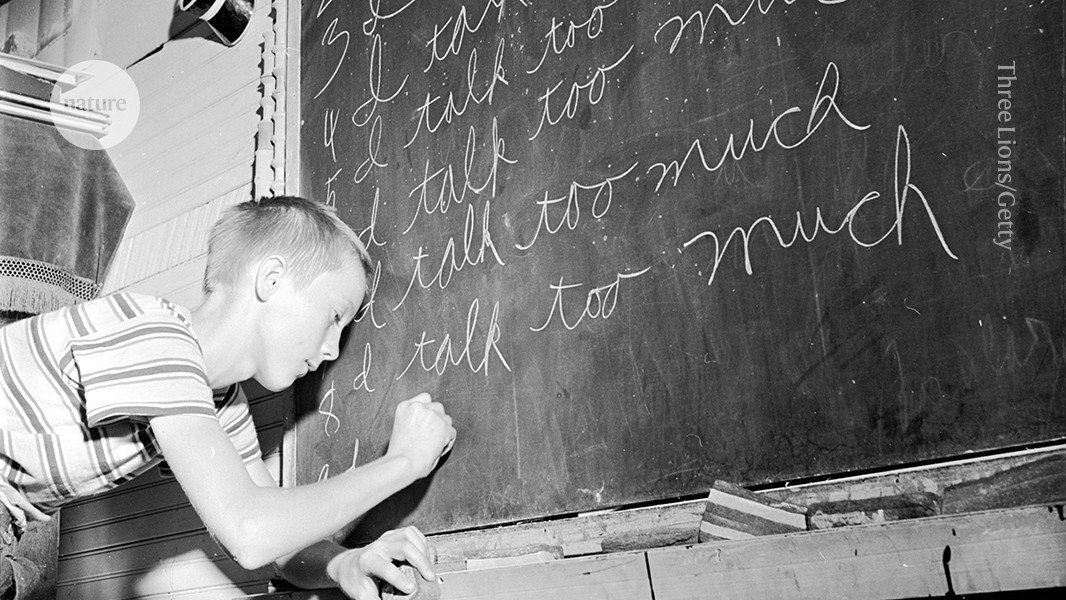
Writing by hand activates parts of the brain associated with learning that typing words does not.Credit: Three Lions/Getty
Cursive is making a comeback. The looping handwriting style defined by flowing, connected letters had faded from curricula in places such as the United States, Finland and Switzerland as schools increasingly embraced digital tools. New Jersey has now become the latest US state to bring penmanship back into the classroom, requiring schools to teach cursive to children in grades 3 to 5 (roughly ages 8 to 11). It joins about two dozen states that in the past decade have introduced similar rules (in some other countries, such as France and Brazil, schools never stopped teaching cursive).

How your brain chemistry rewards hard work
When former New Jersey governor Phil Murphy signed the bill last week, during his last days in office, he said that learning cursive could offer cognitive benefits for students.
Research has consistently shown that handwriting is more challenging and stimulating to the brain than is typing. But evidence that cursive offers an advantage over print handwriting — in which letters are written separately — is limited.
Nature spoke with neuroscientists and education researchers to understand whether cursive writing — or handwriting in general — can help children to learn.
The brain on handwriting
Karin Harman James, a developmental neuroscientist at Indiana University Bloomington, says that it is not uncommon for people not to know cursive in the United States, where this form of handwriting was dropped as a requirement from grade schools in 2010. Her university students, for example, don’t typically write in cursive, she says. James has been studying handwriting since 2004, when she became interested in understanding how the development of fine motor skills affects learning in children.
In one of her studies1, children who had not yet learnt to read were taught either to handwrite letters or to type them on a keyboard. Later, while undergoing functional-magnetic-resonance-imaging scans, they were shown images of the letters. Researchers found that, in children who had learnt to write the letters, the activated brain areas were similar to those engaged when adults read, a pattern that did not appear in children who had learnt only to type.

‘Controlled chaos’: how to create an environment that fosters genius
These results, along with other behavioural tests, suggested that writing by hand improves children’s ability to recognize letters and numbers. “It seems like the act of handwriting was really helping children to learn how to identify things,” James says. “This isn’t too unexpected, because we know that fine motor skills in children are very important for development in all different kinds of tasks.”
Audrey van der Meer, a neuroscientist at the Norwegian University of Science and Technology in Trondheim, also compared the brain activity of children while handwriting with that which occurs while typing. By placing a net of electrodes on their heads, she and her colleagues found that, during handwriting, the brain’s electrical activity was concentrated near the learning and memory centres of the brain, whereas, during typewriting, these areas were much less involved2.
She says that her work highlights the importance of handwriting for children’s development. “When writing by hand, you’re forming all these intricate motor patterns, whereas when typing, it’s only very simple finger movements,” says van der Meer. She adds that, in Norway, some schools have gone completely digital: on the first day of school, six-year-old students receive a tablet, on which they learn how to read and write. “Now, first-grade teachers complain that they receive students who barely know how to hold the pencil,” she says. She and her colleagues are now recommending that the Norwegian government reinstate handwriting requirements.

