


You have full access to this article via your institution.
Hello Nature readers, would you like to get this Briefing in your inbox free every day? Sign up here.

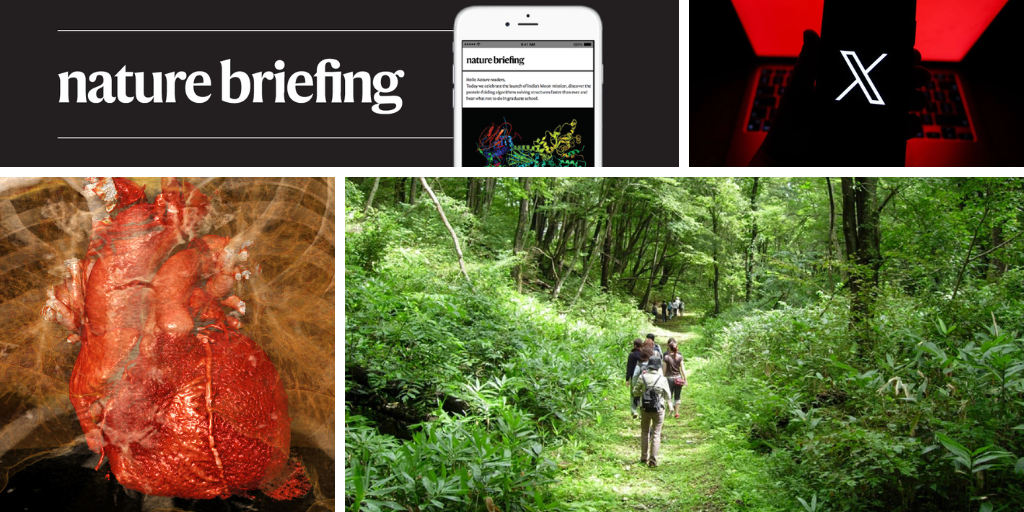
Heart damage caused by a myocardial infarction is exacerbated by activation of a heart–brain–immune axis.Credit: Sevolod Zviryk/Science Photo Library
Frenzied crosstalk between the heart, the brain and the immune system could be what damages the heart after a myocardial infarction, a study in mice suggests. Researchers found that during a heart attack, a set of neurons in the vagus nerve relay signals between the heart and the brain, which activates immune and inflammatory responses and causes widespread damage to the heart. Blocking these signals improved outcomes after heart attacks, which could pave the way for developing new therapies.
Blue manakins (Chiroxiphia caudata) decorate their nests with elaborate ‘tails’ of organic material to confuse visually-oriented predator birds. These tails, which can be up to two metres long, are an example of ‘disruptive camouflage’ — the adornments don’t hide the nest, but alter its shape so predators are less likely to recognize them. Researchers set up nests containing fake eggs in the blue manakins’ usual nesting spots and found that those without tails were raided by predators 10 times more often than those with them.
Reference: Biology Letters paper
Posts on social-media platform X (née Twitter) that are critical of scientific research can act as early warning signs of problematic articles. Two separate analyses found that articles that went on to be retracted were more likely to have had at least one critical X post than articles that weren’t retracted, and that tweets about a paper that included ‘red flag’ words, such as fraud or flawed, were also associated with an increased risk of retraction. Post-publication critique can be a useful way to spot suspect papers, but publishers should be cautious of giving undue weight to such discourse, says academic-publishing researcher Hajar Sotudeh, who co-authored one of the studies.
Reference: Scientometrics paper & Journal of the Association for Information Science and Technology paper
Chatbots that impersonate people could corrupt or invalidate the online surveys that power thousands of studies every year, say researchers. The offer of payment for participation can incentivize people to game the system using bots, and researchers have shown that some artificial intelligence models can evade most of the security mechanisms put in place to root out fraud. As bots get more sophisticated, it’s time that researchers “start rethinking the way that we have traditionally done survey research”, says political scientist Ryan Kennedy.
Features & opinion

Evidence is building that the traditional Japanese practice of forest bathing (shinrin-yoku) is indeed good for your health. Forests are cooler and less polluted than cities, but there are hints that the benefits go beyond just offering people a break from urban sources of harm. Plants release phytoncides — organic compounds that make the woods smell so good — that counteract plant parasites and might also have immune benefits for people. And researchers suggest that the misty air near moving water sources commonly found in and around forests can inundate us with beneficial microbes and charged ions.
This editorially independent article is part of Nature Outlook: Lung health, a supplement produced with financial support from Boehringer Ingelheim.
Unlike other hallucinogenic fungi, the mushroom Lanmaoa asiatica causes strikingly similar visions in people who eat it before it’s properly cooked — hordes of tiny people everywhere. Cases of these ‘lilliputian hallucinations’ have been documented in scientific literature since the 1990s, but researchers only pinned down the species that causes them in 2015. Even with their culprit in hand, scientists are still working to discover what about the mushroom gives rise to the sometimes days-long hallucinations, and why the apparitions are almost always the same.
“The age of humans is increasingly an age of sameness,” write palaeobiologist Mark Williams and Jan Zalasiewicz — a process that some scientists have taken to calling the ‘Homogenocene’. Exquisitely adapted animals are wiped out and their niches are filled by the same hardy, adaptable species. Others lose their uniqueness as the natural barriers that once kept populations separate are wiped out. “If the Anthropocene describes a planet transformed by humans, the Homogenocene is one ecological consequence: fewer places with their own distinctive life,” write the authors.
Reference: Philosophical Transactions of the Royal Society B paper
Today I’m looking for ways to stay dry in the rainy London weather. I have a coat with a hood and a brolly to shield myself, but those seem boring compared to a drone-powered, flying umbrella. Inventor John Tse’s hovering shelter uses tracking technology to follow him around. Unfortunately, his creation is so far a one-of-a-kind prototype, so I’ll have to stick to my good old hand-held.
Please shower us with your feedback on this newsletter at [email protected].
Thanks for reading,
Jacob Smith, associate editor, Nature Briefing
With contributions by Flora Graham
• Nature Briefing: Careers — insights, advice and award-winning journalism to help you optimize your working life
• Nature Briefing: Microbiology — the most abundant living entities on our planet — microorganisms — and the role they play in health, the environment and food systems
• Nature Briefing: Anthropocene — climate change, biodiversity, sustainability and geoengineering
• Nature Briefing: AI & Robotics — 100% written by humans, of course
• Nature Briefing: Cancer — a weekly newsletter written with cancer researchers in mind
• Nature Briefing: Translational Research — covers biotechnology, drug discovery and pharma

