


Cell culture
MOLM-13 cells were cultured in Roswell Park Memorial Institute 1640 Medium (Thermo Fisher Scientific). U2OS (American Type Culture Collection (ATCC)) were cultured in McCoy’s 5A Medium (Thermo Fisher Scientific). HEK293T cells were cultured in DMEM media (Thermo Fisher Scientific). MOLM-13, U2OS and HEK293T cells were supplemented with 10% fetal bovine serum (Thermo Fisher Scientific) and 1× penicillin–streptomycin (Thermo Fisher Scientific). Primary umbilical vein endothelial cells (HUVECs; ATCC) were cultured in vascular cell basal medium (ATCC) supplemented with endothelial cell growth kit-VEGF (ATCC). Keratinocyte cells (ATCC) were cultured in dermal cell basal medium (ATCC) supplemented with keratinocyte growth kit (ATCC). All the experiments on HUVECs are performed before passage 10. All cells were cultured at 37 °C with 5% CO2 and maintained as mycoplasma negative. U2OS cells were transfected with Avalanche-Omni Transfection Reagent (EZ Biosystems). Immortalized HUVECs expressing BFP (Im-HUVEC-BFP; a gift from R. Kamm at MIT)79 were cultured in VascuLife VEGF-Mv endothelial medium (Lifeline Cell Technology) and passage p15 was used for experiments.
Live-cell enzyme and chemical treatments
For RNase treatment, RNase A (Sigma) and ShortCut RNase III (New England Biolabs (NEB)) were added directly to the cell culture at a final concentration of 18 µM and 100 U ml−1, respectively. MOLM-13, U2OS, HUVECs and keratinocytes were all treated for 45 min.
For heparinase treatment, heparinase I (NEB), heparinase II (NEB) and heparinase III (NEB) were added directly to the cell culture at a final concentration of 4 units per millilitre (each) for 30 min.
For sodium chloride (NaCl) and sodium chlorate (NaClO3) treatment, NaCl and NaClO3 were added to the cell culture at a final concentration of 50 mM for 24 h.
For exogenous Tega HS chain treatment, rHS09 (TEGA Therapeutics) and rHS37 (TEGA Therapeutics) were added directly to the cell culture at a final concentration of 4 µM for 60 min.
For serum starvation, HUVECs were cultured in vascular cell basal medium (PCS100030, Bioresource Center) without endothelial cell growth kit-VEGF (Bioresource Center) after being washed briefly three times with phosphate buffer saline (PBS). VEGF-A165 (Thermo Fisher Scientific), VEGF-A121 (Thermo Fisher Scientific), EGF (Thermo Fisher Scientific), VEGF-A165HS WT (Supplementary Table 3, cell-free Escherichia coli protein production by Liberum Biotech) and VEGF-A165 HS(R/K) (Supplementary Table 3, cell-free E. coli protein production by Liberum Biotech) were then added to starved HUVECs at a final concentration of 3 ng ml−1 and 25 ng ml−1 for 5 min, separately. The WT and R/K proteoforms differ by approximately 400 Da (or approximately 1% total mass) so equal mass was added in each experiment, which is approximately equal moles.
Live-cell labelling and microscopy analysis
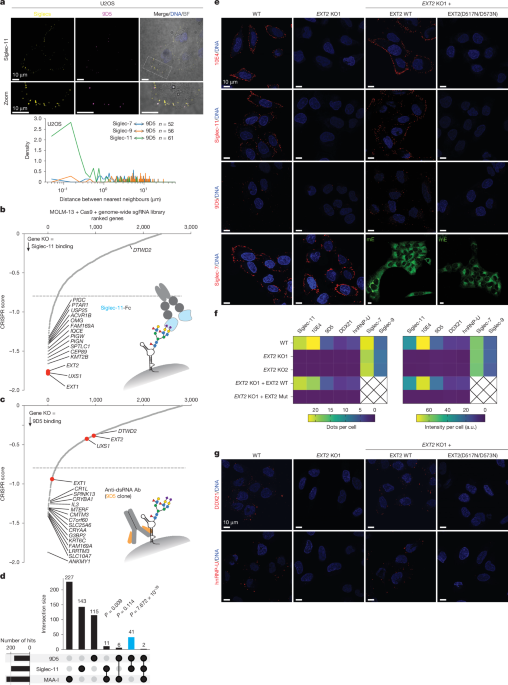
Adherent cells were cultured on glass coverslips #1.5 (Bioscience Tools) 24 h before labelling. MOLM-13 cells were counted and then blocked as per the manufacturer’s protocol with Human TruStain FcX (Fc block, BioLegend) for 15 min on ice before labelling. For Siglecs staining in live cells, 1 µg ml−1 of recombinant human IgG1 Fc (R&D Systems), Siglec-1–Fc chimera protein (R&D Systems), Siglec-2–Fc chimera protein (R&D Systems), Siglec-3–Fc chimera protein (R&D Systems), Siglec-4–Fc chimera protein (R&D Systems), Siglec-5–Fc chimera protein (R&D Systems), Siglec-6–Fc chimera protein (R&D Systems), Siglec-7–Fc chimera protein (R&D Systems), Siglec-8–Fc chimera protein (R&D Systems), Siglec-9–Fc chimera protein (R&D Systems), Siglec-10–Fc chimera protein (R&D Systems), Siglec-11–Fc chimera protein (R&D Systems), Siglec-14–Fc chimera protein (R&D Systems) and Siglec-15–Fc chimera protein (R&D Systems) were precomplexed with 0.5 µg ml−1 of donkey anti-human IgG AF647 (ImmunoResearch) secondary antibody in FACS buffer (0.5% BSA (Sigma) in 1× PBS) for 45 min on ice. For 9D5, 10E4 and 3G10 staining, 2.5 µg ml−1 9D5 (Absolute Antibody), 1 µg ml−1 anti-HS 10E4 (Amsbio), 1 µg ml−1 anti-HS 3G10 (Amsbio) and anti-VEGF (R&D Systems) were precomplexed with 1.25 µg ml−1 of goat anti-rabbit AF647 secondary antibody (Thermo Fisher Scientific), 0.5 µg ml−1 of goat anti-mouse AF647 secondary antibody (Thermo Fisher Scientific) or donkey anti-goat IgG AF647 (Thermo Fisher Scientific) secondary antibodies in FACS buffer for 45 min on ice, separately. For VEGF-A165, VEGF-A121 and VEGFR2 staining, 1 µg ml−1 of anti-VEGF-A165 (R&D Systems), 1 µg ml−1 of anti-VEGF-A (Proteintech), and 1 µg ml−1 anti-VEGFR2 (R&D Systems) were precomplexed with 0.5 µg ml−1 of goat anti-rabbit AF647 secondary antibody and donkey anti-goat AF647 secondary antibody (Thermo Fisher Scientific). Precomplexed antibodies were then incubated with cells for 45 min on ice. For DDX21 and hnRNP-U staining, 2.5 µg ml−1 of anti-DDX21 (Novus Biological) and anti-hnRNP-U (Proteintech) were incubated with cells for 45 min on ice. Cells were gently washed twice by FACS buffer and then stained with 2.5 µg ml−1 of goat anti-rabbit AF647 for 30 min on ice.
For 9D5 and Siglecs co-staining, recombinant human Siglec–Fc chimera proteins were precomplexed with donkey anti-human IgG AF488 (ImmunoResearch), 9D5 was precomplexed with goat anti-rabbit AF647 secondary antibody. For 9D5, Siglec-11 and 10E4 co-staining, 10E4 was precomplexed with goat anti-mouse AF568 (Thermo Fisher Scientific). For 10E4, Siglec-11 and DDX21 co-staining, 10E4 was precomplexed with goat anti-mouse AF568 (Thermo Fisher Scientific), Siglec-11 was precomplexed with donkey anti-human IgG AF488 (ImmunoResearch) and anti-DDX21 was incubated with precomplexed 10E4 and Siglec-11 on cells for 45 min on ice. Cells were gently washed twice by FACS buffer and then stained with goat anti-rabbit AF647 for 30 min on ice. For VEGF-A165 and Siglec-11 co-staining, anti-VEGF-A165 was precomplexed with donkey anti-goat AF647 secondary antibody, recombinant human Siglec-11–Fc chimera protein was precomplexed with donkey anti-human IgG AF488. For 9D5 and DDX21 or hnRNP-U co-staining, mouse host 9D5 (Absolute Antibody) was precomplexed with goat anti-mouse AF488 secondary antibody (Thermo Fisher Scientific). Sequential labelling was used for cs-DDX21 and hnRNP-U labelling as described above. Antibodies or regents were precomplexed in separate tubes with the same concentration as used in single-channel staining and then mixed before adding to cells. After staining, cells were washed three times with ice-cold PBS and a fixation was performed with 3.7% formaldehyde for 15 min at room temperature in the dark. Nuclei were stained with 0.1 µg ml−1 DAPI in PBS. MOLM-13 cells were applied to glass slides using a CytoSpin centrifuge (Thermo Fisher Scientific) at 500g for 5 min.
For mEmerald-positive U2OS cell imaging, cells were fixed with 3.7% formaldehyde for 15 min at room temperature and then stained with DAPI. Finally, all samples above were mounted in ProLong Diamond Antifade Mountant (Thermo Fisher Scientific) and a coverglass was sealed over the samples with nail polish. All samples were then imaged on a Leica SP8 STED ONE microscope with ×63 oil lens. Images were acquired using Leica LAS X software. The DAPI channel was acquired with a PMT detector while all other channels were imaged using hybrid detectors.
For quantification and statistical analysis, at least three random regions of interest (ROIs) from three independent samples were acquired across one or more z-slices. To analyse the colocalization, images were processed using Imaris Microscopy Image Analysis software (Oxford Instruments). A single z-slice from each ROI was taken, selected to be near the middle of the cells (with respect to their z-thickness), and the spot-finder function was used to identify spots of roughly 0.5 µm. In-software background subtraction was used as the default settings, and spots were selected by thresholding spot quality at the elbow of the distribution. This resulted in a series of x and y positions for each spot from each channel, which were then exported for quantitative analysis. Colocalization of spots from paired channels were analysed by implementing a custom Python script (https://github.com/FlynnLab/jonperr) to identify the nearest neighbours of each spot (in nm) with a k-d tree algorithm (scipy.spatial.KDTree). Then, the distances between nearest neighbours were calculated for each pair of targets across all ROIs and plotted in a histogram. To assess the relative fraction of each spot type (channel #1) within the spots of the other pair (channel #2), we calculated a Manders’ colocalization coefficient using the aforementioned Python script. We performed this calculation in both directions: spots of channel #1 in total channel #2 spots, and the reverse.
To quantify and compare the intensities of spots on the cell surface, Leica LAS X software was used to identify ROIs throughout the entire 4× slice z-stack. To quantify and compare the spot numbers of spots on the cell surface, Imaris was used to identify spots throughout the entire 4× slice z-stack. The mean intensities and numbers of ROIs were then divided by the cell numbers and compared across groups. Statistical analysis and data plotting were performed using GraphPad Prism 10.
Live-cell flow cytometry
MOLM-13 cells were directly counted. U2OS cells were gently lifted with Accutase (Sigma-Aldrich) for 3 min at 37 °C, quenched with growth media and then counted. For each condition, 50,000 cells were used. For antibody staining, MOLM-13 cells were blocked as per the manufacturer’s protocol with Human TruStain FcX in FACS buffer for 15 min on ice. Of recombinant human IgG1–Fc, Siglec-7–Fc chimera protein and Siglec-11–Fc chimera protein, 1 µg ml−1 was precomplexed with 0.5 µg ml−1 of donkey anti-human IgG AF647 secondary antibody in FACS buffer for 45 min on ice. Precomplexed antibodies were then added to bind cells on ice for 45 min. For live-cell periodate labelling of cell surface glycans33, cells were washed twice with cold PBS + Ca + Mg and then incubated at 4 °C in cold PBS + 1 mM sodium periodate for 5 min at 1 million cells per millilitre. Cells were then quenched with 1 mM glycerol added to the PBS, and then cells were washed twice with cold PBS. Cells were then incubated at 4 °C in cold FACS buffer + 25 µM aminooxy-biotin (Cayman Chemical) + 10 mM aniline for 30 min at 1 million cells per millilitre. Cells were mixed via pipetting halfway through the incubation. Cells were then washed once with cold 1× PBS and blocked as per the manufacturer’s protocol with Human TruStain FcX in FACS buffer for 15 min on ice. Cells were then stained for 30 min on ice with streptavidin–AF647 at 1 µg ml−1. After staining, all cells were spun at 4 °C for 3 min at 400g and supernatant was discarded. Cells were washed once with 150 µl of FACS buffer, spun under the same conditions, and finally resuspended in FACS buffer containing 0.1 µg ml−1 DAPI. Data collection occurred on a BD Biosciences LSRFortessa 3, and a gating strategy was used to isolate live, single cells, to examine antibody binding using FlowJo Software (FlowJo LLC).
Western blot
Cells were quickly rinsed with ice-cold PBS and directly lysed with sample buffer (150 mM NaCl, 50 mM Tris and 0.5% Triton X-100, pH 7.4) containing phosphatase inhibitor cocktail (Cell Signaling Technology) on ice for 15 min. Zebrafish samples were sonicated in samples buffer. After centrifugation at 12,000g for 15 min at 4 °C, lysates were heated at 95 °C for 10 min in 1× NuPAGE LDS loading buffer (Thermo Fisher Scientific) containing 5 mM dithiothreitol. Samples were then resolved by SDS–PAGE using AnyKD Criterion TGX Precast Midi Protein Gels (Bio-Rad Laboratories) and transferred to nitrocellulose membranes. Membranes were blocked in blocking buffer and incubated with primary antibodies (diluted in blocking buffer) at 4 °C overnight. After washing three times for 3 min each in 1× PBS with 0.1% Tween-20 (PBST), membranes were incubated with secondary antibodies at room temperature for 45 min, followed by the same three times PBST washing. Membranes were finally rinsed in 1× PBS and scanned on a LI-COR Odyssey CLx scanner. Images and intensity of bands were acquired using LI-COR Image Studio software.
The primary antibodies used were: mouse monoclonal anti-EXT2 (sc-514092, Santa Cruz; immunoblot 1:1,000), anti-EXT1 (sc-515144, Santa Cruz; immunoblot 1:1,000), mouse monoclonal anti-GAPDH (sc-47724, Santa Cruz; immunoblot 1:1,000), rabbit polyclonal anti-GFP (A11122, Invitrogen; immunoblot 1:1,000), mouse monoclonal anti-NDST1 (sc100790, Santa Cruz; immunoblot 1:1,000), mouse monoclonal anti-HS6ST1 (sc-398231, Santa Cruz; immunoblot 1:1,000), mouse monoclonal anti-HS2ST1 (sc-376530, Santa Cruz; immunoblot 1:1,000), rabbit monoclonal anti-phospho-p44/42 MAPK (Erk1/2(Thr202/Tyr204); 4370S, Cell Signaling Technology, immunoblot 1:500), mouse monoclonal anti-p44/42 MAPK (Erk1/2; 4696S, Cell Signaling Technology; immunoblot 1:500), rabbit monoclonal anti-phospho-VEGFR2(Tyr1175) (2478S, Cell Signaling Technology; immunoblot 1:500), rabbit polyclonal anti-VEGFR2 (26415-AP, Proteintech; immunoblot 1:500), mouse monoclonal anti-HA (sc-7392, Santa Cruz; immunoblot 1:1,000), rabbit polyclonal anti-DDX21 (NB100-1718, Novus Biologicals; immunoblot 1:500), rabbit polyclonal anti-hnRNP-U (14599-1-AP, Proteintech; immunoblot 1:500) and rabbit polyclonal anti-WNT3A (26744-1-AP, Proteintech; immunoblot 1:500). The secondary antibodies used were: IRDye 800CW goat anti-rabbit IgG secondary antibody (926032211, LI-COR Biosciences; immunoblot 1:1,000) and IRDye 800CW goat anti-mouse IgG secondary antibody (926-32210, LI-COR Biosciences; immunoblot 1:1,000).
Genome-wide CRISPR–Cas9 screening
MOLM-13 cells expressing Cas9 under blasticidin selection23 were grown as above and selected with 10 µg ml−1 blasticidin for 3 days to ensure a homogenous starting population. Starting after selection on day 0, 30 million cells were infected with 1:150 the genome-wide single-guide RNA (sgRNA) lentivirus23 in 60 ml of fresh media with 8 µg ml−1 polybrene. On day 3, cells were spun down and resuspended in 70 ml of fresh media with 1 µg ml−1 puromycin to select for sgRNA-infected cells. On day 5, the media were exchanged for fresh media with 1 µg ml−1 puromycin. On day 6, the cells were switched to normal media without puromycin for expansion. From days 7 to 18, the cells were counted and passaged as needed in fresh media to maintain a cell density between 750,000 and 2,000,000 cells per millilitre. On day 18, cells were counted: 40 million cells were saved before sorting for an input population reference and 200 million cells for each Siglec-11, 9D5 and MAA-I were saved for staining and sorting. To stain, 1,000 µg Siglec-11 was precomplexed with 270 µg secondary antibody, 450 µg 9D5 was precomplexed with 225 µg secondary antibody, and 266 µg of MAA-I was precomplexed with 266 µg streptavidin–AF647. Live-cell staining was performed as noted above with Fc blocking; however, before FACS sorting, cells were filtered over a 40-µm strainer (Corning) and stained with DAPI. Cells were selected for DAPI negative (live) and then the bottom 5% intensity of cells stained with each Siglec-11, 9D5 or MAA-I were sorted into tubes. Cells were collected in FACS buffer after sorting and spun down into pellets at 500g for 4 min at room temperature; input cells were processed in a similar manner to obtain a cell pellet. After removing the supernatant, cell pellets were frozen at −80 °C for later processing. Cells were then processed by resuspending in 200 µl 1× PBS + 5 µl RNaseA + 20 µl proteinase K and incubated at 25 °C for 5 min. Then, 200 µl of Buffer AL (Qiagen) was added and samples were carefully vortexed to mix without shearing genomic DNA (gDNA). The samples were then headed to 56 °C for 60 min. After heating, 200 µl of 100% ethanol was added, gentle vortexing was again used, and then the material was purified over Zymo columns. All spins were performed at 6,000g for 20 s; after spinning the sample through, the columns were washed twice with 80% ethanol and then the DNA was eluted with 2 × 15 µl water. For input samples the initial volumes were scaled up from 200 µl to 1,000 µl of digestion and Qiagen buffers.
To amplify the sgRNAs out of the gDNA, we performed real-time PCR and for each sample performed 12 parallel reactions each with 1 µg of input gDNA. The PCRs were 50 µl final with 200 nM forward and reverse primers with 1× Q5 PCR Master Mix (NEB); 23 cycles of 98 °C for 20 s, 65 °C for 20 s and 72 °C for 90 s were completed. After PCR, the 12 reactions were pooled and purified over a Zymo column following the manufacturer’s recommended protocol for PCR DNA. To add a final index primer for sequencing, a final round of PCR was performed by taking 100 ng of amplified sgRNA library, and five cycles of the above PCR program was run followed by Zymo column clean up. The finally indexed libraries were assessed for size and concentration on a BioAnalyzer High Sensitivity DNA Chip (Agilent). Libraries were pooled equimolar and then sequencing on the NextSeq platform (Illumina) with a 19-bp read 1 and two 8-bp index reads. For the read 1, a custom sequencing primer 5′-TCTTCCGATCTCTTGTGGAAAGGACGAAACACCG-3′ was used. Enrichment of guides and genes were analysed using the MAGeCK statistical package80 by comparing read counts from each cell line with counts from matching plasmid as the initial population.
Generation of KO and stably expressing cell lines
All CRISPR–Cas9 KO assays used PX459 (ref. 81). The target oligonucleotides used are listed in Supplementary Table 3. U2OS cells were transfected with gDNA vectors. Two days later, puromycin (ant-pr-1, Invivogen) was added to the cell culture at a final concentration of 2 µg ml−1 and the live cells were selected by flow cytometry (FACS Calibur 2, BD Science) for isolation of single clones. The expanded individual clones were screened by gDNA sequencing and western blot analysis.
cDNA for human EXT2 was amplified from the cDNA library (Takara Bio); cDNAs for Sulf1 and Sulf2 were gifts from S. Rosen (Addgene plasmid)46. All three cDNA were inserted into mEmerald-C1 (Addgene). All plasmids were verified by DNA sequencing. To generate U2OS cells stably expressing mEmerald–EXT2, mEmerald–EXT2(D517N/D573N), mEmerald–Sulf1 or mEmerald–Sulf2, cells were transfected with the indicated plasmids and selected using 200–1,000 µg µl−1 (gradually increasing) G418 (Invivogen) for 2 weeks; green-positive cells were sorted into mono-clones by flow cytometry and cultured in the presence of 200 µg µl−1 G418 for 2 weeks. Proliferated clones were verified by immunoblotting and fluorescence imaging.
UV crosslinking
25 ng ml−1 of VEGF-A165 was added to starved HUVECs for 5 min. Cells were treated by UV (60,000 µJ, approximately 2 min) on ice and then directly lysed with samples buffer. For RNase treatment, RNase A and RNase III were added to the samples at a final concentration of 1,000 ng ml−1 and 20 U ml−1, resepectively. Samples were all incubated at 37 °C for 10 min and then lysed on ice for another 10 min. After centrifugation at 12,000g for 15 min at 4 °C, lysates were incubated with 5 µl Protein-G bead (Thermo Fisher Scientific) pre-conjugated with 1 µg of anti-VEGF-A (Proteintech) at 4 °C overnight. The beads were washed three times with PBS and heated at 95 °C for 10 min in 1× NuPAGE LDS loading buffer containing 5 mM dithiothreitol. Samples were then analysed by western blot described above. Anti-VEGF-A165 (AF293-NA, R&D Systems; immunoblot 1:1,000) and donkey anti-goat IgG secondary antibody (92632214, LI-COR Biosciences; immunoblot 1:1,000) were used as primary and secondary antibodies, separately.
Microfluidic device setup
IdenTx3 microfluidic chips were purchased from AIM Biotech (#DAX-1). Each chip consists of a central 3D gel channel flanked by two media channels. Type I collagen gel was prepared using a collagen kit (Nitta Gelatin) consisting of Cellmatrix type I-A (3 mg ml−1), 10× Ham’s F12 medium and reconstitution buffer in an 8:1:1 ratio, resulting in a final collagen concentration of 2.4 mg ml−1. The chips were cultured using vascular cell basal medium supplemented with endothelial cell growth kit-VEGF, with or without 10 µM RNase A (0.121 mg ml−1 final concentration).
The central channel of the devices was first filled with 18 µl of collagen. After collagen polymerization for 30 min at 37 °C, one of the medium channels was injected with 15 µl of Im-HUVEC-BFP cell suspension (±RNase A supplementation) at a concentration of 8 million cells per millilitre. The other medium channel was filled with 15 µl of medium ± RNase A. The microfluidic chip was then tilted by 90° for 1–2 min to allow cells to adhere to the collagen gel surface. Subsequently, the four reservoirs in each chip were filled with 50 µl of medium ± RNase A. After 2 h, the medium ± RNase A in the reservoirs was replaced. The devices were cultured for 6 days, and all four reservoirs were replenished daily with 50 µl of medium ± RNase A.
Use and analysis of microfluidic devices
Cells in the idenTx3 chips were fixed with 4% paraformaldehyde in 1× PBS for 20 min and permeabilized with 0.2% Triton X-100–PBS for 5 min. Then, the cells were incubated with 1% BSA in 0.2% Triton X-100–PBS for 30 min to block nonspecific binding. The cells were rinsed with 0.2% Triton X-100–PBS two times for 5 min each and incubated overnight at 4 °C with Alexa Fluor 488-conjugated mouse anti-human platelet/endothelial cell adhesion molecule-1 (PECAM-1; Cell Signaling Technology) at a 1:300 dilution in 0.2% Triton X-100–PBS. Afterwards, the cells were rinsed with 0.2% Triton X-100–PBS three times for 5 min each and incubated with Alexa Fluor Plus 555 Phalloidin (Thermo Fisher Scientific) at a 1:400 dilution in PBS for 20 min at room temperature. Finally, the cells were rinsed three times with PBS and stored in PBS for immunofluorescence imaging.
Images were acquired using a Nikon AXR point scanning confocal microscope with ×10 and ×20 objectives (Nikon), and z-stack images were processed using the Nikon Denoise.ai software and ImageJ. The total migration area was determined by manually measuring the total area of endothelial migration starting from the original gel interface in ImageJ. Statistical analysis (unpaired t-test) was performed in GraphPad Prism 10.
In vitro immunoprecipitation and rPAL
For the small RNA fraction used for immunoprecipitation, TRIzol extractions were performed as previously described in detail9. For specifics: TRIzol was added to cultured HEK293T cells. After the initial lysis, the TRIzol’ed samples were incubated at 37 °C to further denature non-covalent interactions. Phase separation was initiated by adding 0.2× volumes of 100% chloroform, vortexing to mix, and finally spinning at 12,000g for 15 min at 4 °C. The aqueous phase was carefully removed, transferred to a fresh tube and mixed with 2× volumes of 100% ethanol. The RNA was then purified over a Zymo column. For all column cleanups, we followed the following protocol. First, 350 µl of pure water was added to each column and spun at 10,000g for 30 s, and the flowthrough was discarded. This step was repeated until all the precipitated RNA was passed over the column once. The column was then washed three times total: once using 400 µl of RNA Prep Buffer (3 M GuHCl in 80% ethanol) and twice with 400 µl of 80% ethanol. The RNA was then treated with proteinase K (Ambion) on the column. Proteinase K was diluted 1:19 in water and added directly to the column matrix and then allowed to incubate on the column at 37 °C for 45 min. Next, eluted RNA was spun out into fresh tubes and a second elution with water was performed. To the eluate, 1.5 µg of the mucinase StcE (Sigma-Aldrich) was added for every 50 µl of RNA and placed at 37 °C for 30 min to digest. The RNA was then cleaned up again using the Zymo column. Of RNA-binding buffer, 2× volumes were added and vortexed, and then 2× (samples + buffer) of 100% ethanol were added and vortexed. After total RNA extraction, the RNA can be further processed to fractionate small RNA (approximately 17–200 nt) and large RNA (more than 200 nt) using Zymo columns, as recommended by the manufacturer. First, an adjusted RNA-binding buffer was made by mixing equal volumes of RNA-binding buffer and 100% ethanol. Two volumes of the adjusted buffer were added to the total RNA and were vortexed thoroughly to mix. The sample was then bound to the column, but the flow through (small RNA fraction) was saved. One volume of 100% ethanol was added to the small RNA and vortexed to mix. The small RNA was then bound to new columns, cleaned up using 2 × 400 µl 80% ethanol, and finally eluted using water. Lyophilized RNA was resuspended in the size-exclusion chromatography buffer (6 M guanidine hydrochloride (Sigma) in 1× PBS) and loaded onto a superose 6 (5/150, Cytiva) column. The sample was run at a flow rate of 0.3 ml min−1 and finally collected into 150-µl fractions. The RNA fractions were cleaned on Zymo column before immunoprecipitation.
For Siglec-11 immunoprecipitation, 5 µl Protein-A bead was pre-conjugated with 10 pmol of IgG–Fc or Siglec-11 in samples buffer for 1 h at room temperature. After washing three times with samples buffer, beads were incubated with 1 µg of small RNA for 3 h at 4 °C. After washing three times with samples buffer, the beads were suspended in 100 µl RNA-binding buffer and heated for 5 min at 55 °C. The beads were removed and the RNA extract solution was transferred to a new tube. Here, 50 µl of pure water was added and vortexed for 10 s, and then 300 µl of 100% ethanol was added and vortexed for 10 s. The RNAs were purified over a Zymo column.
For VEGF immunoprecipitation, 5 µl Protein-G bead was pre-conjugated with 1 µg of anti-VEGF-A (Proteintech) antibodies in samples buffer for 1 h at 4 °C. After washing three times with samples buffer, beads were incubated with 5 µg of VEGF-A165HS WT and VEGF-A165HS(R/K) immunoprecipitation for 2 h at 4 °C. The beads were washed three times with samples buffer and then incubated with small RNA for 2 h at 4 °C. After washing three times with samples buffer, the beads were suspended in 50 µl RNA-binding buffer and heated for 5 min at 55 °C. The beads were removed and the RNA extract solution was transferred to a new tube. Here, 100 µl of pure water was added and vortexed for 10 s, and then 300 µl of 100% ethanol was added and vortexed for 10 s. The RNAs were purified over a Zymo column.
For rPAL labelling, experiments were performed as previously described10. Specifically, lyophilized RNAs were suspend with 28 µl blocking buffer (1 µl 16 mM mPEG3-Ald (BroadPharm), 15 µl 1 M MgSO4 and 12 µl 1 M NH4OAc pH5 (with HCl)) and then incubated for 45 min at 37 °C. One microlitre of 30 mM aldehyde reactive probe (ARP/aminooxy biotin, Cayman Chemicals) was added first, then 2 µl of 2 mM NaIO4 (periodate) was added. The periodate was allowed to perform oxidation for exactly 10 min at room temperature in the dark. The periodate was then quenched by adding 3 µl of 22 mM sodium sulfite. The reaction was allowed to proceed for 5 min at 25 °C and then moved to 35 °C for 90 min. The reaction was then cleaned up by the Zymo column. The RNAs were eluted from the column using 2 × 6.2 µl water. For in vitro RNase treatment, the RNase cocktail enzyme mix (Thermo Scientific) was added directly to RNA samples with RNase buffer (200 mM Tris pH 7.5, 1 M KCl and 1 mM MgCl2) at a final concentration of 100 U ml−1 and 4,000 U ml−1, separately. The digestion was incubated at 37 °C for 1 h. After RNase digestion, the samples (digested or mock treated) were directly combined with Gel Loading Buffer II (95% formamide, 18 mM EDTA and 0.025% SDS) with a final concentration of 1× SybrGold (Thermo Fisher Scientific) and denatured at 55 °C for 10 min. Immediately after this incubation, the RNA was placed on ice for at least 2 min. The samples were then loaded into a 1% agarose, 0.75% formaldehyde and 1.5× MOPS buffer (Lonza) denaturing gel. RNA was electrophoresed in 1× MOPS at 115 V for 34–45 min, depending on the length of the gel. Subsequently, the RNA was visualized on a UV gel imager. The RNA was transferred with 3 M NaCl pH 1 (with HCl) to a nitrocellulose membrane for 90 min at 25 °C. Post-transfer, the membrane was rinsed in 1× PBS and dried on Whatman Paper (GE Healthcare). Dried membranes were rehydrated in Intercept Protein-Free Blocking buffer (LI-COR Biosciences) for 30 min at room temperature. After the blocking, the membranes were stained using IRDye IR800 streptavidin for 30 min at 25 °C. Excess streptavidin–IR800 was washed from the membranes using three washes with 0.1% Tween-20 in 1× PBS for 3 min each at 25 °C. The membranes were scanned on a LI-COR Odyssey CLx scanner (LI-COR Biosciences). Images were acquired using LI-COR Image Studio software.
VEGF immunoprecipitation sequencing
Of Protein-G beads, 5 µl was pre-conjugated with 1 µg of anti-VEGF-A antibody (Proteintech) in samples buffer for 1 h at 4 °C. After washing three times with samples buffer, beads were incubated with 1 µg of VEGF-A165 (Thermo Fisher Scientific) for 2 h at 4 °C. The beads were then incubated with 1 µg of biological triplicates small RNA extracted from HUVECs for 2 h at 4 °C. After washing three times with samples buffer, the beads were suspended in 50 µl RNA-binding buffer and heated for 5 min at 55 °C. The beads were removed and the RNA extract solution was transferred to a new tube. Of pure water, 100 µl was added and vortexed, and then 300 µl of 100% ethanol was added and vortexed for 10 s. The RNAs were purified over a Zymo column and then lyophilized overnight. Of HUVEC small RNA, 100 ng served as input. Sequencing libraries were generated largely as reported in ref. 82, with the following new 3′ ligation linker, RT primer and cDNA ligation linker ordered from IDT (Supplementary Table 3). Libraries were sequenced on the Illumina NovaSeq X Plus in single-end mode (read 1, 100 bp). Raw reads were demultiplexed, unique molecular identifiers (UMI) extracted and adapter trimmed using Cutadapt (v4.9)83. Reads were aligned to a custom reference of human small non-coding RNAs84 (https://github.com/y9c/m6A-SACseq/tree/main/db) using Bowtie2 (v2.5.4)85 with -k 10 to retain up to 10 alignments per read. Aligned reads were deduplicated by UMI and position using a published Python script86. In brief, reads with the same UMI and alignment position were grouped; within each group, if one alignment had the highest score, it was retained, otherwise one of the tied top-scoring alignments was selected at random.
Deduplicated transcript-level UMI counts were used for differential analysis in DESeq2 (v1.42.1). Two DESeq2 models were built: one comparing immunoprecipitation versus input (pI), and one comparing control versus input (cI). Size factors were estimated from all transcripts excluding long rRNAs (18S, 28S and 45S). To detect transcripts specifically enriched in the immunoprecipitation condition, we defined a centred Z-score:
$${z}_{\mathrm{centred}}=\frac{({\text{log}}_{2}{\mathrm{FC}}_{\mathrm{pl}}-{\text{log}}_{2}{\mathrm{FC}}_{\mathrm{cl}}+{\Delta }_{\mathrm{SF}})}{\sqrt{{{\mathrm{SE}}_{\mathrm{pI}}}^{2}+{{\mathrm{SE}}_{\mathrm{cI}}}^{2}}}$$
Where
$${\Delta }_{\mathrm{SF}}={\log }_{2}\frac{\mathrm{size}\,{\mathrm{factor}}_{\mathrm{cI}}}{\mathrm{size}\,{\mathrm{factor}}_{\mathrm{pI}}}$$
is the average size-factor correction across replicate-matched samples. An empirical null was estimated from Z-scores with ∣Z∣ < 0.5, assuming a Gaussian distribution. Wald tests were performed, and P values were adjusted using the Benjamini–Hochberg procedure.
RIP hits were defined by the following criteria:
Plots were generated using R (v4.3.3).
Electrophoretic mobility shift assay
Of rHS29 (TEGA Therapeutics), 2 µM was incubated with 1 µg of VEGF-A165 HS WT or VEGF-A165 HS(R/K) in PBS for 30 min at 25 °C. Of 50% glycerol, 4 µl was added to 10 µl of sample and the mix was then loaded into anyKD PAGE gel without SDS in the running buffer. Electrophoresis was conducted at constant voltage (150 V) at 4 °C. Gel was stained with Bulldog blue dye for 30 min at room temperature, washed three times with pure water for 5 min each, and finally scanned on a LI-COR Odyssey CLx scanner.
Microscale thermophoresis assay
Fluorescent HUVEC small RNA served as the target and VEGF-A served as the ligand in the microscale thermophoresis assay. For small RNA end repair, 10 µg of small RNA was incubated with 2.5 µl of FastAP (Thermo Fisher Scientific), 2.5 µl of T4 PNK (NEB) and 10 µl of reaction buffer (NEB) for 45 min at 37 °C. After 3′ end repair, the RNAs were purified over a Zymo column and eluted in 2 × 10 µl of pure water. For ligation, 2.5 µg of small RNA was incubated with 1.5 µl of 1 mM ATP, 3 µl of DMSO, 4.86 µl of 10 µM AF647 pCp (Jena Bioscience), 2 µl of 30 U T4 RNA ligase (NEB), 9 µl of 15% PEG8000 and 3 µl of 10× reaction buffer (NEB) overnight at 16 °C. The RNAs were then purified over a Zymo column. The binding of labelled small RNA to VEGF-A was measured on a Monolith NT.115 machine (NanoTemper) with the software MO.Control. Small RNA concentration was set as 5 nM (estimated from the average molecular weight of the small RNA pool). The VEGF-A165 gradient was set from 5.5 µM to 0.000336 µM; the VEGF-A121 gradient was set from 15 µM to 0.000458 µM. Excitation power was 4% and microscale thermophoresis power was 40% at 25 °C. Data from two independent biological replicates were analysed by GraphPad Prism.
Animal models
Zebrafish (D. rerio) lines were housed in AAALAC-accredited facilities and maintained in accordance with protocols approved by the Massachusetts Institute of Technology’s Committee on Animal Care. All experiments were conducted using zebrafish of the AB/Tübingen (TAB5/14) genetic background. The experiments involved zebrafish embryos at stages ranging from 1 to 5 days post-fertilization. As sex determination in zebrafish occurs after these stages, sex was not considered a variable in this study. Embryos were raised in clutches under standard growth conditions, without allocation into specific experimental groups or isolation.
Mouse work was performed in strict accordance with the recommendations in the Guide for the Care and Use of Laboratory Animals of the US National Institutes of the Health. All of the animals were handled according to the approved institutional animal care and use committee protocols (#00001771) of the Boston Children’s Hospital. Sex was not considered a variable in this study. Every effort was made to minimize suffering.
Blinding strategy was applied in all animal experiments. Animals were all picked randomly.
Intraocular injection and retinal analysis
Intraocular injection of human recombinant WT VEGF-A165 HS WT and VEGF-A165 HS(R/K) was performed in postnatal day 6 C57BL/6 pups based on previous publications with minor modifications55,87. Pups were first anaesthetized by hypothermia. The eyelids were carefully separated by a 30-G needle and eyeballs were lifted by a forceps for injection. Of VEGF-A165 HS WT and VEGF-A165 HS(R/K) both at a concentration of 100 ng μl−1 or saline (vehicle control), 1 µl was injected into the vitreous humor using a Nanofil syringe attached with a 35-G needle (World Precision Instrument). Pups were placed on a heating pad and returned to the mother’s care. After 4 h, eyeballs were collected and processed for retina immunohistochemistry.
Retina immunohistochemistry is based on a publication with minor modifications87. In brief, isolated eyeballs from postnatal day 6 pups were fixed in 4% paraformaldehyde in PBS at room temperature for 30 min. Retinas were isolated under dissection microscopy, permeabilized in 0.1% Triton X-100 and 0.1% PBST at room temperature for 30 min, and blocked with 1% BSA in PBST at room temperature for 30 min. Primary antibodies were added to the sections with indicated dilution in PBST (anti-ERG from Abcam, dilution 1:500; anti-mVEGF165 from R&D system, dilution 1:500) and Alexa Fluor 647 isolectin GS-IB4 conjugate (Invitrogen, dilution 1:500) at 4 °C overnight. Retinas were further washed three times with PBST for 10 min at room temperature and incubated with fluorescent-conjugated secondary antibodies (Alexa 546 donkey anti-rabbit IgG, Alexa 488 donkey anti-goat IgG) with 1:500 dilution in PBST for 1 h at room temperature. Stained retinas were washed three times with PBST for 10 min at room temperature and mounted using Fluoromount-G slide mounting medium (Southern Biotech) on microscope slides (Thermo Fisher Scientific). Flat mount retina slides were proceeded to image with confocal microscopy.
Quantification of retinal images
Quantifications were based on previous publications87,88. Images were acquired using a LSM810 or LSM910 confocal microscope (Zeiss) equipped with an EC Plan-Neofluar ×10/0.3, a Plan-Apochromat ×20/0.8 or a Plan-Apochromat ×63/1.4 Oil DIC objective. Images were taken using Zen2.1 software (Zeiss) and processed and quantified with Fiji (NIH).
For vascular front and endothelial cell number quantification, tile-scanned images of flat-mounted retinas stained with IB4 and ERG were used. Vascular front areas were manually lassoed based on the first three rows of ERG+ cell number and IB4 signal. Numbers of ERG+ cells were manually counted. A value of average signals from a single retina is represented as n = 1.
For filopodia number quantification, tile-scanned images of flat-mounted retinas stained with IB4 were used. Filopodia numbers were manually counted from images taken with ×10, ×20 or ×63 objective. A value of average signals from a single retina is represented as n = 1.
Wnt3a–VEGF-A–HS fusions
gBlocks (double-strand DNA) of Wnt3a, Wnt3a–HS WT and Wnt3a–HS(R/K) (Supplementary Table 3) were purchased from IDT, and then used as templates to perform PCR with primers (GGATCCTAATACGACTCACTATAGGGAGA served as the forward primer for all three DNAs; GAATTCTTACTTGCAGGTGTGCACGT served as the reverse primer for Wnt3a; GAATTCTTACCGCCTCGGCTTGTCACATC served as the reverse primer for Wnt3a–HS WT; and GGATTCTTATTTTTTCGGCTTGTCACATT served as the reverse primer for Wnt3a–HS(R/K)). All PCR products were digested by EcoRI (R3101M, NEB) and BamHI (R3136M, NEB), and then ligated into pcDNA3.1 (Invitrogen). All plasmids were verified by DNA sequencing. Double-strand DNAs of Wnt3a, Wnt3a–HS WT and Wnt3a–HS(R/K) were generated through EcoRI/BamHI digestion, agarose gel separation and purification. For the in vitro transcription reaction, 500 ng and 300 ng of linearized, digested DNA were used in an overnight (2-h) setup with the mMESSAGE mMACHINE T7 ULTRA Transcription Kit (AM1345, Invitrogen). The resulting in vitro transcription product was treated with TURBO DNase, included in the same kit, for 15 min. Following DNase treatment, the samples underwent poly-A tailing using the tailing reaction provided by the mMESSAGE mMACHINE Kit. Before adding the ePAP (NEB) enzyme, 2 μl of the sample was set aside for later analysis via RNA agarose gel to confirm band size and serve as a control for the post-poly-A tailing reaction. The samples were then purified using the Zymo RNA Clean and Concentrator kit (Zymo Research).
Zebrafish embryo analysis
Tg(fli1a–eGFP) zebrafish line and WT zebrafish were applied for Vegfa and Wnt3a injection, separately. Zebrafish were crossed by placing a male and female in a shared container, keeping them physically separated until the following morning when they were combined for fertilization. Embryos were collected for injection 30 min after combining the males and females. The injection mix, consisting of 35 ng μl−1 in vitro-transcribed RNA encoding Wnt3a or 17.5 ng µl−1 in vitro-transcribed RNA encoding VEGF-A165 and 0.07% Phenol Red solution (Sigma), was prepared and loaded into needles made from glass capillary tubing (64-0766). Each embryo was injected with 1 nl of the injection mix using a picolitre injector (Warner Instruments). Injected embryos, along with uninjected controls, were incubated in fish water at 28 °C until collection at 24–36 h post-fertilization.
Zebrafish embryos at 24 h post-fertilization were collected, dechorionated using ethanol-sterilized forceps, and transferred to fresh fish water. Individual embryos were anaesthetized by transferring them into 1X Tricaine solution, prepared by diluting a 25X Tricaine stock solution (pH 7, containing 4 mg ml−1 Tricaine-S (Syndel) and 20 mM Tris) to 1X in fish water. Following anaesthesia, embryos were fixed in 4% paraformaldehyde in fish water. Tg(fli1a–eGFP) zebrafish samples were permeabilized in Triton X-100 and then immunolabelled with anti-GFP antibody. For imaging, embryos were embedded in 1.5% low-melt agarose (50100, Lonza) and transferred to a clear dish suspended in low-melt agarose. Images were captured using a Leica M205 FCA fluorescence stereo microscope at ×5.5 magnification, with the same settings applied to all embryos. For vessel quantification in fli1a–eGFP line, the longitudinal length of all vessels (termed ‘L’) along axial with the same length (termed ‘l’ = 200 μm, anterior to posterior) was measured in ImageJ. The ratio L:l was quantified.
qRT–PCR
Quantitative reverse transcriptase PCR (qRT–PCR) was performed using Brilliant II SYBR Green qRT–PCR one-step Master Mix kit (600825, Agilent) on a CFX Connect Real-Time System (Bio-Rad). Of RNA, 60 ng was used in the reaction with 1.25 µM primers. The data were analysed using the ΔΔCt method. 18S rRNA was used as a control to normalize the expression of target genes89. The primer sequences used for RT–PCR in this study are listed in Supplementary Table 3.
Reporting summary
Further information on research design is available in the Nature Portfolio Reporting Summary linked to this article.

