


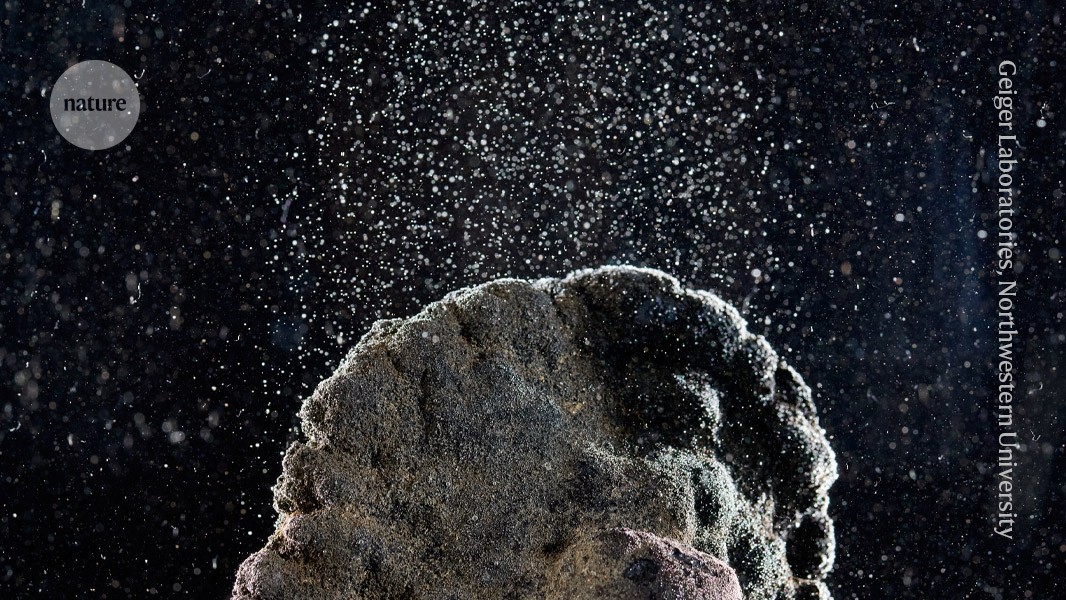

Bubbles of oxygen are produced on the surface of a polymetallic nodule.Credit: Geiger Laboratories, Northwestern University
Researchers have unveiled plans to investigate the mysterious production of ‘dark oxygen’ on the sea floor — large amounts of the gas that seem to be coming from a region too deep for sunlight to power photosynthesis.
The discovery of the oxygen 4,000 metres below the surface of the Pacific Ocean was first published in 2024 in Nature Geoscience1. The team behind it is embarking on a fresh series of studies to verify their findings and establish what could be causing the phenomenon.
Mystery oxygen source discovered on the sea floor
At a press conference in London last week, the researchers unveiled a suite of instruments specifically designed to look at oxygen production, either on the sea floor or in laboratory experiments that reproduce deep-sea conditions, including 400 atmospheres of pressure. The Nippon Foundation, a Tokyo-based charity, is funding the follow-up studies with a grant of US$5.2 million.
By May, project scientists will travel to the Clarion–Clipperton Zone — the region between Hawaii and Mexico where the original discovery was made — aboard the research vessel Nautilus. Speaking at the event, team leader Andrew Sweetman, a sea-floor ecologist at the Scottish Association for Marine Science in Oban, UK, described two probes — each with different capabilities — designed to land on the sea floor to take measurements and samples.
“We will be taking landers that are specifically built to look at dark-oxygen production,” he says. The probes will have pH sensors to measure the concentration of protons in the seawater — high levels of which would suggest that water molecules are splitting, and that molecular oxygen is forming. The landers that made the original discovery could not measure pH because they were not designed to detect or study oxygen production, says Sweetman.
Ancient metals
The original study found dark oxygen in a region containing polymetallic nodules, ancient nuggets of valuable metals such as manganese and cobalt that form on ocean floors over millions of years. This led the team to speculate that these nodules, which look like large black truffles, could be catalysts for water-splitting, similar to those used to produce hydrogen gas in electrochemical cells. But this is not the only way that oxygen could be produced deep beneath the surface — microbes could play a part.
The new suite of experiments is designed to both confirm the team’s original findings, and to investigate what could be producing dark oxygen.“Our primary culprits are electrochemistry and biology. Perhaps they work separately, perhaps they work in tandem,” said team member Jeff Marlow, a geobiologist at Boston University in Massachusetts, at the press conference. “We will build microscale maps of microbes, minerals and metabolic activity in nodules,” he added.

Researchers will re-visit the Clarion–Clipperton Zone and deploy landers that have been designed to investigate dark oxygen.Credit: Scottish Association for Marine Science
Chemist Franz Geiger at Northwestern University in Evanston, Illinois, says he will conduct pressure-chamber experiments on polymetallic nodules retrieved from the sea floor to investigate the rocks’ electrochemistry and examine their surfaces using special transmission electron microscopes that work in liquid cells. This tool will be able to map the chemical states of metals on the surface in the presence of saltwater.
Custom-built arrays of electrodes will measure voltage differences between hundreds of locations across a nodule, to see whether they could catalyse water splitting.

