


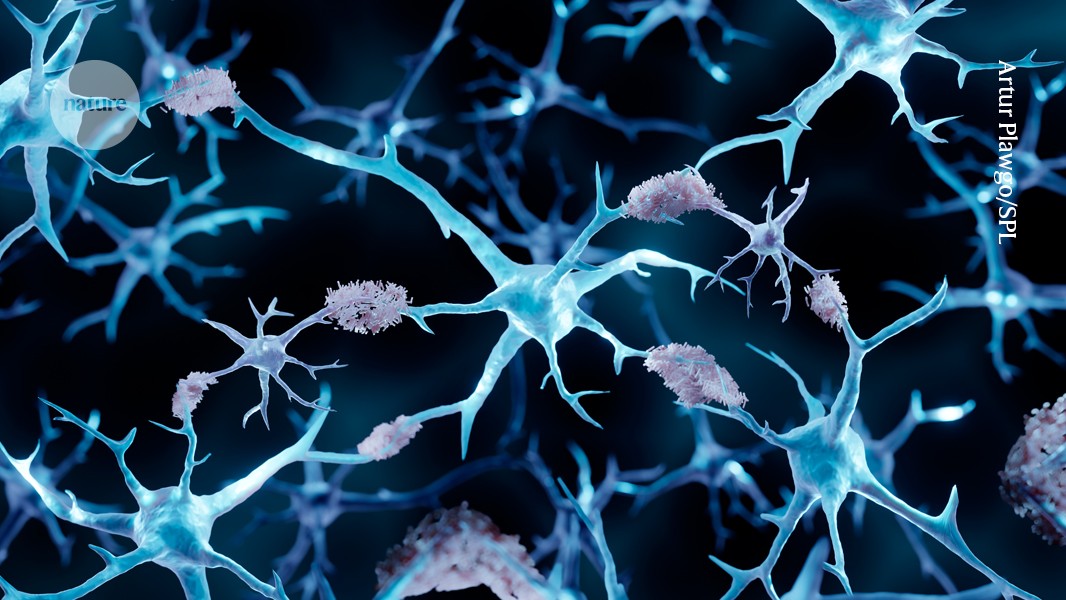

Amyloid plaques (light pink; artist’s illustration) speckle neurons in a brain affected by Alzheimer’s disease.Credit: Artur Plawgo/Science Photo Library
For decades, researchers have noted that cancer and Alzheimer’s disease are rarely found in the same person, fuelling speculation that one condition might offer some degree of protection from the other.
Now, a study in mice provides a possible molecular solution to the medical mystery: a protein produced by cancer cells seems to infiltrate the brain, where it helps to break apart clumps of misfolded proteins that are often associated with Alzheimer’s disease. The study, which was 15 years in the making, was published on 22 January in Cell1 and could help researchers to design drugs to treat Alzheimer’s disease.
“They have a piece of the puzzle,” says Donald Weaver, a neurologist and chemist at the Krembil Research Institute at the University of Toronto in Canada, who was not involved in the study. “It’s not the full picture by any stretch of the imagination. But it’s an interesting piece.”
Alzheimer’s mystery
Weaver has been interested in that puzzle ever since he began his medical training, when a senior pathologist made an offhand comment: “If you see someone with Alzheimer’s disease, they’ve never had cancer.” The remark stuck with Weaver over the years as he diagnosed thousands of people with Alzheimer’s disease. “I can’t remember a single one that has had cancer,” he says.

How common is Alzheimer’s? Blood-test study holds surprises
Epidemiological data do not draw such a clear divide, but a 2020 meta-analysis of data from more than 9.6 million people found that cancer diagnosis was associated with an 11% decreased incidence of Alzheimer’s disease2. It has been a difficult relationship to unpick: researchers must control for a variety of external factors. For example, people might die of cancer before they are old enough to develop symptoms of Alzheimer’s disease, and some cancer treatments can cause cognitive difficulties, which could obscure an Alzheimer’s diagnosis.
Over the years, however, the data converged enough to convince Youming Lu, a neurologist at Huazhong University of Science and Technology in Wuhan, China, to take a closer look at the biology underlying this trend.
Long search
Researchers in Lu’s laboratory spent the next six years searching for the best way to model the two conditions in mice. Eventually, the team decided to transplant three different types of human tumour — lung, prostate and colon — into mouse models of Alzheimer’s disease. The mice with cancer did not develop the brain plaques characteristic of Alzheimer’s disease, says Lu. “So then we asked, ‘why’?”
The researchers sifted through the proteins that were secreted by these cancer cells, searching for those that can cross the protective boundary known as the blood–brain barrier to infiltrate the brain. This search, which took more than six years, narrowed the list to one: a protein called cystatin C.
How cancer hijacks the nervous system to grow and spread

