


Animals
All animal work was conducted in compliance with animal ethics committees at the Peter MacCallum Cancer Centre (PMCC), the University of Melbourne, Monash University, the University of Queensland and Institutional Animal Care and Use Committee at Weill Cornell Medical College.
Zebrafish
The following published transgenic lines were used at the stages indicated in the figures: Tg(kdrl:EGFP)s843 (ref. 46); Tg(fli1a:nEGFP)y7 (ref. 47); Tg(−5.2lyve1b:DsRed)nz101 (ref. 48); Tg(14xUAS:NfsB-mCherry)c264 (ref. 49); Tg(lyve1b:ERK-KTRClover)uom117; Tg(kdrl:Hsa.HRAS-mCherry)s916 (ref. 50); Tg(mpeg1.1:gal4FF)gl25 (ref. 51); TgBAC(lamp2-RFP)pd1044 (ref. 52); Tg(adamts3:GAL4FF)mu400 (ref. 53); Tg(ccbe1:mCitrine)hu6741 (ref. 53); Tg(vegfc:GAL4FF)mu402 (ref. 53); Tg(5xUAS:EGFP)zf82 (ref. 54); Tg(lyz:BFP)zf217Tg (ref. 55) and Tg(mpeg1.1:TagBFP)bcz53Tg (ref. 56). flt4um203 mutants were previously published in ref. 57 and were used at the stages indicated.
Shark, axolotl, chicken, fat-tailed dunnart and mouse
Tissue samples were collected from stage 38 axolotl (Ambystoma mexicanum) larvae and prehatching epaulette sharks (Hemiscyllium ocellatum) at Monash University. Samples from chicken embryos were collected at 10 dpf at the University of Melbourne. Mouse brains from 6-month-old mice were collected at the PMCC. Following euthanasia mice were perfused with PBS transcardially by means of injection through the right ventricle. Brains and abdominal organs were collected from 1-year-old fat-tailed dunnarts (Sminthopsis crassicaudata) during postmortem dissections at the University of Melbourne.
Transgenesis
The osr2 targeted knock-in line Ti(osr2int2-Gal4vp16/4xnrUAS-mTagBFP2) was generated using the CRISPR–Cas9 Insertional Mutagenesis Protocol and tool kit58. CRISPR RNA (crRNA)(tacatcacacttttaccccg GGG, PAM sequence in uppercase) targeting the second intron of the Osr2 gene was designed using the IDT online tool (https://sg.idtdna.com/site/order/designtool/index/CRISPR_CUSTOM). A solution containing the pSA1-T2A-Gal4vp16_synCoTC/4xnrUAS-mTagBFP2 plasmid (17 ng μl−1), precomplexed guide RNAs (gRNAs) (Alt-R) targeting the Osr2 intronic sequence (6 μM) and plasmid (3 μM) and Cas9 protein (Cas9 HiFi v.3, Integrated DNA Technologies) was injected into one-cell stage zebrafish eggs. Injected embryos were screened for mTagBFP2 fluorescence, raised to adulthood and outcrossed with wild-type zebrafish to identify founders. Cassette integration in the genome was confirmed by PCR and Sanger sequencing using the following primers:
mTagBFP2 forward: AGCTGGGACACAAGCTGAAT
osr2 reverse: TCTGAGGAACAGGCGAGAG
T2A reverse: GGTTCTCCTCCACATCTCCA
osr2 forward: AGTGGAGAGAGCTGAACACC
Tg(+45osr2:E1b:GFP)uom135 and Tg(−48cdh6:E1b:GFP)uom134 transgenic lines were generated for this study by cloning a 500-bp PCR fragment of the osr2 enhancer and a 501-bp PCR fragment of the cdh6 enhancer, respectively, into E1b zebrafish enhancer detection vectors59.
The specific genomic region upstream of osr2 and cdh6 was obtained by PCR amplification from genomic DNA (gDNA) using the primers:
+45osr2 forward: 5′–CAGATGGGCCCTCGAGAACACACACACACTTCA AAGTCCC–3′
+45osr2 reverse: 5′–CCGCAAGCTTGCTAGCTGTGTTGTGAAAACATCAGACAGATGTTTAGG–3′
−48cdh6 forward: 5′–CCGCAAGCTTGCTAGCCTGTAAATTCAATTGTAACAATAGTTTAGTCTG-TAAATACCCT–3′
−48cdh6 reverse: 5′–CAGATGGGCCCTCGAGCGGTTTCGGAGCACATAAACAG–3′
Cloning into the E1b vector plasmid was performed by digestion of the plasmid with restriction enzymes XhoI and NheI (NEB), before cloning of the PCR product using In-Fusion (Takara Bio). The E1b zebrafish enhancer detection vector was a kind gift from E. Wong.
The transgenic lines were made by performing microinjections into single-cell staged embryos as previously described in ref. 60. Next 50 ng μl−1 of transposase messenger RNA (mRNA) was injected with fully assembled Tol2 DNA constructs (40 ng μl−1)61. Zebrafish embryos mosaically expressing the Tol2 construct were then selected and raised to adulthood. Stable transgenic lines were established by assessing F1 larvae for germline transmission and raising positive animals to adulthood.
Genome editing and embryo manipulations
CRISPR–Cas9 genome editing for generating knockout zebrafish embryos was performed as previously described in refs. 62,63. gRNA was generated by annealing and elongation using T4 DNA polymerase (M0203S, New England Biolabs). A gene specific oligonucleotide sequence (Integrated DNA Technologies) was annealed with a constant oligonucleotide, elongation was performed by adding dNTP Mix (U1511, Promega) and T4 DNA polymerase.
The single-guide RNA (sgRNA) target site for osr2 was as follows:
osr2: 5′–GCAGATGAACCGGTGGACGG–3′
The sgRNA target site for cdh6 was as follows:
cdh6-g2: 5′–TGTCACTCAAGTGACCGCCC–3′
This template was purified using DNA Clean & Concentrator-5 Kit (D4014, Zymo Research). Template DNA was transcribed into sgRNA using MEGAscript T7 Transcription Kit (AM1334, ThermoFisher) and subsequently purified using RNA Clean & Concentrator-5 (R1013, Zymo Research). The sgRNA was then combined with Cas9 nuclease (10 mg ml−1) to form a ribonucleoprotein complex that guides targeted cleavage of gDNA. A final concentration of 160 ng ml−1 was used for osr2 crRNA. Ribonucleoprotein mixes were then microinjected into single-cell staged embryos as previously described in ref. 60. Uninjected embryos were used as controls.
To allow imaging of older animals in the absence of pigment (Figs. 1 and 2 and Extended Data Figs. 1–3), CRISPR–Cas9 genome editing was used to target slc45a2 gene (ENSDARG00000002593) for generating F0 melanocyte-deficient adult zebrafish as previously described in ref. 64.
Genotyping
For the use of osr2 and cdh6 F0 founders generated by CRISPR–Cas9 and gRNA injections, cutting of gDNA at the targeted sequence and putative biallelic loss was confirmed by PCR and indicated by running amplicons on a high-percentage agarose gel.
The following primers were used for PCR:
osr2 forward: 5′–ATCATTAACGGGGCCGTGC–3′
osr2 reverse: 5′–CCAGATTGGCGAAGTCGAAG–3′
cdh6-g2 forward: 5′–TTTCATTAGCCATGGGCAAGAGC–3′ cdh6-g2-reverse: 5′–GGATGGCCCTCTTTGATACTGT–3′
Targeting of osr2 resulted in a 7-bp deletion in exon 2, this was predicted to lead to a subsequent frameshift and generation of a premature stop codon at amino acid 107 of the osr2 protein sequence (pThr51AlafsTer57). The allele was transmitted to F1 animals and used to establish a stable mutant strain designated allele osr2uom133. The predicted effect of this allele is loss of osr2 three zinc-finger domains (Extended Data Fig. 3a). All experiments in osr2uom133 mutant fish were conducted in F3 animals or subsequent generations. Fish were imaged and analysed blindly with genotyping retrospectively.
Targeting of cdh6 resulted in a 5 bp deletion in exon 3, this predicted to lead to a subsequent frameshift and generation of a premature stop codon at amino acid 181 of the cdh6 protein sequence (pAla178GlyfsTer4). The allele was transmitted to F1 animals and used to establish a stable mutant strain designated allele cdh6uom132. The predicted effect of this allele is loss of four of the five cdh6 cadherin domains. All experiments in cdh6uom132 mutant fish were conducted in F2 animals. Fish were imaged and analysed blindly with genotyping retrospectively.
Clodronate injections
Zebrafish embryos at 24 hpf were incubated in system water supplemented with N-phenylthiourea (PTU) at a final concentration of 0.003% to inhibit pigmentation65. Clodronate injections were performed as previously described in ref. 66. Clodronate and control liposomes (CP-005-005, Liposoma) were used at a concentration of 5 mg ml−1 and supplemented with dextran, Cascade Blue, 10,000 molecular weight (D1976, Invitrogen) to a working concentration of 5 mg ml−1. A microinjection glass needle and a pneumatic pump were used to perform microinjections. Larval fish at 5 dpf were immobilized with tricaine (0.08 mg ml−1) and mounted laterally to ensure accessibility to the posterior cardinal vein for microinjection. The pressure of the pneumatic pump was adjusted to ensure consistent 2-nl volume of injection for each larval fish. Each injection was validated by seeing immediate distribution of the injected fluorescent dextran mix using a fluorescence microscope. All larval fish that show correct distribution of the fluorescent marker in the body vasculature were recovered in fresh system water supplemented with 0.003% PTU and incubated at 28.5 °C for 48 h. Fish were imaged 48 h postinjection and analysed for scavenging cell depletion.
Dye injections
Zebrafish osr2−/− mutants and siblings embryos at 24 hpf were incubated in system water supplemented with PTU at a final concentration of 0.003% to inhibit pigmentation. Dextran, Cascade Blue, 10,000 molecular weight (D1976, Invitrogen) was diluted to a working concentration of 5 mg ml−1. A microinjection glass needle and a pneumatic pump were used to perform microinjections. Larval fish at 7 dpf were immobilized with tricaine (0.08 mg ml−1) and mounted laterally to ensure accessibility to the posterior cardinal vein for microinjection. The pressure of the pneumatic pump was adjusted to ensure consistent 2-nl volume of injection for each larval fish. Each injection was validated by seeing immediate distribution of the injected fluorescent dextran mix using a fluorescence microscope. All larval fish that showed correct distribution of the fluorescent marker in the body vasculature were recovered in fresh system water supplemented with 0.003% PTU and incubated at 28.5 °C for 2 h. Fish were imaged and analysed blindly with genotyping retrospectively.
Morpholino injections
The ccbe1 start codon targeting morpholinos (MO) and control MO (Genetools) were injected at a concentration of 2.5 ng per embryo, as previously described in ref. 41.
The sequences of the ccbe1 start codon targeting MO and control MO are as follows:
ccbe1 ATG MO: 5′–CGGGTAGATCATTTCAGACACTCTG–3′
Control MO: 5′–CCTCTTACCTCAGTTACAATTTATA–3′
Larval brain wounding
Siblings and osr2−/− mutant Tg(fli1a:nEGFP)y7; Tg(−5.2lyve1b:DsRed)nz101 transgenic fish; Tg(−5.2lyve1b:DsRed)nz101; Tg(mpeg1.1:gal4FF)gl25; (5xUAS:EGFP)zf82 transgenic fish and Tg(lyve1b:ERK-KTRClover)uom117 and Tg(lamp2:RFP)pd1044 transgenic fish were raised at 28.5 °C to 6 dpf in system water supplemented with PTU at a final concentration of 0.003% to inhibit pigmentation. Fish were then immobilized with tricaine (0.08 mg ml−1), mounted ventrally in 0.5% low gelling agarose (BioRad) as previously described in ref. 67, and injured with a single 27 G needle insertion in the left hemisphere of the larval fish midbrain. Fish were then gently recovered in embryo water supplemented with 0.003% PTU and incubated at 28.5 °C for 24 h. Fish were imaged and analysed blindly with genotyping retrospectively.
HCR-RNA-FISH
Tissue preparation and fixation
Whole axolotl heads and spinal cords were fixed in 4% PFA (Sigma) in PBS for 2 days at 4 °C. Epaulette shark brains were prefixed for 10 min at room temperature by injecting 4% PFA in PBS into the chondrocranium before dissection. The shark brains were subsequently dissected free and fixed in 4% PFA in PBS for 3 days at 4 °C. Zebrafish brains were dissected free and fixed in 4% PFA in PBS overnight at 4 °C. Whole chicken heads were fixed in 4% PFA in PBS overnight at 4 °C, before removal of the beak and eyes. Fat-tailed dunnart and mouse organs were dissected free and fixed in 4% PFA in PBS overnight at 4 °C.
Cryogenic protection and embedding
Following fixation, axolotl and epaulette shark samples were washed 3 times with PBS for 15 min at room temperature. Samples were then infiltrated with a gelatin–sucrose embedding solution (8% fish gelatin (Sigma), 20% sucrose (Sigma), dissolved in PBS) for a minimum of 1 hour at room temperature. Samples were submerged in fresh embedding solution in easy-peel moulds (ProSciTech, catalogue no. RR88-T) and oriented for transverse section, then quickly frozen on dry ice. Following fixation, zebrafish, chicken, fat-tailed dunnart and mouse samples were washed 3 times with PBS for 15 min at room temperature. Samples were then submerged in a 30% sucrose (Sigma) solution in PBS and incubated overnight at 4 °C, until complete sinking of the tissues. Samples were then submerged in fresh optimal cutting temperature embedding solution in easy-peel moulds (ProSciTech) and oriented for transverse section, then quickly frozen in dry-ice cold isopropanol. Embedded samples were stored at −80 °C until sectioning.
Cryogenic sectioning
Axolotl and shark samples were sectioned to 20-μm thicknesses in a precooled Leica CM3050 S cryostat (chamber −30 °C and objective −28 °C); zebrafish, chicken, fat-tailed dunnart and mouse samples were sectioned to 4-μm thicknesses in a precooled ThermoScientific CryoStar NX50 cryostat (chamber −40 °C and objective −30 °C). All sections were collected on Superfrost Plus glass slides (Menzel Glaser) and allowed to completely dry at room temperature before being stored at −80 °C until further processing.
HCR-RNA-FISH staining
All stainings were performed following the HCR-RNA-fluorescence ISH (FISH) protocol for fixed frozen tissue sections (Molecular Instruments). Probe set designing and production was completed by Molecular Instruments, based on either gene National Center for Biotechnology Information accession numbers:
Mouse: Csf1r (NM_001037859.2); Lyve1 (NM_053247.4); Osr2 (NM_001368665.1); Flt4 (NM_008029.3); Prox1 (NM_008937.4)
Chicken: csf1r (NM_001321517.2); lyve1 (NM_001199587.2); osr2 (NM_001398381.1); flt4 (NM_001293093.2); prox1 (NM_001005616.1)
Zebrafish: csf1ra (NM_131672.1); lyve1b (NM_001327897.1); osr2 (NM_001017694.1), flt4 (NM_130945.2); prox1a (NM_131405.2)
or by blasting of zebrafish reference genes against non-model organism whole genome:
Axolotl: ambMex 6.0-DD
Epaulette shark: sHemOce1_pat_c1
Fat-tailed dunnart: in-house sequence data (unpublished)
Imaging acquisition and analysis
Image acquisition
Imaging was conducted at the Centre for Advanced Histology and Microscopy (PMCC) and Weill Cornell Medical College. Live embryos and adult fish at indicated stages were immobilized with tricaine (0.08 mg ml−1) and mounted either laterally or dorsally in 1% low gelling agarose (BioRad) as previously described in ref. 41. Embryos, larval and adult fish were imaged on either a Nikon Yokogawa CSU-W1 spinning disc confocal microscope, Zeiss LSM 900 confocal microscope or an Olympus Multiphoton FVMPE-RS microscope at ×4, ×10, ×20, ×25 or ×40 objectives. HCR-RNA-FISH sections were imaged on a Nikon Yokogawa CSU-W1 spinning disc confocal microscope at ×4, ×10 and ×20 objectives.
Quantification
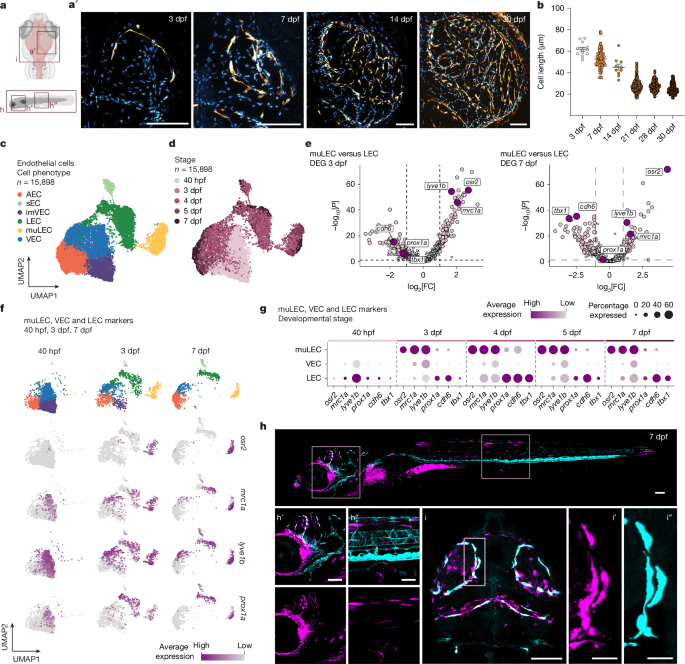
Generally, quantification of muLECs was performed by identifying ECs using Tg(fli1a:nEGFP)y7 or Tg(kdrl:EGFP)s843 transgenic reporters and lymphatic cells using Tg(−5.2lyve1b:DsRed)nz101 expression. For Fig. 2k, Tg(lyve1b:ERK-KTRCloveruom117 was used. muLECs were defined as ECs found mural to blood vasculature and the mesencephalic vein specifically for quantification in Figs. 1 and 2 and Extended Data Figs. 3 and 4. The length of lyve1b-positive muLECs covering the mesencephalic vein in the wild-type midbrain of the zebrafish at different stages (3 dpf, 7 dpf, 14 dpf, 21 dpf, 28 dpf and 30 dpf) was quantified for each individual cell across z-stacks, using the point and segment tools from Imaris (v.10.0.0, Oxford Instruments).
Changes in muLEC phenotypes in response to osr2 and cdh6 mutants were analysed blindly with retrospective genotyping in osr2−/− mutants and control siblings at 7 dpf, 14 dpf, 21 dpf and 30 dpf and in cdh6−/− mutants at 5 dpf, 7 dpf and 10 dpf. The overall length of the fish was measured using a stereo microscope; the number of total muLECs covering the mesencephalic vein was counted manually examining each z-stack individually using the point tool from Imaris (v.10.0.0, Optical Instruments). The length of muLECs covering the mesencephalic vein was measured across different z-stacks using the segment tool from Imaris (v.10.0.0, Optical Instruments), whereas the number of contacting muLECs was defined as cells physically contacting along the mesencephalic vein across the different z-stacks.
The difference in dextran, Cascade Blue, 10,000 molecular weight (D1976, Invitrogen) uptake in response to osr2 knockout (Extended Data Fig. 4j) was analysed blindly with retrospective genotyping in osr2−/− mutants and control siblings at 7 dpf. Briefly, a mask of the lyve1b-positive cells was generated over a consistent region of the mesencephalic vein, using the surface tool from Imaris (v.10.0.0, Optical Instruments). The average intensity of the Cascade Blue fluorophore within the masked area was then recorded for each animal.
Quantification of scavenging cell depletion on clodronate liposomes injection (Extended Data Fig. 8j) was performed by individually counting the number of mpeg1-positive macrophages and lyve1b-positive muLECs, using the point tool from Imaris (v.10.0.0, Optical Instruments).
The difference in total number of microglia and/or macrophages and neutrophils in flt4 mutants and ccbe1 MO-injected animals (Fig. 3i–l and Extended Data Fig. 8s) was performed by individually counting the number of mpeg1-positive and lyz-positive cells, respectively, covering the midbrain of either flt4−/− mutants and ccbe1 MO-injected animals at 7 dpf and in adults (4 months postfertilization (mpf)), using ImageJ. As a method of normalization, the overall width of the brain was measured as the longest distance across the midbrain of 4-mpf control, flt4−/− and ccbe1 morphants (Extended Data Fig. 8p,q).
To assess overall brain vessel density, midbrains of 4 mpf flt4 mutants, control siblings and age-matched ccbe1 MO-injected animals were analysed using ImageJ. Vessels marked by fli1a:GFP were segmented using the threshold function, and the quantified vessel area was normalized to brain area to calculate vascular density as a percentage. Using the same set of images, we used an approach based on a previously published method to examine heterogeneous vascular network patterning phenotypes68. The density of five distinct regions per brain across the surface meningeal vasculature were quantified, with equivalent regions selected for each brain to avoid any sampling bias. This captured intra-sample spatial heterogeneity to measure vascular patterning defects in each animal. Then, variance values per animal were calculated and were compared across the groups; control, flt4 mutants and ccbe1 MO-injected animals as shown in Fig. 3h and Extended Data Fig. 8n.
All images were processed using ImageJ2 v.2.9.0/1.53t (National Institutes of Health) software.
Sample preparation for scRNA-seq and snATAC-seq
Wounding dataset
Tg(kdrl:Hsa.HRAS-mCherry)s916 transgenic zebrafish were raised at 28.5 °C to 6 dpf. Fish were then mounted dorsally in 1% low gelling agarose (BioRad) as previously described in ref. 67, and injured with a single 27 G needle insertion in 1 of the 2 hemispheres of the midbrain of the larval fish. Fish were then gently recovered in embryo water and incubated at 28.5 °C for 24 h. Injured fish and uninjured control siblings were then euthanized with 0.04% tricaine methanesulfonate in system water, on an ice-cold pad. Heads were dissected and collected in sterile Eppendorf tubes. Single cells were isolated from Tg(kdrl:Hsa.HRAS-mCherry)s916 wounded and control transgenic zebrafish larval heads as previously described in ref. 14. The BD FACSAria Fusion 5 Flow Cytometer (BD Biosciences) was used to sort a population of Zombie Violet−/DsRed+ cells. Cells were sorted directly into cold 100% FBS (Lonza). Sorted cells were taken immediately to the sequencing facility and used for scRNA-seq.
Mouse dataset
Meninges from two female C57 mice at 3 months of age were dissociated as previously described in refs. 69,70. In brief, mice were euthanized using an intraperitoneal injection of sodium pentobarbitone (1.6 mg g−1 body weight), before being transcardially perfused with 15 ml of PBS. Brains were immediately removed, and thin shavings of the cortical surface collected with scalpel. Collected tissue was diced with a scalpel and digested for 16 min at 37 °C in 0.1% papain (Worthington Biochemical) and 0.1% DNaseI (Roche Australia) in Hank’s buffered salt solution (ThermoScientific), with titration to dissociate the tissue. Cells were washed and resuspended in wash media (Hank’s buffered salt solution containing 10% fetal calf serum), then filtered into a single-cell suspension through a 100-µm sieve (Falcon, BD Biosciences). Dissociated cells were suspended in 500 μl of wash media and incubated with 6 μl of acetylated-LDL-Alexa488 (Invitrogen) for 1 h at 37 °C. Cells were washed twice with 5 ml of wash media and strained through a 70-μm cell strainer. Then 10 μl of Draq7 were added to the cell suspension, and 488acLDL+/Draq7− cells were fluorescence-activated cell sorted using a Cytopeia Influx Cell Sorter (BD Bioscience) into 100% FBS. Cells were subsequently quantified and loaded onto a 10X Chromium platform scRNA-seq at the Institute for Molecular Bioscience Genomics Facility (University of Queensland).
osr2 mutant dataset
Fifteen osr2−/− and 22 sibling animals were raised to 30 dpf, carefully genotyped and euthanized with 0.04% tricaine methanesulfonate in system water, on an ice-cold pad. As much as possible, tissues surrounding the brain were carefully removed by dissection to facilitate the dissociation of brain tissues without affecting the dorsal leptomeningeal layers. Tissues were collected in sterile Eppendorf tubes. Single cells were isolated from Tg(−5.2lyve1b:DsRed)nz101; Tg(fli1a:nGFP)y7 osr2−/− and sibling transgenic zebrafish 30-dpf brains as previously described in ref. 14. The BD FACSAria Fusion 5 Flow Cytometer (BD Biosciences) was used to sort a population of Zombie Violet−/GFP+/DsRed+ cells. Cells were sorted directly into cold 100% FBS (Lonza). Sorted cells were taken immediately to the sequencing facility and used for scRNA-seq.
scRNA-seq library preparation
Library preparation and sequencing was performed at the Molecular Genomics Core Facility (PMCC). Single-cell suspensions from fluorescence-activated cell sorting were spun down and a cell count was performed to determine postsort viability and cell concentration. The single-cell suspension was partitioned and barcoded using the 10X Genomics Chromium iX Controller (10X Genomics) and the Single Cell 3′ Library and Gel Bead Kit (Wounded dataset, V3.1; 10X Genomics; PN-1000121, mouse dataset V2). The cells were loaded onto the Chromium Single Cell Chip G (10X Genomics; PN-1000120) to target 10,000 cells. Gel bead in Emulsion generation and barcoding, complementary DNA amplification and library construction was performed according to the 10X Genomics Chromium User Guide. The resulting single-cell transcriptome libraries contained unique sample indices for each sample. The libraries were quantified on the Agilent TapeStation 4200 using High Sensitivity D1000 ScreenTape and reagents (Agilent, 5067-5585, 5067-5584). Single-cell transcriptome libraries were pooled in equimolar ratios before being sequenced (wounded dataset: Illumina NovaSeq 6000 using S4 300-cycle chemistry; mouse dataset: Illumina NextSeq 500using S4 300-cycle chemistry; osr2 mutant dataset: Illumina NextSeq 6000 using S4 300-cycle chemistry). Read1 supplies the cell barcode and UMI, i7 and i5 the sample indexes, and Read2 the 3′ sequence of the transcript. Sequencing read lengths were trimmed to 28 bp (read 1), 10 bp (i7 index), 10 bp (i5 index) and 91 bp (read 2), ensuring compatibility with the 10X Genomics analysis software, Cell Ranger. After sequencing, fastq files were generated using bcl2fastq2 (v.2.20.0.422).
scRNA-seq data processing
The following general workflow was applied to all datasets. Detailed parameter descriptions and version for software for preprocessing, genome versions, sample specific metrics and cluster annotation details are described in Supplementary Data Table 1. For details about R package versions, please see the renv.lock file at https://atlassian.petermac.org.au/bitbucket/projects/HL/repos/hogan_lab/browse/2024_Gaudi_et_al_muLEC. Sequencing quality was assessed using FastQC71 v.0.11.6 and MultiQC72 v.1.7 viewer for aggregated reports. Cell Ranger73 v.6.0.2 or v.5.0.0 count (and aggr where appropriate) was used to generate count files. Doublets were identified from the filtered aggregated count files using Scrublet74 in Python v.3.6 or scDblFinder v.1.12 in R statistical software v.4.2.2. Sequence reads corresponding to ribosomal and global genes were removed, cells filtered according to library size and mitochondrial content, normalized, followed by uniform manifold approximation and projection (UMAP) dimension reduction, clustering (louvain) and cell-cycle analysis using Seurat75 v.4.1.1. The quality of the dataset was evaluated before and after normalization using both custom plots and built-in functions in Seurat76 and scater77 v.1.26.1. Cluster solutions were evaluated, the most appropriate resolution selected using ClusTree78 v.0.5.0, and cluster identity was defined using key markers of phenotype.
The datasets in the following subsections had modifications to the general workflow.
Zebrafish developmental time-course dataset
In addition to the 7 dpf wild-type sample generated in this study, previously published14 fastq files for 40 hpf, 3 dpf, 4 dpf and 5 dpf were used. After normalization and filtering (as described above and in Supplementary Data Table 1), all samples were merged into one Seurat object using the merge function. The merged object was subsequently scaled using all features and splitting by sample name. FindVariableFeatures function was run with selection.method = ‘vst’ and nfeatures = 5,000 followed by principal components analysis dimension reduction (npcs = 20) and UMAP (dims = 1:20). Finally, we applied CSS simspec78 v.0.0.9 function cluster_sim_spectrum with label_tag = ‘Stage’ and repeated UMAP dimension reduction and clustering with reduction = ‘css’.
osr2 mutant dataset
Cellbender79 v.0.3.0 was applied to remove potential ambient RNA from these samples using the remove-background function with a learning rate of 106. Cellbender outputs were converted to a Seurat compatible format using pytables v.3.9.2.
GSE245311 human 23 weeks postconception dataset
Published H5Seurat files for the data presented in figure 3b from ref. 30 (GSE245311) were converted to Seurat objects using SeuratDisk80 v.0.0.0.9021. Following the original author’s code, cell type labels were adjusted and detailed immune-cell labels were obtained by matching barcodes from the subset of immune-cell dataset (figure 4d in the original publication). Finally, only cells from 23 weeks postconception from the leptomeninges were retained and reprocessed using a standard Seurat workflow without sc transformation81. The amended published cell type annotations were used for downstream analysis.
PRJNA826269 human dataset
In agreement with the original publication in ref. 31 (PRJNA826269), we identified a cluster expressing both barrier-associated macrophage (BAM) as well as microglia genes. For simplicity, this cluster was named ‘BAM’ in the main figure (Fig. 3b,f).
DanioCell dataset
The processed Seurat object and corresponding annotations published in ref. 38 were downloaded and subsequently subset into tissue specific objects as described by the original authors. The EC clusters in the ‘haematopoietic/vasculature’ object were then annotated in greater detail using expression of marker genes. Renaming of clusters is outlined in more detail in Supplementary Table 5.
ABC mouse atlas
The Allen Brain Cell (ABC) mouse atlas was accessed using the interactive web viewer using the ‘Mouse whole-brain transcriptomic cell type atlas’ dataset provided by the original authors of ref. 29. Plots presented in Extended Data Fig. 5d were acquired using the provided download function.
scRNA-seq data analysis
All plots and visualizations were performed using Seurat76 v.4.1.1, ggpubr v.0.4.0 or ggplot2 (ref. 82) v.3.4.1 as described in scripting.
Marker genes and differential gene expression
Marker genes for relevant datasets were calculated using the FindAllMarkers function with only.pos = TRUE, min.pct = 0.1, return.thresh = 1 and logfc.threshold = 0. For cross-species correlation analysis, marker genes were calculated using FindAllMarkers function with only.pos = FALSE, min.pct = 0.1, return.thresh = 1 and logfc.threshold = 0. Further filtering of this list was done as appropriate for each downstream analysis tool. For the larval brain wounding scRNA-seq dataset, we identify DEGs between wounded and unwounded cells for each cell type using the Seurat function FindMarkers with the default parameters except min.pct = 0.1, logfc.threshold = 0, return.threshold = 1 and only.pos = FALSE. For the lollipop plot in Extended Data Fig. 8e, genes with adjusted P < 0.05 and log2 fold change (log2[FC]) greater than 0.5 were considered DEG. For the osr2 mutant scRNA-seq dataset, we identified DEG between osr2 mutant and wild-type siblings for each cell type using the Seurat function FindMarkers with the default parameters except min.pct = 0.1, logfc.threshold = 0, return.threshold = 1 and only.pos = FALSE. For the stacked bar plot in Fig. 2i genes with adjusted P < 0.05 and absolute log2[FC] greater than 0.5 were considered DEG.
Gene set enrichment analysis
All gene set enrichment analyses were performed using enrichR83 v.3.2, setting EnrichR site84 to FishEnrichr and using GO_Biological_Process_2018, GO_Cellular_Component_2018 and GO_Molecular_Function_2018 databases. Genes with adjusted P < 0.05 and log2[FC] > 0.5 were considered significantly upregulated. For GO terms upregulated in wounded versus control muLEC, GO Biological Process terms with adjusted P < 0.05 were submitted to REVIGO85 v.1.8.2 (http://revigo.irb.hr/) using the httr86 v.1.4.4 package using the following parameters: cutoff = ‘0.7’, speciesTaxon = ‘7955’, measure = ‘STIMREL’, namespace = ‘1’ and output.type = ‘Xgmml’. Finally, the Xgmml files were imported to Cystoscape87 v.3.10.2 for network visualization. For GO terms upregulated in muLEC versus LEC in the wounded sample, all GO categories were considered and the top ten (number of genes overlap with gene set) terms are shown.
Correlation analysis
For the correlation analysis within the zebrafish larval brain wounding dataset, Spearman correlation coefficients between cell types were calculated using scaled normalized expression data for all genes and performed pairwise for each cell type using the R function cor.test in the stats v.3.6.2 package with method = ‘spearman’ and exact = F. For the cross-species analysis, only pairwise marker genes (adjusted P < 0.05, no log2[FC] threshold, upregulated and downregulated) present in both species were considered for correlation and gene names for the mouse and human datasets were translated to zfin or mgi symbols using biomaRt88 v.2.52.0 with host https://dec2021.archive.ensembl.org and uniqueRows = T. For mouse or human gene symbols that mapped to multiple zfin symbols, all orthologues were kept. Scatterplots were generated using the ggscatter function and genes with high shared or exclusive expression for muLEC, BAM or macrophages were coloured. Although all these genes were investigated in more detail, only selected genes have been labelled. Density plots were plotted using the geom_bin2d function and scores represent log-transformed counts. All genes and their cross-species translations can be found at https://atlassian.petermac.org.au/bitbucket/projects/HL/repos/hogan_lab/browse/2024_Gaudi_et_al_muLEC/data/cross_species.
Jaccard similarity analysis
Jaccard similarity was calculated between sets of marker genes between cell types using a custom function. Marker genes were defined as adjusted P < 0.05 and log2[FC] > 0.75 for all datasets, except the GSE245311 human dataset for which a log2[FC] threshold of 0.5 was used. For the cross-species analysis, gene names for the mouse and human dataset were translated to zfin and mgi symbols using biomaRt v.2.52.0 with host https://dec2021.archive.ensembl.org and uniqueRows = T.
Mixing metric
For relevant datasets, we calculated the mixing metric within each cell type separately using the Seurat function MixingMetric. If the number of cells exceeded 300, max.k was set to the number of cells, if not max.k was set to 300. Average mixing score per cell type was then added as a metadata column to the Seurat object for plotting. In addition, we performed statistical analysis using log-transformed metric scores to test for differences between cell types using the function compare_means in ggpubr v.0.4.0 with method = ‘t.test’ for pairwise, and method = ‘anova’ for global comparisons. Mixing metric scores for all cell types can be found at https://atlassian.petermac.org.au/bitbucket/projects/HL/repos/hogan_lab/browse/2024_Gaudi_et_al_muLEC/data/mixing_metric.
Velocyto
Estimates of RNA velocities were calculated for each sample using velocyto89 v.0.17.17, and combined for each dataset using loompy v.2.0.10. Finally, RNA velocities were transferred onto previously generated UMAPs using the velocyto.R89 v.0.6 package. Genes were filtered using the filter.genes.by.cluster.expression function with min.max.cluster.average = 0.1 (spliced) and 0.05 (unspliced). Velocity estimates were computed using the gene.relative.velocity.estimates function using the following parameters: deltaT = 3, kCells = 10, fit.quantile = 0.02. Velocity arrows were then plotted on embeddings using the show.velocity.on.embedding.cor function with the following parameters: n = 400 and scale = ‘sqrt’.
Trajectory analysis
In addition to velocyto, pseudotime analysis was performed using slingshot90 in the ExtendSeurat v.1.1.6 package with the RunSlingshot function using default parameters and group.by = ‘L2_Seurat_cluster_predicted_phenotype’ (for zebrafish developmental dataset) and ‘L2_predicted_phenotype’ (for osr2 mutant dataset). Smoothed gene expression trends were predicted by a generalized additive model following gene expression ~ s(Pseudotime) using the gam function from the mgcv91 v.1.8-42 package. Gene expression trend plots presented in Extended Data Fig. 2c–c” were created by adapting the GeneTrendCurve.Slingshot function in the ExtendSeurat package. In addition, we tested for statistically significant differences in pseudotime for each cell type between genotypes using the package ggpubr v.0.4.0 with method = ‘wilcox.test’ (default) for pairwise, and method = ‘kruskal.test’ for global comparisons (Extended Data Fig. 4f). Pseudotime predictions for all pseudotime trajectories can be found at https://atlassian.petermac.org.au/bitbucket/projects/HL/repos/hogan_lab/browse/2024_Gaudi_et_al_muLEC/data/pseudotime.
snATAC-seq data processing and analysis
The snATAC dataset was previously published in ref. 14. Using ArchR92 v.1.0.2, the ArchR object shared by the original authors was subset to only include cell types of interest (VEC, VEC_02_03, LEC, arterial EC, endocardium and muLEC) and pseudo replicates and peak calling using MACS2 (ref. 93) v.2.1.1 was repeated using groupBy = ‘Phenotype’. Local chromatin accessibility of osr2 (50 kb upstream and 12 kb downstream) was visualized using the plotBrowserTrack for muLEC, LEC and VEC.
Statistical analysis
Graphic representations and statistical analyses were performed using GraphPad Prism v.10. The Shapiro–Wilk test was applied to test normal distribution of the data. When comparing two groups with normal distribution a two-tailed Student’s t-test was used. For multiple group comparisons, a one-way analysis of variance (ANOVA) test was used for normally distributed data. The distribution of per-animal variance values in Fig. 3h and Extended Data Fig. 8n was tested using Levene’s test in Python (v.3.11).
All the scatterplots presented throughout the figures included a depiction of standard error of the mean (s.e.m.). Not significant (NS) P > 0.05, *P ≤ 0.05, **P ≤ 0.01, ***P ≤ 0.001, ****P ≤ 0.0001. Further details on statistics can be found in each figure legend.
Illustration design
Illustrations were designed using BioRender (https://biorender.com; main-text figures, created in BioRender. Usseglio gaudi, A. (2025) https://BioRender.com/w7lx2hd; Extended Data figures, created in BioRender. Usseglio gaudi, A. (2025) https://BioRender.com/2l3p654). For brain sections depicted in Fig. 4 and Extended Data Fig. 9, we used either the imaged sections or published references to match the stage of development of the brains94.
Reporting summary
Further information on research design is available in the Nature Portfolio Reporting Summary linked to this article.

