


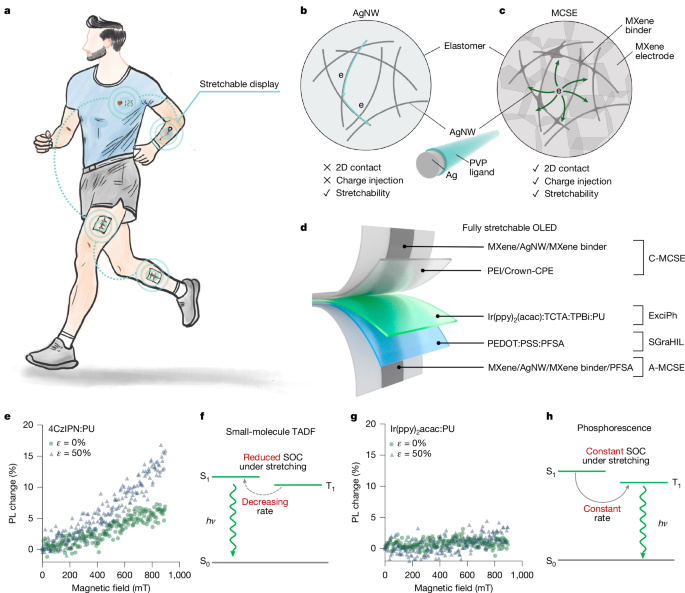
Zhang, Z. et al. High-brightness all-polymer stretchable LED with charge-trapping dilution. Nature 603, 624–630 (2022).
Liang, J., Li, L., Niu, X., Yu, Z. & Pei, Q. Elastomeric polymer light-emitting devices and displays. Nat. Photon. 7, 817–824 (2013).
Matsuhisa, N. et al. High-frequency and intrinsically stretchable polymer diodes. Nature 600, 246–252 (2021).
Zhou, H., Kim, H.-W., Jeong, W. J. & Lee, T.-W. Toward intrinsically stretchable OLEDs with high efficiency. Adv. Mater. 37, 2420008 (2025).
Shi, X. et al. Large-area display textiles integrated with functional systems. Nature 591, 240–245 (2021).
Kim, J.-H. & Park, J.-W. Intrinsically stretchable organic light-emitting diodes. Sci. Adv. 7, eabd9715 (2021).
Zhou, H., Kim, K.-N., Sung, M.-J., Han, S. J. & Lee, T.-W. Intrinsically stretchable low-dimensional conductors for wearable organic light-emitting diodes. Device 1, 100060 (2023).
Adachi, C., Baldo, M. A., Thompson, M. E. & Forrest, S. R. Nearly 100% internal phosphorescence efficiency in an organic light-emitting device. J. Appl. Phys. 90, 5048–5051 (2001).
Liu, W. et al. High-efficiency stretchable light-emitting polymers from thermally activated delayed fluorescence. Nat. Mater. 22, 737–745 (2023).
Han, T.-H. et al. Extremely efficient flexible organic light-emitting diodes with modified graphene anode. Nat. Photon. 6, 105–110 (2012).
Zhou, H. et al. Graphene-based intrinsically stretchable 2D-contact electrodes for highly efficient organic light-emitting diodes. Adv. Mater. 34, 2203040 (2022).
VahidMohammadi, A., Rosen, J. & Gogotsi, Y. The world of two-dimensional carbides and nitrides (MXenes). Science 372, eabf1581 (2021).
Li, X. et al. MXene chemistry, electrochemistry and energy storage applications. Nat. Rev. Chem. 6, 389–404 (2022).
Han, M. et al. Electrochemically modulated interaction of MXenes with microwaves. Nat. Nanotechnol. 18, 373–379 (2023).
Zhou, H. et al. Overcoming the limitations of MXene electrodes for solution-processed optoelectronic devices. Adv. Mater. 34, 2206377 (2022).
Ahn, S. et al. A 2D titanium carbide MXene flexible electrode for high-efficiency light-emitting diodes. Adv. Mater. 32, 2000919 (2020).
Cui, L.-S. et al. Fast spin-flip enables efficient and stable organic electroluminescence from charge-transfer states. Nat. Photon. 14, 636–642 (2020).
Uoyama, H., Goushi, K., Shizu, K., Nomura, H. & Adachi, C. Highly efficient organic light-emitting diodes from delayed fluorescence. Nature 492, 234–238 (2012).
Yang, Z. et al. Recent advances in organic thermally activated delayed fluorescence materials. Chem. Soc. Rev. 46, 915–1016 (2017).
Hu, B., Yan, L. & Shao, M. Magnetic-field effects in organic semiconducting materials and devices. Adv. Mater. 21, 1500–1516 (2009).
Du, C., Wang, H., Yang, F. & Hammel, P. C. Systematic variation of spin-orbit coupling with d-orbital filling: large inverse spin Hall effect in 3d transition metals. Phys. Rev. B 90, 140407 (2014).
Park, Y.-S. et al. Exciplex-forming co-host for organic light-emitting diodes with ultimate efficiency. Adv. Funct. Mater. 23, 4914–4920 (2013).
Park, J. W., Cho, K. H. & Rhee, Y. M. Mechanism of Ir(ppy)3 guest exciton formation with the exciplex-forming TCTA:TPBI cohost within a phosphorescent organic light-emitting diode environment. Int. J. Mol. Sci. 23, 5940 (2022).
Lee, J.-H., Lee, S., Yoo, S.-J., Kim, K.-H. & Kim, J.-J. Langevin and trap-assisted recombination in phosphorescent organic light emitting diodes. Adv. Funct. Mater. 24, 4681–4688 (2014).
Weichsel, C. et al. Storage of charge carriers on emitter molecules in organic light-emitting diodes. Phys. Rev. B 86, 075204 (2012).
Lao, J. et al. Aqueous stable Ti3C2 MXene membrane with fast and photoswitchable nanofluidic transport. ACS Nano 12, 12464–12471 (2018).
Iqbal, A. et al. Anomalous absorption of electromagnetic waves by 2D transition metal carbonitride Ti3CNTx (MXene). Science 369, 446–450 (2020).

