


Good morning! It’s Monday, January 12, 2026, and this is The Morning Shift, your daily roundup of the top automotive headlines from around the world, in one place. This is where you’ll find the most important stories that are shaping the way Americans drive and get around.
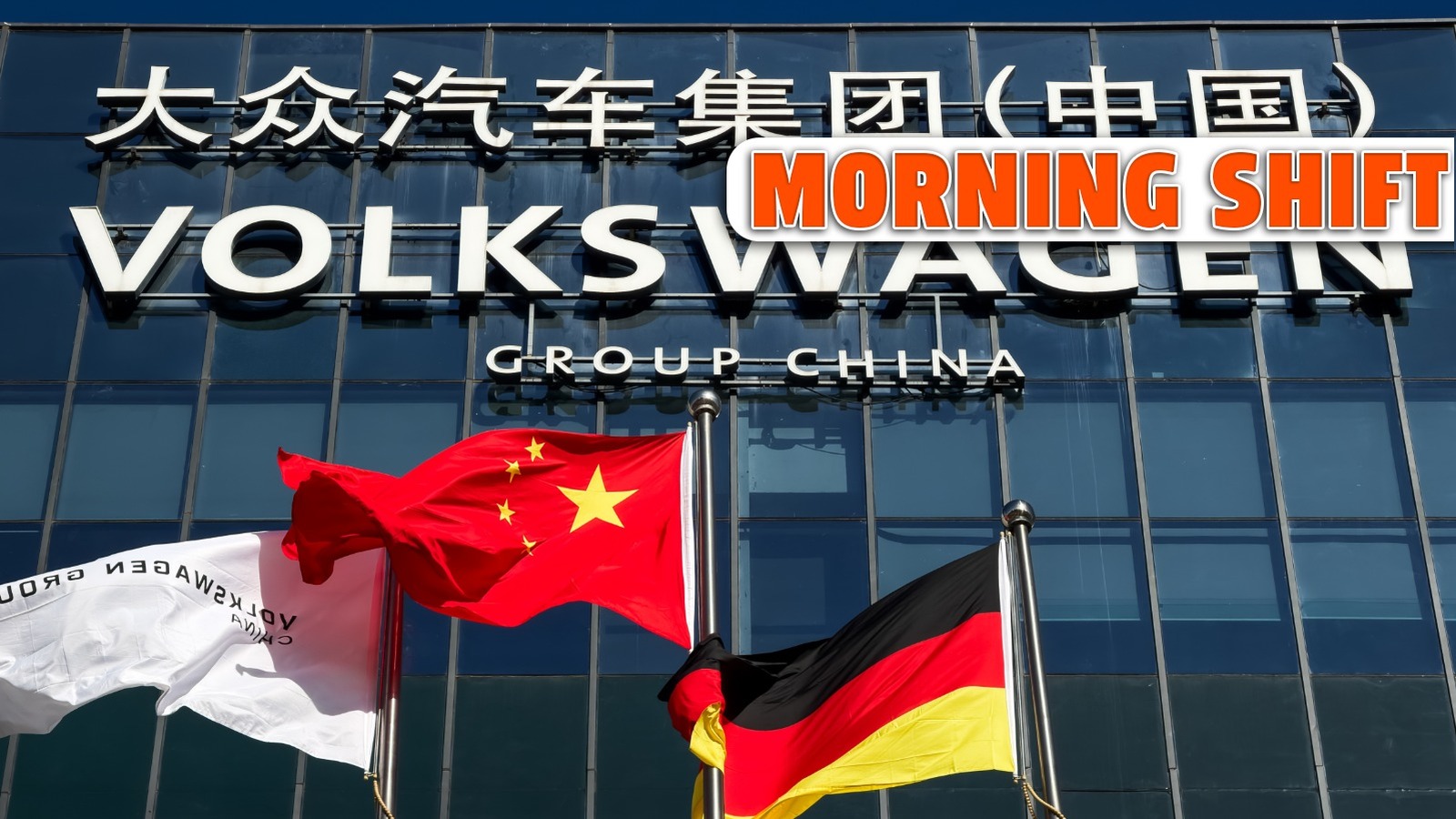
In this shift it’s all about that hot kid on the EV block, China! Europe and China are on the cusp of an agreement that would end tariffs on EVs thanks to Volkswagen breaking with its fellow Chinese manufacturers. Meanwhile, Zeekr and Polestar are cleaning up on the continent, Chinese brands fill in the EV gaps left behind by domestic automakers at the Consumer Electronics Show, and the Detroit Auto Show promises glam and glitz this year. No, really.
1st Gear: Europe and China close on an agreement on removing tariffs from cars sold to the EU
Electric vehicles aren’t exactly popular here in the U.S. these days, but in Europe sales are still booming despite the entire continent’s step back from its 2035 internal combustion ban. European automakers are feeling the pinch of cheaper and, let’s face it, more attractive EVs from China. China’s commerce ministry released a statement Monday morning informing the world that the EU will issue guidelines regarding minimum pricing of EVs from China, Reuters reports. The guidelines are in response to Beijing and Brussels working towards resolving a trade dispute started in 2024, according to the South China Morning Post:
The European Commission issued the document for Chinese exporters on submitting price undertaking offers. It said they can strengthen their proposals by committing to annual shipment volumes and planned future investments in the EU.
The commission will conduct each assessment in an objective and fair manner, following the principle of non-discrimination and in accordance with World Trade Organization rules, it added.
The EU launched an anti-subsidy probe into Chinese EVs in October 2023, and concluded a year later by imposing countervailing duties ranging from 7.8 to 35.3 per cent over a five-year period. While the tariffs remain in place, they could be replaced with minimum import prices under the new scheme.
In this new scheme, instead of paying tariffs, Chinese automakers could volunteer to simply ship a set number of vehicles to Europe. It would be up to the automakers to set minimum prices their cars could be sold for, and in return, Chinese automakers could avoid the anti-subsidy tariffs of up to 35% imposed by the EU in 2024.
This whole dance is a piece of the European Commission’s plan to pull away from the U.S. as Trump’s policies make it attractive for countries to do business elsewhere, according to the New York Times. It may take a while for companies to get their ducks in a row, but one European manufacturer of Chinese EVs — Volkswagen — broke with its fellow manufactures to limit the number of models of its Hefei, China-built Cupra EVs and set a minimum price in Europe. In response, VW asked the EU to drop its 20.7% anti-subsidy tariff. Now that there is a plan in place, the hope is other Chinese automakers will follow suit, a likely course of action considering how China is mopping up in sales even with the tariffs.
2nd Gear: Geely focuses on growing its presence in Europe with Zeekr, Polestar
In Chinese, the second character in the word “danger” also serves as the character for the concept of “opportunity.” The EV manufacturing mega-giant Geely seems ready to pivot to opportunity in the face of any crisis global economics throws at it. You’d think the company would be reeling after Europe’s 2035 ban on ICE vehicles was all but dropped, but nah. Geely instead jammed out a ton of Polestar sales in 2025, and is now looking at pivoting to plug-in hybrids to take advantage of the extension on dino juice cars.
Polestar’s focus on Europe paid off in the last quarter of 2025, with sales boosted 27%. Europe now accounts for nearly 80% of its sales, which totaled 60,119 cars last year. Uncertainty in the U.S. (that’s an understatement) and increased competition in China have all but pushed the joint Volvo-Geely automaker to make its real bread and butter in Europe, Reuters reports. Things aren’t all rosy for the brand — it’s still downing in debt, for instance — but after dropping its physical dealerships and going to direct-to-consumer sales, the company is leaner, meaner and ready to eat Europe’s EV dinner. And while Polestar builds handsome and premium-feeling EVs, so does one of its parent companies, the Chinese automaker Zeekr.
Geely is looking to use both brands to slice itself an even bigger piece of the EU EV pie, Reuters reports, by delivering more plug-in hybrid vehicles and expanding into more European countries. It makes sense, since domestic automakers in Europe are hanging on by their nails via plug-in hybrids, according to Bloomberg. Mercedes sold 9% fewer EVs in Europe last year, and Mercedes, VW and BMW all lost market share in China. Right now you can buy a Zeekr in 12 countries in the EU, but the company is looking to hit some big markets like France, the United Kingdom, Italy and Spain.
3rd Gear: Chinese EVs shows up to CES while American automakers can’t be bothered
The Consumer Electronics Show is finally over. We didn’t make it to this year’s (I have serious ROMO – relief of missing out) but Chinese EV automakers did manage to get to sunny Las Vegas to show off their wares, even though such cars are pretty much banned in the U.S., according to Automotive News.
Geely Holding Group and Great Wall Motor filled in the blanks spots where domestic automakers might strut their latest EV stuff, ya know, if they had any. CES once served as a backdrop for U.S. automakers to announce big products as they all tried to shift from car companies to transportation technology brands. The 2016 show brought GM and Ford out for big announcements in the EV and AV spaces.
This year? Ford did tout its eyes-off driving system, which will debut on Ford’s 2028 Universal EV platform, and an AI assistant (ugh), Automotive News reports. Will EVs still be sold in the U.S. by then? Only time will tell. But one major takeaway from CES this year; the U.S. is handing the technological future of driving over to China thanks to its obsession with gasoline. We’re going to be left in the clean dust of an EV future.
4th Gear: The North American International Auto Show kicks off this week, promises to be less disappointing
When one consumer show closes, another opens. Man, I used to love the auto show. As a kid that’s all anyone talked about Monday morning on the school bus — who went, what they saw, which automaker their parents worked for, etc. As an adult I loved the madcap frenzy of waking up at 5 a.m. to spend two days covering a new vehicle reveal every 15 minutes. It’s not easy to jog across a huge convention center with a decent camera and your phone just to get elbowed in the face by a photographer from MotorTrend. Ah, nostalgia.
Over the last five years or so the importance of the the Detroit Auto Show (also known as the North American International Auto Show, or NAIAS) has waned, but this year is promising way more dazzle and fewer sad open spaces, according to Automotive News, by leaning into the digital aspect of the show rather than trying to revive the excitement of physical reveals. There will be celebrities, two charity previews, new exhibits, and more automakers than in years past. The inclusion of three driving tracks, however, does give me pause. If this is such a bustling show, how come there’s enough room for demos? The Detroit Free Press listed these automakers as attending the show;
- Alfa Romeo
- Ariel
- Aston Martin
- Audi
- Bentley
- Buick
- Cadillac
- Chevrolet
- Chrysler
- Dodge
- Ferrari
- Fiat
- Ford
- GMC
- Honda
- Hyundai
- Ineos
- Jaguar
- Jeep
- Kia
- Koenigsegg
- Lamborghini
- Land Rover
- Lincoln
- Lotus
- Lucid
- Maserati
- McLaren
- Mercedes
- Mini
- Morgan
- Nissan
- Pagani
- Pininfarina
- Polestar
- Porsche
- Ram
- Rolls-Royce
- Subaru
- Toyota
- Volkswagen
The 119th North American International Auto Show runs January 14-25, with media days limited to Thursday and Friday. Last year some 275,000 people attended. I’ll probably check it out. Are you going to go?
Reverse: The Dodge Viper Concept Debuts at the 1989 Detroit Auto Show
Speaking of exciting North American International Auto Shows, the Dodge Viper concept was a total surprise to the flacks working the 1989 show. What a day to be an auto journalist in Detroit.
On The Radio: Sunset Rubdown – I’ll believe in anything
Everyone is going nuts for “Heated Rivalry,” especially the episode “I’ll Believe In Anything,” which is ripped straight from the song that wraps up the episode. It’s very strange to go from being in my 20s and telling people, “My favorite band is pretty underground, part of the Montreal indie scene, you probably never heard of them” to hearing this song everywhere. But before it was a Wolf Parade song, it was by Sunset Rubdown, a band that is led by the weirded half of Wolf Parade, Spencer Krug.
Sunset Rubdown is still one of my all time favorite bands, and instead of being annoyed all these Johnny-come-latelys are digging this tune, I’m ecstatic. That’s called growth, folks.

