


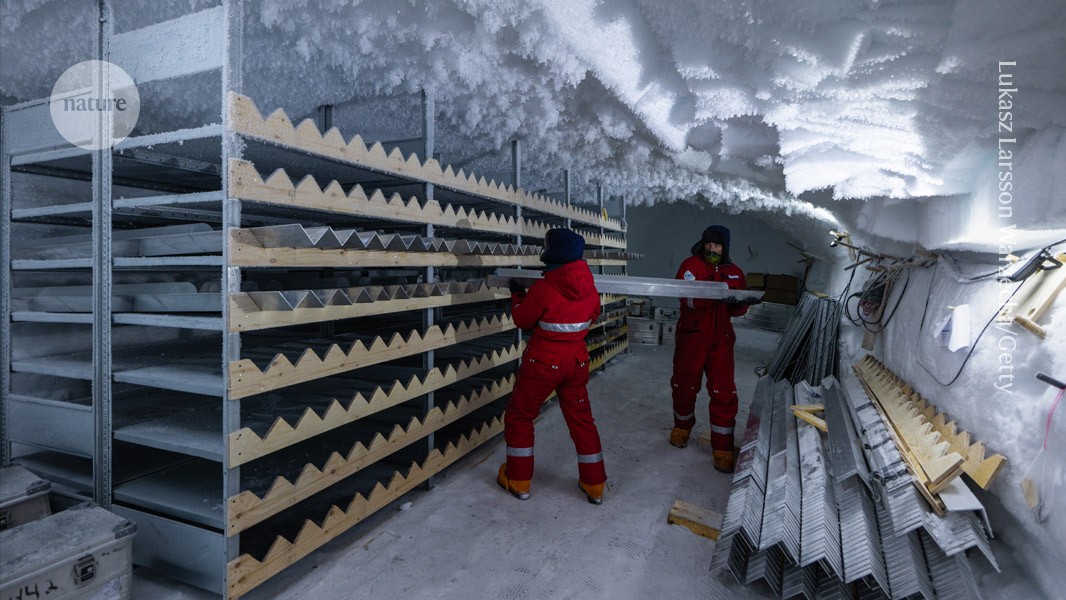

Greenland is a major place of climate research.Credit: Lukasz Larsson Warzecha/Getty
In the aftermath of the United States military’s action to remove Nicolás Maduro, the president of Venezuela on 3 January, US President Donald Trump has reiterated his claim to want to acquire Greenland using “a range of options”, including use of the military, the White House said.
In response, a group of scientists has co-authored a “Statement from US scientists in solidarity with Greenland”, open to any US-based researchers who have conducted research on the island. The letter, published on 9 January, has so far gathered 204 signatures.
Greenland has long been a focal point for researchers in fields ranging from glaciology to evolution. Temperatures in the Arctic have been rising several times faster than in the rest of the planet, and research in Greenland has been crucial for such climate-science studies1.
Nature spoke with Yarrow Axford, who is a palaeoimmunology researcher and science communicator based in Lexington, Massachusetts. Axford runs a research group at Northwestern University in Evanston, Illinois, and is one of the creators of the initiative. Her research has been helping to reconstruct the climate of the past through the study of lake sediments on the island2.
What is Greenland’s significance — can it be described as a canary in the coal mine for climate change?
The Greenland ice sheet is a crucial example of climate change. It has changed so rapidly in the past couple of decades. The impacts are both local and global due to the effects on sea levels, and potentially ocean currents too. So, the region is sensitive to climate change but also a part of the climate system that affects the whole world in a really profound way.
There’s a ton of scientific interest in Greenland, which is seen in the fact that so many researchers are willing to sign this statement. And we’ve limited signees to US-based or US scientists living abroad who work on or study in Greenland, which shows how many US scientists conduct research in Greenland.
What prompted this letter?
A lot of people in the US — not just scientists — are very upset about the rhetoric directed towards Greenland. But scientists who work there feel it very personally. Many of us have friends in Greenland, colleagues and collaborators there. It’s a special place for us and we benefitted from the generosity of communities there. It really motivated us to achieve two main goals with this letter. First, we want to let our colleagues and friends in Greenland know we’re thinking about them right now, and that we stand with them.

Trump’s bid for Greenland threatens to destabilize Arctic research
Second, we want to urge our colleagues here in the US to speak up — by sending letters to the editors of their local papers, or by sharing this letter with senators and representatives in Washington DC.

