


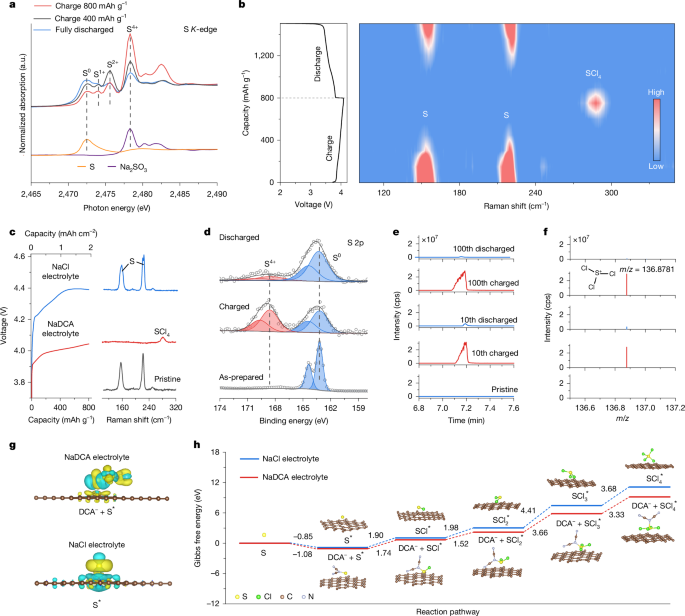
Liu, R. et al. Establishing reaction networks in the 16-electron sulfur reduction reaction. Nature 626, 98–104 (2024).
Pan, H. et al. Non-encapsulation approach for high-performance Li–S batteries through controlled nucleation and growth. Nat. Energy 2, 813–820 (2017).
Liao, M. et al. Hybrid polymer network cathode-enabled soluble-polysulfide-free lithium–sulfur batteries. Nat. Sustain. 7, 1709–1718 (2024).
Bai, R. et al. Preferable single-atom catalysts enabled by natural language processing for high energy density Na-S batteries. Nat. Commun. 16, 5827 (2025).
Zhao, L. et al. A critical review on room-temperature sodium-sulfur batteries: from research advances to practical perspectives. Adv. Mater. 36, 2402337 (2024).
Yao, W. et al. Rechargeable metal-sulfur batteries: key materials to mechanisms. Chem. Rev. 124, 4935–5118 (2024).
He, J., Bhargav, A., Shin, W. & Manthiram, A. Stable dendrite-free sodium–sulfur batteries enabled by a localized high-concentration electrolyte. J. Am. Chem. Soc. 143, 20241–20248 (2021).
Lei, Y.-J. et al. Understanding the charge transfer effects of single atoms for boosting the performance of Na–S batteries. Nat. Commun. 15, 3325 (2024).
Mamantov, G. et al. The use of tetravalent sulfur in molten chloroaluminate secondary batteries. J. Electrochem. Soc. 127, 2319 (1980).
Mamantov, G. et al. SCl3+AlCl4−: improved synthesis and characterization. J. Inorg. Nucl. Chem. 41, 260–261 (1979).
Steudel, R., Jensen, D. & Plinke, B. Low temperature Raman spectra of dichlorosulfane (SCl2), tetrachlorosulfurane (SCl4), dichlorodisulfane (S2Cl2) and dichlorodiselane (Se2Cl2). Z. Naturforsch. B. 42, 163–168 (1987).
Dezarnaud, C., Tronc, M. & Modelli, A. Shape resonances in low-energy electron transmission and sulfur K-shell photoabsorption spectroscopies: CH3SH, C2H5SH, (CH3)2S, (C2H5)2S, C6H5SH, C6H5SCH3, CH3SCN, CH3NCS, SCl2. Chem. Phys. 156, 129–140 (1991).
Zhu, G. et al. Rechargeable Na/Cl2 and Li/Cl2 batteries. Nature 596, 523–530 (2021).
Lu, Y. et al. A compatible anode/succinonitrile-based electrolyte interface in all-solid-state Na–CO2 batteries. Chem. Sci. 10, 4306–4312 (2019).
Hu, C. et al. Carbonate ester-based sodium metal battery with high-capacity retention at −50 °C enabled by weak solvents and electrodeposited anode. Angew. Chem. Int. Ed. 63, e202407075 (2024).
Dementjev, A. P. et al. X-ray photoelectron spectroscopy reference data for identification of the C3N4 phase in carbon–nitrogen films. Diam. Relat. Mater. 9, 1904–1907 (2000).
Chen, X. et al. Electrochemically and thermally stable inorganics–rich solid electrolyte interphase for robust lithium metal batteries. Adv. Mater. 36, 2307370 (2024).
Hu, L. et al. Restructuring electrolyte solvation by a versatile diluent toward beyond 99.9% Coulombic efficiency of sodium plating/stripping at ultralow temperatures. Adv. Mater. 36, 2312161 (2024).
Liu, P. et al. Inorganic–organic hybrid multifunctional solid electrolyte interphase layers for dendrite-free sodium metal anodes. Angew. Chem. Int. Ed. 62, e202312413 (2023).
He, J. et al. Tuning the solvation structure with salts for stable sodium-metal batteries. Nat. Energy 9, 446–456 (2024).
Sun, B. et al. Dendrite-free sodium-metal anodes for high-energy sodium-metal batteries. Adv. Mater. 30, 1801334 (2018).
Zhuang, R. et al. Fluorinated porous frameworks enable robust anode-less sodium metal batteries. Sci. Adv. 9, eadh8060 (2023).
Tan, S. et al. Synchronized breathing in anion-derived interphases. ACS Energy Lett. 10, 3746–3754 (2025).
Feng, G. et al. Imaging solid–electrolyte interphase dynamics using operando reflection interference microscopy. Nat. Nanotechnol. 18, 780–789 (2023).
Geng, M. et al. A stable anode-free Na–S full cell at room temperature. Energy Storage Mater. 52, 230–237 (2022).
Zheng, S. et al. Construction of dangling and staggered stacking aldehyde in covalent organic frameworks for 2e− oxygen reduction reaction. Carbon Neutraliz. 3, 415–422 (2024).
Welton, T. Room-temperature ionic liquids. Solvents for synthesis and catalysis. Chem. Rev. 99, 2071–2083 (1999).
Demirci, U. B., Akdim, O. & Miele, P. Aluminum chloride for accelerating hydrogen generation from sodium borohydride. J. Power Sources 192, 310–315 (2009).
Li, Y. et al. Interfacial engineering to achieve an energy density of over 200 Wh kg−1 in sodium batteries. Nat. Energy 7, 511–519 (2022).
Vaalma, C., Buchholz, D., Weil, M. & Passerini, S. A cost and resource analysis of sodium-ion batteries. Nat. Rev. Mater. 3, 18013 (2018).
Hueso, K., Armand, M. & Rojo, T. High temperature sodium batteries: status, challenges and future trends. Energy Environ. Sci. 6, 734–749 (2013).
Li, Z. et al. Air-breathing aqueous sulfur flow battery for ultralow-cost long-duration electrical storage. Joule 1, 306–327 (2017).
Lu, C. et al. High-performance fibre battery with polymer gel electrolyte. Nature 629, 86–91 (2024).
Brinkkötter, M. et al. Influence of anion structure on ion dynamics in polymer gel electrolytes composed of poly(ionic liquid), ionic liquid and Li salt. Electrochim. Acta 237, 237–247 (2017).
Wang, P. et al. Niobium phosphide-induced sulfur cathode interface with fast lithium-ion flux enables highly stable lithium–sulfur catalytic conversion. Angew. Chem. Int. Ed. 64, e202502255 (2025).
Gardiner, D. J. & Graves, P. R. in Practical Raman Spectroscopy (eds Gardiner, D. J. & Graves, P. R.) Ch. 1 (Springer, 1989).
Kresse, G. & Hafner, J. Ab initio molecular dynamics for liquid metals. Phys. Rev. B 47, 558–561 (1993).
Kresse, G. & Furthmüller, J. Efficiency of ab-initio total energy calculations for metals and semiconductors using a plane-wave basis set. Comput. Mater. Sci. 6, 15–50 (1996).
Kresse, G. & Joubert, D. From ultrasoft pseudopotentials to the projector augmented-wave method. Phys. Rev. B 59, 1758–1775 (1999).
Mathew, K. et al. Implicit solvation model for density-functional study of nanocrystal surfaces and reaction pathways. J. Chem. Phys. 140, 084160 (2014).
Jiang, Y. et al. Origin of the overpotential for oxygen reduction at a fuel-cell cathode. J. Phys. Chem. B 108, 17886–17892 (2004).

