


Virus and 4′-FlU
A lineage VII LASV isolate Germany ex Togo/2016/7082 (Genbank accessions KU961971 and KU961972) originated from serum of a LASV-infected patient who was medically evacuated to Germany from Togo59. The study challenge material was from the third passage of Vero 76 cells (ATCC CRL-1587) exposed to this serum. Authentication of Vero 76 cells was not performed beyond that performed by the providing repository (American Type Culture Collection (ATCC)). The passage two isolate was from the European Virus Archive and was obtained from T. Rieger and S. Gunther and passaged once at University of Texas Medical Branch (UTMB). The cell supernatants were stored at −80 °C as aliquots of ~1 ml. No mycoplasma or endotoxin was detected (<0.5 endotoxin units (EU) ml−1). 4′-FlU was obtained from MedChemExpress (HY-146246) and prepared in DMSO as 60 mM working stocks and frozen at −80 °C until use.
Study oversight
All study protocols described were approved by the UTMB Institutional Animal Care and Use Committee (IACUC) which were compliant with UTMB Institutional Biosafety Committee (IBC) guidelines under BSL-4 containment. UTMB animal facilities used in this work are accredited by the Association for Assessment and Accreditation of Laboratory Animal Care International and adhere to principles specified in the eighth edition of the Guide for the Care and Use of Laboratory Animals, National Research Council.
NHP challenge and treatment
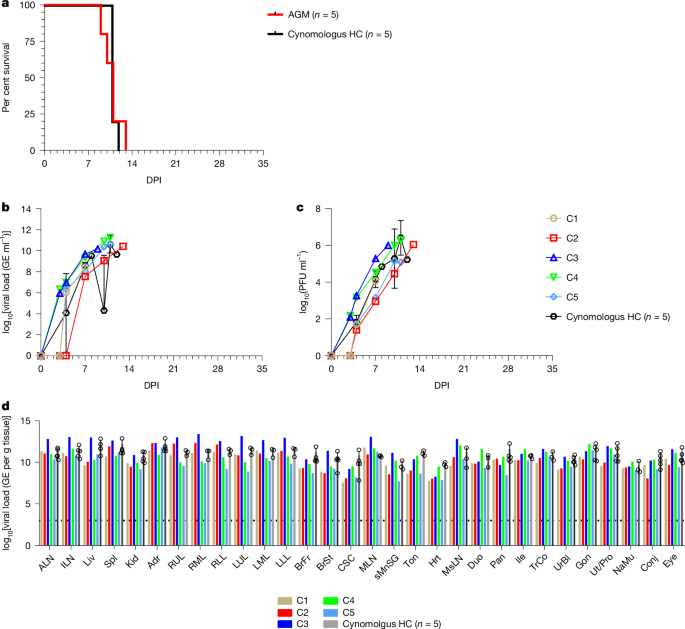
Prior to conducting the 4′-FIU study, a power analysis was performed to determine the minimum cohort size for the study. For LASV, assuming a one-tailed alpha of 0.05, sample sizes of 5 per group will provide >80% power to detect a difference in the proportion of surviving animals between the treatment group (100% survival rate) and the control group (0% survival rate), using a Fisher’s exact test. For the 4′-FIU treatment study, animals were assigned to treatment or control groups using a random number generator in Microsoft Excel. All animals were anaesthetized via intramuscular injection with ketamine (10 mg kg−1) prior to procedures (for example, blood collection, weight and rectal temperature measurement). An initial study of 5 (2 male, 3 female) healthy adult AGMs (C. aethiops, PreLabs) weighing ~3.3 to 6.1 kg was performed to determine the pathogenic potential of LASV Togo in AGMs. All five monkeys were challenged by intramuscular injection in the left quadricep with a target dose of 1,000 PFU of LASV Togo (actual dose 840 PFU). As all five of these LASV Togo-infected AGMs succumbed to Lassa fever, a single control animal was used to confirm lethality of the challenge material used in the treatment study in which clinical parameters were compared with the five AGMs derived from the initial model experiment using the identical challenge material (that is, same virus passage). This allows for an ethical reduction in the number of animals used for data with highly predictable, lethal outcomes.
For the 4′-FIU treatment study, 6 (2 male, 4 female) healthy adult AGMs (PreLabs) weighing ~2.9–6.3 kg were challenged by intramuscular injection in the left quadricep with target dose of 1,000 PFU of LASV Togo (actual dose 1,312 PFU). Assignment to the treatment group or untreated positive control group was determined prior to challenge by randomization by Excel. Blinding was not performed for this study. Five monkeys were treated by oral gavage with 5 mg kg−1 4′-FIU (as a 1:10 suspension of 4′-FIU in DMSO to 1% methyl cellulose in water vehicle) beginning 6 days after LASV-Togo exposure. These 5 monkeys received daily doses of 4′-FIU for 10 days (6–15 DPI). The LASV Togo positive control monkey was not treated. The duration of the study was 35 days. This study was not blinded. All six AGMs were monitored daily and scored for disease progression with an internal LASV humane end-point scoring sheet approved by the UTMB Institutional Animal Care and Use Committee. The scoring changes measured from baseline included posture and activity level, attitude and behaviour, food intake, respiration, and disease manifestations, such as visible rash, haemorrhage, ecchymosis or flushed skin. A score of ≥9 indicated that an animal met the criteria for euthanasia.
Haematology and serum biochemistry
Total white blood cell counts, white blood cell differentials, red blood cell counts, platelet counts, haematocrit values, total haemoglobin concentrations, mean cell volumes, mean corpuscular volumes, and mean corpuscular haemoglobin concentrations were analysed from blood collected in tubes containing EDTA using a Vetscan HM5 laser-based haematologic analyser (Zoetis). Serum samples from blood collected in serum-separating tubes were tested for concentrations of albumin, amylase, alanine aminotransferase, aspartate aminotransferase, alkaline phosphatase, blood urea nitrogen, calcium, creatinine, C-reactive protein, γ-glutamyltransferase, glucose, total protein and uric acid by using a Piccolo point-of-care analyser and Biochemistry Panel Plus analyser discs (Abaxis).
RNA isolation from LASV-infected AGM
On procedure days, 100 μl of blood from K2-EDTA collection tubes was collected prior to centrifugation and was added to 600 μl of AVL viral lysis buffer with 6 μl carrier RNA (Qiagen) for RNA extraction. For tissues, approximately 100 mg was stored in 1 ml RNAlater (Qiagen) for at least 24 h for stabilization. RNAlater was completely removed, and tissues were homogenized in 600 μl RLT buffer and 1% β-mercaptoethanol (Qiagen) in a 2 ml cryovial using a tissue lyser (Qiagen) and 1.4 mm ceramic beads. The tissues sampled included axillary and inguinal lymph nodes, liver, spleen, kidney, adrenal gland, lung, brain, pancreas, urinary bladder, ovary or testis, uterus or prostate, conjunctiva and eye. All blood samples were inactivated in AVL viral lysis buffer, and tissue samples were homogenized and inactivated in RLT buffer prior to removal from the BSL-4 laboratory. Subsequently, RNA was isolated from blood using the QIAamp viral RNA kit (Qiagen), and from tissues using the RNeasy minikit (Qiagen) according to the manufacturer’s instructions supplied with each kit.
Quantification of viral load
Primers and a probe targeting the N gene of LASV were used for real-time quantitative PCR (RT–qPCR) with the following primers and probe for LASV Togo: forward: 5′-ACAGTTGCAAATGGTGTGCT-3′; reverse: 5′-TGGCAGTGATCTTCCCATGT-3′; Probe: 6-carboxyfluorescein (FAM)–5′-TGCCTCTCCCAGAGTCAAGTGCA-3′–6 carboxytetramethylrhodamine (TAMRA). Viral RNA was detected using the CFX96 detection system (Bio-Rad) with one-step probe RT–qPCR kits (Qiagen) with the following cycle conditions: 50 °C for 10 min, 95 °C for 10 s, and 45 cycles of 95 °C for 10 s and 55.7 °C for 30 s. Threshold cycle (Ct) values representing viral genomes were analysed with CFX Maestro v.5.3.022.1030 software, and the data are presented as genome equivalents. To create the GE standard, RNA from viral stocks was extracted, and the number of strain-specific genomes was calculated using Avogadro’s number and the molecular weight of each viral genome.
Plaque titration of infectious LASV
Virus titration was performed by plaque assay using Vero 76 cells (ATCC CRL-1587) from all plasma or tissue samples as previously described26. In brief, increasing tenfold dilutions of the samples were adsorbed to Vero 76 cell monolayers in duplicate wells (200 μl) and overlaid with 0.8% agarose in 1× Eagle’s minimum essentials medium (MEM) with 5% fetal bovine serum and 1% penicillin-streptomycin. After 5 days incubation at 37 °C, 5% CO2, neutral red stain was added, and plaques were counted after 48 h of incubation. The limit of detection for this assay is 25 PFU ml−1 for plasma and 250 PFU per g for tissues. Independent validation of the Vero 76 cell line was not performed outside of any authentication performed by ATCC. Cells were tested for mycoplasma contamination. No detectable mycoplasma or endotoxin levels were measured (<0.5 EU ml−1).
ELISA
Sera collected at the indicated time points were tested for total anti-LASV IgG antibodies by ELISA using MaxiSorp (44204 ThermoFisher) uncoated and ReLASV Pf-GP Lineage VII IgG (Zalgen) antigen-absorbed 96-well plates. Sera were initially diluted 1:200 in duplicate and then two-fold through 1:25,600 in ELISA diluent (2% BSA in 1× PBS, and 0.2% Tween-20). After 1 h incubation, cells were washed 4 times with wash buffer (1× PBS with 0.2% Tween-20) and incubated for 1 h with a dilution of horseradish peroxidase (HRP)-conjugated anti-monkey IgG (1:10,000; Fitzgerald Industries). O-phenylenediamine (OPD) substrate tablet (Thermo Scientific; 34006) and stable peroxide buffer (Thermo Scientific; 34062) were added to the wells after four additional washes to develop the colorimetric reaction. The reaction was stopped with 2.5 M sulfuric acid for about 10 min after OPD addition and absorbance values were measured at a wavelength of 492 nm on a spectrophotometer (BioTek Cytation 5). Absorbance values were normalized by subtracting uncoated from antigen-coated wells at the corresponding serum dilution. End-point titres were defined as the reciprocal of the last adjusted serum dilution with a value ≥0.2.
Plaque reduction neutralization test
Neutralization titres were calculated by determining the dilution of serum that reduced 50% of plaques (PRNT50) as previously described16.
Histopathology and immunohistochemistry
Tissue sections were deparaffinized and rehydrated through xylene and graded ethanols. The tissue sections were processed for IHC using the Thermo Autostainer 360 (ThermoFisher). Slides were treated with Proteinase K for 5 min to unmask antigens (Dako). Specific anti-LASV CLD4 NP immunoreactivity was detected using an anti-LASV CLD4 NP primary antibody (Zalgen Labs) at a 1:1,000 dilution for 60 min. The secondary antibody used was biotinylated goat anti-rabbit IgG (Vector Laboratories, BA-1000) at 1:200 for 30 min followed by Vector Streptavidin Alkaline Phosphatase at a dilution of 1:200 for 15 min (Vector Laboratories, SA-5100). Slides were developed with ImmPact Red Substrate Kit (Vector Laboratories SK-5105) for 20 min and counterstained with haematoxylin for 30 s.
Transcriptional analysis
Targeted transcriptomic analysis of the expression of 770 host mRNAs was quantified via the Nanostring NHP Immunology v.2 panel. RNA from whole blood was extracted via the QIAamp Viral RNA Mini Kit (Qiagen) and run on the nCounter SPRINT Profiler according to the manufacturer’s instructions. Output files were loaded into nSolver v.4.0, and background thresholding was performed using the default parameters. Samples that did not pass the nSolver internal quality checks were removed from downstream analysis. Thresholded count matrices were exported from nSolver and analysed with limma v.3.62.1 (edgeR v.4.4.1) in R v.4.4.258,60; scripts are available on GitHub (https://github.com/geisbert-lab/lasv-togo-4fiu).
Naive clustering with PCA and k-means was used to bin samples into six disease states (Fig. 5a and Extended Data Fig. 2a): baseline (0 DPI), early (3–4 DPI, sampled in control animals), middle (7 DPI), late (>7 DPI in control animals), transitional (9–12 DPI in treated animals), and recovered (≥15 DPI in treated animals). The disease course in positive control and 4′-FIU-treated animals was quantified by comparing each post-infection disease state to baseline samples (Fig. 5b and Extended Data Fig. 2c,d). Disease course differences between positive control and treated animals were quantified by comparing baseline and middle disease states (Fig. 5c and Extended Data Fig. 2b). Transitional samples in treated animals and late samples in positive control animals were also compared to capture where disease course diverged (Fig. 5d). For all comparisons, genes with a false discovery rate-adjusted P value <0.05 and a log2 fold change >1 or <−1 were considered significantly differentially expressed.
Cell-type deconvolution (Fig. 5e and Extended Data Fig. 2e) was performed by calculating a cell-type score per sample, which was defined as the mean log2 counts per million of the cell-type marker genes defined by Nanostring. Canonical signalling pathways, functions and upstream regulators were identified via Ingenuity Pathway Analysis61 using the differentially expressed genes from controls at late time points compared to baseline and treated at transitional time points compared to baseline (Fig. 5f).
Statistics and reproducibility
Data collection and analysis were not performed blinded to the conditions of the experiments. No animals or data points were excluded from analysis in this work. Owing to the small numbers of animals used in this study, determination of effects of sex to treatment success were not possible; however, we did attempt to ensure that close to even distribution of each sex was represented in the experimental groups. Description of a priori power analysis to determine group size is described in ‘NHP challenge and treatment’. With regard to histopathological analysis of photomicrographs, representative photomicrographs were qualitatively considered to display lesions that were nominally or ordinally measured by masking of the pathologist post-examination and ranking lesions to satisfy the study objectives. Additionally, thorough examinations of multiple slides of the target tissues multiple times (at least two times per tissue) were performed in a timely manner to maintain interpretation consistency, which comports with established criteria62. Additional data analysis and plotting was performed in Microsoft Excel (current Office 360 version) and/or GraphPad Prism v. 9.3.1 and/or GraphPad Prism v. 10.5.0.
Reporting summary
Further information on research design is available in the Nature Portfolio Reporting Summary linked to this article.

