


You have full access to this article via your institution.
Hello Nature readers, would you like to get this Briefing in your inbox free every day? Sign up here.

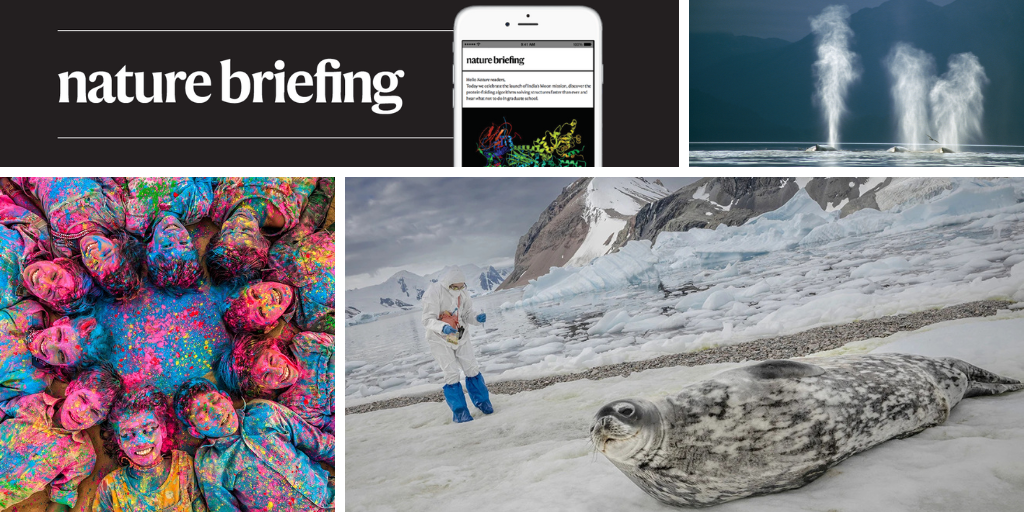
A new study tracking whales is the latest to demonstrate the value of drones as a less-invasive way of studying the health of marine mammals. (Duncan Murrell/Robert Harding via Alamy)
A virus that sickens marine mammals has been detected in Arctic waters for the first time. Scientists used drones armed with petri dishes to collect samples of blow — the air and mucus whales expel from their blowholes — from whales in northern Norway. The team identified cetacean morbillivirus in samples from humpback whales (Megaptera novaeangliae) and one sperm whale (Physeter macrocephalus), though the humpbacks showed no symptoms of disease. Using drones to collect samples from whales over time — and as they migrate — could enable researchers to better track the transmission of pathogens in these elusive species.
The New York Times | 5 min read
Reference: BMC Veterinary Research paper
A blood-cleaning method called Mirasol, which relies on the vitamin riboflavin and ultraviolet light to disable pathogens, will soon be tested to fight cancer. This month a phase I trial will study whether tumour cells, inactivated by the Mirasol process and then reintroduced into people with ovarian cancer, can trigger a safe immune response that could slow or prevent relapse.
The administration of US President Donald Trump has made moves to promote artificial intelligence and quantum-information science, by highlighting them as research priorities and, last month, ordering US states not to regulate AI. Some researchers question the effectiveness of the administration’s strategy and argue that it might be hampered by other, conflicting policies, such as visa policies that discourage international students and researchers.
Where I work

Buse Tuğba Zaman is an analytical chemist at Yildiz Technical University, Istanbul, Turkey.Credit: Sebnem Coskun/Anadolu via Getty
Analytical chemist Buse Tuğba Zaman says she “loved every minute” of a research trip to Antarctica to study contaminants such as heavy metals, pesticides and microplastics in wildlife. It took ten days of travel from her university in Turkey to fulfill her lifelong dream of visiting the continent, where she collected faecal samples from Adélie penguins (Pygoscelis adeliae) on Horseshoe Island. “There are no words to describe the silence and beauty of this place,” says Zaman.
Features & opinion
A tiny number of human cells in our bodies aren’t genetically ours.These ‘microchimeric’ cells pass between mother and child in utero; so mothers carry cells from their biological children and children can have cells from their mothers, grandmothers or older siblings. In Hidden Guests, journalist Lise Barnéoud explores what is known about these rare cells and the implications they have for understanding immunology. A captivating blend of history and philosophy, the book “is a must-read for anyone curious about science and self-identity — and willing to let their imaginations run wild”, writes infectious-disease paediatrician Sing Sing Way in his review.
Academic journals should be subject to external regulation to bolster research integrity, argues cancer research Jennifer Byrne. Independent oversight could push publishers to crack down on low-quality papers, and to correct or retract papers quickly when required, she says. She suggests that publishers voluntarily subscribe to an existing international quality-management standard known as ISO-9001 so that all journals are held to the same standards. This system “could help to balance the commercial interests of academic publishers with the needs of everyone who relies on quality information”, Byrne writes.
Public health scientist Robert Kaplan, who characterizes himself as an “occasional light drinker”, delves into the evidence to determine whether to give up booze for the month (or even longer).
Read more about the risks of moderate drinking — and how people should assess them — in our in-depth feature from March (Nature | 14 min read)
In the coming year, small-scale AI models could outcompete Large Language Models in reasoning, clinical trials of gene editing to treat rare human disorders get underway and a mission heads to Mars’s moon Phobos to collect samples. Nature reporter Miryam Naddaf joins the podcast to discuss the science events to look out for in 2026.
Nature Podcast | 20 min listen
Subscribe to the Nature Podcast on Apple Podcasts, Spotify or YouTube Music, or use the RSS feed.
Today I’m enjoying a tongue-in-cheek analysis of biomedical articles to find out just what different disciplines mean by ‘recent’ when they say “a recent study”. It turns out that it varies from an average of under two years in critical care papers (makes sense) to around 14 years (come on now, dentistry!) “It is a word that conveys urgency and relevance, while neatly sidestepping any commitment to a specific year,” note the authors. “Much like saying ‘I’ll call you soon’ after a first date: reassuring, yet infinitely interpretable.”
I hope you enjoyed this recent newsletter! Your feedback is always welcome at [email protected].
Thanks for reading,
Flora Graham, senior editor, Nature Briefing
With contributions by Jacob Smith
• Nature Briefing: Careers — insights, advice and award-winning journalism to help you optimize your working life
• Nature Briefing: Microbiology — the most abundant living entities on our planet — microorganisms — and the role they play in health, the environment and food systems
• Nature Briefing: Anthropocene — climate change, biodiversity, sustainability and geoengineering
• Nature Briefing: AI & Robotics — 100% written by humans, of course
• Nature Briefing: Cancer — a weekly newsletter written with cancer researchers in mind
• Nature Briefing: Translational Research — covers biotechnology, drug discovery and pharma

