



Hidden Guests: Migrating Cells and How the New Science of Microchimerism is Redefining Human Identity Lise Barnéoud, transl. Bronwyn Haslam Greystone Books (2025)
The chimaera of Greek mythology was “an evil creature with a lion’s head, a goat’s body, and a serpent’s tail”, notes journalist Lise Barnéoud in Hidden Guests. Humans are also chimaeras — thanks to the presence of cells that are not our own inside our bodies.
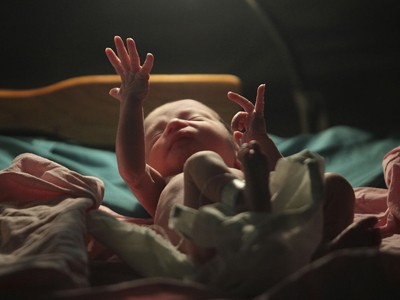
Could baby’s first bacteria take root before birth?
Mothers carry cells that came from their biological children, passed across the placenta when the baby was in the womb. Likewise, children carry cells that were transferred to them in utero from their mothers — some of which might even be from the child’s maternal grandmothers, older siblings or twin.
These ‘microchimeric’ cells have been found in every organ that has been studied so far. But they are also rare — much rarer, for example, than the trillions of microorganisms that reside in our guts, on our skin and in many other organs. We carry only one microchimeric cell for every 10,000 to 1 million of our own cells.
In Hidden Guests, the author invites readers to learn about the pioneering “microchimerists” — scientists who discovered these fascinating shared cells. She also challenges us to consider the broader implications for health and science, and the philosophy of the fact that we are all chimaeras.
Unplanned discovery
Microchimeric cells were, we learn, discovered through a series of accidental observations. In the late 1800s, pathologist Georg Schmorl described ‘giant cells’ in the lungs of people who had died from eclampsia — a life-threatening inflammatory condition that can occur during pregnancy. These giant cells resembled the cells of the placenta, leading Schmorl to suggest that fetal cells passing into the bloodstream of mothers was the norm, rather than the exception.
The probiotic home: where microbes are welcome guests
Then, in 1969, a team studying immunity in pregnant people detected white blood cells that contained the Y chromosome in the blood of individuals who would eventually give birth to boys1. For more than two decades, it was presumed that these microchimeric cells were a temporary feature of pregnancy. It wasn’t until 1993 that geneticist Diana Bianchi found cells with Y chromosomes in women who had given birth to sons between one and 27 years earlier2.
This finding overturned the dogma that children inherit genes from their parents and never the other way around — these transferred fetal cells move through the family tree, travelling ‘backwards in time’ from children to their mothers. Bianchi and others would go on to show that these cells have remarkable regenerative properties — promoting wound healing in mothers by transforming into blood vessels or skin cells.
Immunological implications
Microchimerism also calls into question a central tenet of immunology: that the immune system works by classifying cells in a binary fashion, as ‘self’ or ‘non-self’. Under this simplistic model, microchimeric cells should trigger an immune response and be rejected by the body — but they do not. Barnéoud challenges readers to consider whether forcing microchimerism-related discrepancies to fit into existing immunological rules is appropriate, instead of allowing these cells to influence new immunological rules.
At around the same time that Bianchi was making her groundbreaking discovery, rheumatologist Lee Nelson also found Y-chromosome-containing cells in people who had previously given birth to sons3. Nelson was studying autoimmune diseases, which disproportionately affect middle-aged women, and at the time were thought to be caused by hormone imbalances.

Cells pass from mother to baby, and vice versa, across the placenta.Credit: Jeffrey Davis/Getty

