


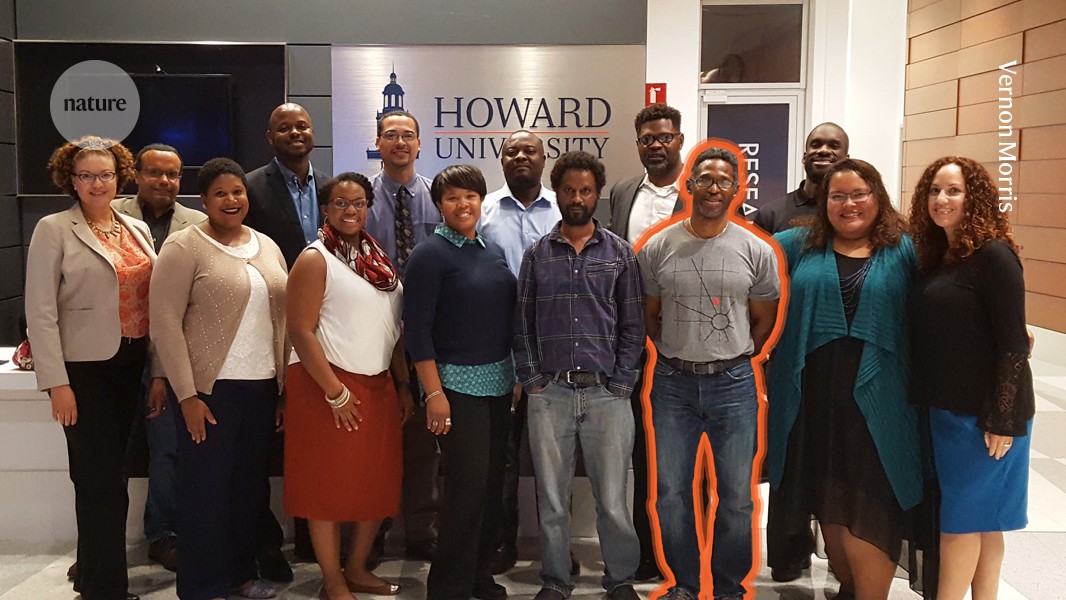

Vernon Morris (outlined) with alumni from the atmospheric sciences PhD programme he established at Howard University in Washington DC.Credit: Vernon Morris
When Vernon Morris earned his doctorate in Earth and atmospheric sciences in 1991 from the Georgia Institute of Technology in Atlanta, he was the first African American to do so, joining fewer than a dozen other Black atmospheric sciences PhD holders in the United States at that time.
From the get-go, Morris knew that something needed to change to create more opportunities for Black scientists in his field. In 2001, as a professor at Howard University in Washington DC, he became founding director of the first PhD-granting graduate programme in atmospheric sciences at a historically Black college and university (HBCU). Between 2006 and 2018, that programme produced at least 50% of African American and 30% of Latinx PhD graduates in atmospheric sciences in the United States.
A specialist in airborne particle processes, Morris studies long-range transport of mineral dust from desert regions and densely populated areas, such as megacities. His team’s work feeds into global and regional models of weather and climate that are used to make predictions in forecast models for hurricanes and tropical storms.
I encourage women to claim their space in astrophysics and beyond
For example, Morris studies microbial populations found on grains of desert sand transported from Africa to the Caribbean, and then on to the continental United States and South America. “We’re finding fairly rich microbial populations on those” grains, he says, and the populations “change as the surface chemistry changes”. These microorganisms can affect ecosystem health in the oceans or in soils where they are deposited, he notes. Understanding particle transport “can have domino effects in how we understand biogeochemistry and microbial exchange between continents”, he says.
Morris is now an associate dean for knowledge enterprise and strategic outcomes at Arizona State University in Tempe. Much as with particle transport, his influence on younger generations of scientists is far-reaching.
In 2023, Morris received the American Geophysical Union’s Lifetime Achievement Award for Diversity and Inclusion. He was recognized for having mentored more than 200 students and geoscientists of colour and for creating partnerships that benefited at least 1,000 undergraduate and graduate students. What’s more, he initiated No Time for Silence, a collaborative call to action for anti-racism in the geoscience community. Morris spoke to Nature about chasing dust storms and why science needs intellectual activists now more than ever.
What’s the coolest discovery or surprise that has occurred in your research?
Our understanding of aerosols has evolved a lot since I was a graduate student. At that time, researchers thought that aerosols didn’t even react. The particles might as well have been billiard balls moving back and forth, and were not thought to linger in the atmosphere long enough to affect any chemistry.
I had my white colleagues walk in a Black student’s shoes for a day
What we have found since is that the higher the resolution with which you can probe particles in the atmosphere, the more you can learn about them.
The fact that you have active microbial communities in dust storms was not known at the beginning of my career. A lot of the theories said that the microbes would die instead of being transported, because there’s too much radiation in the atmosphere and not enough moisture. There were all sorts of rationales that had nothing to do with direct observation.
We focused a lot of effort on going into and tracking dust storms in situ, and taking detailed measurements. We found from direct observations that a lot of the assumptions were just wrong.
How do you deal with criticism of your diversity, equity and inclusion (DEI) and anti-racism work?
I have always encountered criticism and scepticism with regards to inclusive practice. I have never allowed uninformed criticism to dictate my response, behaviour or expectations of the outcomes of my efforts.
But the criticism has been pretty constant.
Established leaders in the field were actively against setting up a graduate programme in atmospheric science at Howard. At the time, we were being actively challenged about whether there was significant interest in minoritized communities. Most of the established PhD programmes in atmospheric sciences had never admitted, let alone graduated, more than two African American, Puerto Rican or Native American students. I also think that we were suffering from a ‘three strikes’ prejudicial cynicism: we were all junior faculty members, we were all people of colour and we were at an HBCU, and not an exclusive research university. We were challenged by our critics to find 50 ‘competitive’ graduate students from minoritized communities. We found more than 200, all of whom attended a National Science Foundation-sponsored workshop at Howard.

The financial shackling of historically Black universities in the United States
There’s always pushback. When I give talks focused on critical analysis of data to show that there’s discrimination or racialization in certain practices and privileges in the scientific community, I’ve had people try to disrupt my presentations. When that happens, it’s mostly on me to stop the disruption because other people don’t usually intervene.
But I was bussed to school, aged 7, as part of efforts to reduce segregation by moving pupils around, and people were spitting at us and throwing trash. My parents were lifelong activists who led strikes, marches and protests. As an undergraduate in the 1980s, I took part in civil-rights demonstrations in Forsyth County, Georgia, at which people were hit in the head with rocks and bottles. I worked for the Voter Education Project in South Georgia to register Black and rural voters, and was literally run out of town. I’ve seen how bad it can get.
So, if someone’s trying to ask me a ‘gotcha’ question at a conference or a talk, it’s typically not going to get worse than that. It’s aimed at trying to intimidate or silence me, and I don’t intimidate easily.
What advice would you give to a 20-something researcher in your field?
Try to find the enjoyment in the creation or advancement of knowledge. Relishing the life of the mind is important. Don’t let someone else define your success for you.

