


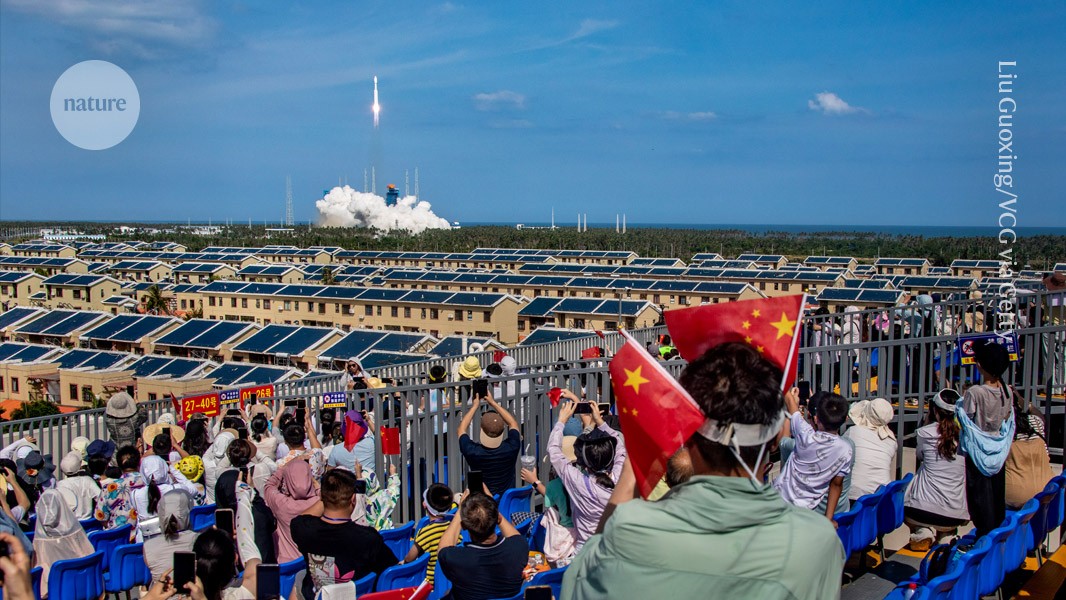

China produces the largest share of high-quality research for 66 technologies.Credit: Liu Guoxing/VCG via Getty
China is leading research in nearly 90% of the crucial technologies that “significantly enhance, or pose risks to, a country’s national interests”, according to a technology tracker run by the Australian Strategic Policy Institute (ASPI) — an independent think-tank.
The ASPI’s Critical Technology Tracker evaluated research on 74 current and emerging technologies this year, up from the 64 technologies it analyzed last year. China is ranked number one for research on 66 of the technologies, including nuclear energy, synthetic biology, small satellites, while the United States topped the remaining 8, including quantum computing and geoengineering.
The results reflect a drastic reversal. At the beginning of this century, the United States led more than 90% of the assessed technologies, whereas China led less than 5% of them, according to the 2024 edition of the tracker.
“China has made incredible progress on science and technology that is reflected in research and development, as well as in publications,” says Ilaria Mazzocco, who researches China’s industrial policy at the Center for Strategic and International Studies, a non-profit research organization based in Washington DC.
Mazzocco says the general trend identified by the ASPI is not a surprise, but it is “remarkable” to see that China is so dominant and advanced in so many fields compared with the United States.
This might have something to do with the type of technologies that are tracked, says Wang Yanbo, a science-policy researcher at the University of Hong Kong. The country is more likely to be a research leader in new technologies, where it has focused its efforts, compared to traditional fields where other country’s lead, such as semi conductor chips, he notes.
Tracking high-impact research
The ASPI team based its analysis on a database that contains more than nine million publications from all around the world. It ranked nations in each technology by identifying the top 10% of the most-cited papers produced by researchers in a country over a five-year period, between 2020 and 2024, and calculated that country’s global share.
One noteworthy finding is that China is outpacing the United States in cloud and edge computing, according to David Lin, a national security and technology strategist at the Special Competitive Studies Project, a non-profit organization based in Arlington, Virginia. Cloud computing enables artificial intelligence (AI) companies to train models and process data without the need for physical infrastructure, whereas edge computing processes data locally. China’s research intensity in these fields “probably reflects the urgency with which Beijing is moving AI from the lab into deployment”, Lin says.
The analysis should not be interpreted as “a collapse of American power”, says Steven Hai, a political economist focusing on technology innovation at Xi’an Jiaotong–Liverpool University in Suzhou, China. In general, the United States is still an important player globally in these technologies, Hai says.
Jenny Wong-Leung, a data scientist at ASPI who participated in the study, warns that the findings show democratic nations risk losing “hard-won, long-term advantages in cutting-edge science and research” in a range of essential sectors, which is the crucial for the development and advancement of the world’s most important technologies.

