


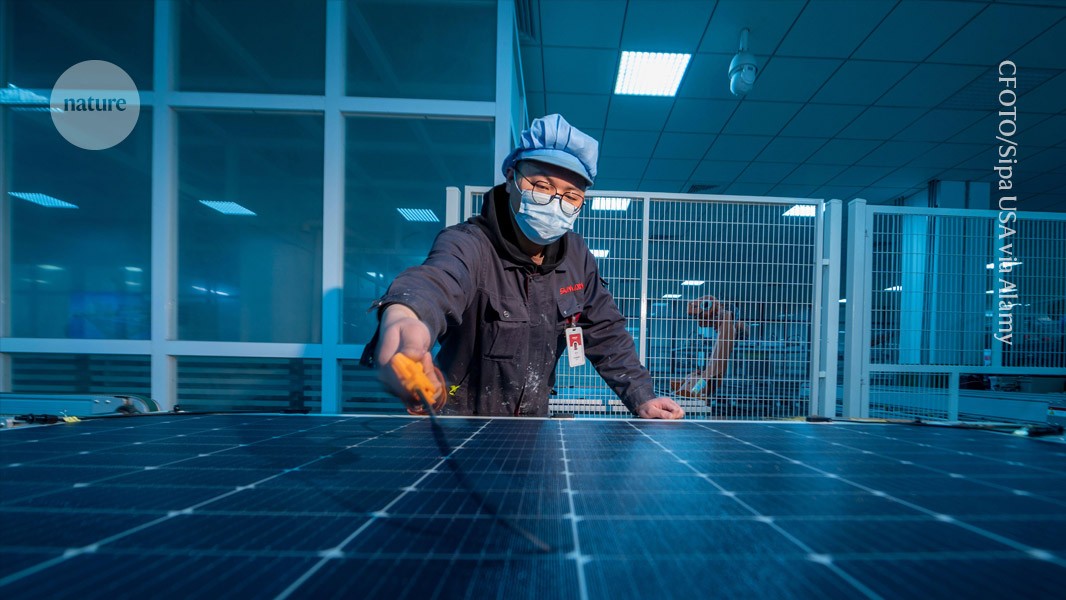

A technician in China works on an intelligent production line for solar photovoltaic modules.Credit: CFOTO/Sipa USA via Alamy
The clear divergence in approaches to public research funding in the East and West is laid bare in the first Nature Index ranking for applied sciences.
China dominates the ranking and other Asian countries, such as South Korea and Singapore, boast an outsized performance in the field for the scale of their overall research output. It’s a different story for many Western countries, however, which have a relatively small Nature Index output in the applied sciences.
The ranking is based on research articles published last year in 25 applied-sciences journals and conferences that, in a survey, were named by almost 4,200 researchers as venues where they would want to publish their ‘most significant’ work (see ‘Selecting applied-sciences journals and conferences for the Nature Index’). The venues, which include some new to the Nature Index and others already in the natural-science section of the database, span fields such as engineering, computer science and food science. Applied-sciences articles in multidisciplinary journals that are already part of the Nature Index — such as Nature and Science — also counted towards the results.
Researchers based in China contributed to 56% of the applied-sciences output included for the ranking, with a Share of 22,261 (the Nature Index metric Share is a fractional count of authorships of research articles). The United States is a distant second, with a Share of 4,099, which represents 10% of the applied-sciences research in 2024 (see ‘Applied measures’). The leading ten research institutions in applied sciences are also all based in China (see ‘Clean Sweep’).
South Korea, which was seventh in the Nature Index 2025 Research Leaders ranking — on the basis of articles published in 2024 in the 145 natural and health-sciences journals that make up the database — comes fourth in the applied-sciences ranking, with a Share of 1,342, representing 3.4% of global output in 2024. This is only marginally behind Germany, in third, which has a Share of 1,488. The United Kingdom, in fifth place, has a Share of 1,024, or 2.6% of global output, just ahead of Japan in sixth and India in seventh. France — a major force in the current configuration of the Nature Index, with an overall placing in this year’s Research Leaders of sixth — is twelfth for applied sciences.
This apparent East–West split for applied sciences is also evident when using the data to answer a slightly different question: what proportion of a country’s research output in the Nature Index is in applied sciences once the new journals are added?
For Malaysia, it is almost 90%, helping it to reach 31st place in the table (it did not make the Research Leaders top 50). For China, that figure stands at 52%; for South Korea it is 53% and for Singapore it is 49%. Compare that with Germany: only 27% of its Nature Index research is in the applied sciences. For the United Kingdom, the proportion is 23%, and for France and the United States it’s just under 18% (see ‘Applied measures’).
The performance of Asian countries in the applied sciences should come as no surprise, says Christos Petrou, chief analyst at the academic consultancy firm Scholarly Intelligence, based in Tokyo. “This is not an overnight success story,” he says. Instead, it follows a deliberate and concerted effort by governments to encourage and foster science that they have identified as likely to yield practical innovations in the near term, says Petrou. “They have been at it for several years.”
Fundamental versus applied
Part of this is down to a key difference in how some Asian and Western governments think about their national research priorities, says Rob Atkinson, president of the Information Technology & Innovation Foundation, a public-policy think tank in Washington DC.
Atkinson describes the United States as a “science society”, in which the government prioritizes fundamental research with the admirable, if lofty, aim of producing knowledge that benefits the world at large: science for science’s sake. By contrast, he characterizes China and South Korea as “engineering societies”, where public money is focused on advanced technology and manufacturing, and on producing knowledge to support industries deemed to be strategically important.
China, in particular, intentionally supports research that suits its economic goals, such as being a global centre for technology, computing and artificial intelligence. The country has become the main hub for the development of electric cars, for example, accounting for 70% of global production. And between 2014 and 2023, inventors based in China filed more than 38,000 generative-AI patents — six times more than inventors based in the United States.
“This is the result of strategic long-term thinking by China,” says Petrou. “You get an edge on the global stage by thriving in tech.”
Others in the science-policy world argue the opposite, saying that fundamental science provides the data and knowledge that private firms routinely exploit in developing new products, although the research is too expensive and risky for the companies themselves to take on.
“Basic sciences are a sort of reservoir of knowledge from which various applications can be drawn,” says So Young Kim, a science and technology policy researcher at the Korea Advanced Institute of Science and Technology in Daejeon. She says that academics have long investigated how fundamental science leads to economic growth in the form of “technological innovation, the creation of knowledge bases, training the next generation of scientists and engineers, and the development of new tools”.

