


Mice
All mouse studies complied with relevant ethics regulations and were approved by either the Genentech Institutional Animal Care and Use Committee (IACUC) in an Association for Assessment and Accreditation of Laboratory Animal Care (AAALAC)-accredited facility or by the Oregon Health and Science University IACUC. Mice were housed in individually ventilated cages within animal rooms maintained on a 14-h–10-h light–dark cycle. Animal rooms were temperature and humidity controlled, at 20–26 °C and 30–70%, respectively, with 10–15 exchanges of air in the room per hour. Rock1fl/flRock2fl/fl Villin.creERT2 mice on a C57BL/6J genetic background have been described previously35. Experimental cohorts of female mice were generated through two rounds of breeding: first Rock1fl/+Rock2fl/+ Villin.creERT2 mice were crossed to Rock1fl/+Rock2fl/+ mice, and then their offspring were bred together (either Rock1fl/flRock2fl/fl Villin.creERT2 × Rock1fl/flRock2fl/fl or Rock1+/+Rock2+/+ Villin.creERT2 × Rock1+/+Rock2+/+). Before infection with C. rodentium DBS100, mice aged 12–14 weeks (Extended Data Fig. 5h) or 5–8 weeks (Fig. 4i–k and Extended Data Fig. 5j) were treated by intraperitoneal injection with 75 mg kg−1 tamoxifen in sunflower oil for five consecutive days. Four hours after the final tamoxifen injection, mice were infected with C. rodentium. Mice were grouped by genotype or by treatment with no randomization. The C57BL/6J female mice in Extended Data Fig. 5i were from the Jackson Laboratory and were eight weeks old at the time of infection.
C. rodentium were streaked out from glycerol stocks on MacConkey agar plates at 37 °C overnight. A single colony was inoculated into 10 ml Luria broth (LB) and grown on a shaker at 37 °C overnight. The overnight culture was diluted 1:100 and grown to log phase (optical density at 600 nm (OD600 nm) of around 0.5 after approximately three hours). Bacteria were collected by centrifugation at 6,000g for 15 min, washed twice with phosphate-buffered saline (PBS) and prepared for infection by equalization to 1 × 10¹⁰ CFUs per ml (1 OD600 nm = 8 × 10⁸ bacteria per ml). Mice were fasted for four hours and then dosed by oral gavage with 5 × 10⁹ (Fig. 4i–k and Extended Data Fig. 5j) or 2 × 10⁹ (Extended Data Fig. 5h,i) CFUs of C. rodentium (strains described below). Mice had access to food and water ad libitum after infection. At six or ten days after infection, mice were euthanized and gastrointestinal samples, including colon and caecum, were collected. Tissues were resected and splayed open, and the luminal contents were removed and resuspended in pre-weighted tubes containing 1 ml PBS. Tissues were later washed with PBS to remove non-adherent bacteria. Colon, caecum or spleen homogenate was plated on MacConkey agar containing 100 mg ml−1 streptomycin (Extended Data Fig. 4e) or LB agar containing nalidixic acid (Fig. 4e) to determine CFUs. Mice were picked and treated by the same individual, so blinding to genotype and treatment as well as during data collection and analysis was not possible. No statistical methods were used to predetermine sample size.
Intestinal permeability assay
Female Rock1fl/flRock2fl/fl Villin.creERT2 mice and control Villin.creERT2 littermates, aged five to eight weeks, were administered tamoxifen intraperitoneally at a dose of 90 mg kg−1 in sunflower oil for five consecutive days. Mice underwent food restriction for 12 h before receiving a 600 mg kg−1 oral gavage of 4 kDa FITC–dextran. Four hours later, blood and faecal pellets were collected, and FITC fluorescence (485/528 nm ex/em) was measured.
Bacteria
EHEC O157:H7 EDL933 (ATCC700927) and C. rodentium DBS100 (ATCC51459) were obtained from the American Type Culture Collection (ATCC). A nalidixic-acid-resistant strain was derived from DBS100 by first growing 1 ml DBS100 overnight. The culture was centrifuged, resuspended in 100 µl PBS and plated on LB agar containing 30 µg ml−1 nalidixic acid. This resistant strain was used to generate the nleL mutant. The E. coli and C. rodentium nleL open reading frame (ORF) was replaced with a kanamycin resistance cassette from the pACYC177 vector using lambda red recombinase expressed by pKD46 (refs. 36,37). Gene replacement was verified by colony PCR (E. coli ΔnleL::kanR), and whole-genome sequencing (C. rodentium DBS100 WT and C. rodentium DBS100ΔnleL::kanR). The C. rodentium DBS100 WT assembly was generated using a combination of 75-bp paired-end Illumina reads and Oxford Nanopore Technologies long reads from isolate-derived total genomic DNA. The assembly and polishing of the combined long- and short-read data were performed using MicroPIPE v.0.9 (ref. 38). Illumina reads were mapped onto the C. rodentium DBS100 WT genome using GSNAP (v.2013-10-10)39. Single-nucleotide variants were detected using in-house R scripts, which used the Bioconductor packages GenomicRanges40, GenomicAlignments40 VariantTools and gmapR. Only base calls with a phred quality score of at least 30 were used for variant calling. Knockout of nleL was confirmed by visual inspection of read pile-ups using the Integrative Genomics Viewer41. Bacteria were transformed by electroporation with the pBR322-AmpR-dasherGFP plasmid11 to visualize bacteria, and complementation of C.r.ΔnleL::kanR was achieved by transformation of the mutant strain with pBR322-GentR-nleL-COMP.
The primers used to generate recombineering insertions (5′ to 3′) include:
C.r.DBS100_NleLF1: ACAGGCAGAACTGGAGAATG
C.r.DBS100_NleLR1: GGGCGATTCAGGCCTGGTTTATCGCACTCCTTCTACTTAG
C.r.DBS100_NleLkanF1: CTAAGTAGAAGGAGTGCGATAAACCAGGCCTGAATCGCCC
C.r.DBS100_NleLkanR1: ATAATATTCATCTATGGTCTCTAAAacaaccaattaaccaa
C.r.DBS100_NleLF2: ttggttaattggttgtTTTAGAGACCATAGATGAATATTAT
C.r.DBS100_NleLR2: AATAACGAACATAATTTTCG
EDL933_NleLF1: TACAGGGACAGAAAGTTGTCC
EDL933_NleLR1: GGGCGATTCAGGCCTGGTAGAACTACAATGGCATAAAGAT
EDL933_NleLkanF1: ATCTTTATGCCATTGTAGTTCTACCAGGCCTGAATCGCCC
EDL933_NleLkanR1: ATAATATTCATCCATGGTCTCTAAAacaaccaattaaccaa
EDL933_NleLF2: ttggttaattggttgtTTTAGAGACCATGGATGAATATTAT
EDL933_NleLR2: TATGATTCTCCACGATTTGC
Outside primers to check insertion include:
C.r.DBS100_NleL_OUTF: GCTGGATGAAGTGGGCAGTGA
C.r.DBS100_NleL_OUTR: TCTCCACGATTTGTCCAG
EDL933_NleL_OUTF: AATCTGACATCTTATTTGTGGG
EDL933_NleL_OUTR: CTATAGTAACAAAAACATATTAATCTG
Cell culture
EA.hy926 (ATCC), 293T (ATCC), HT-29 (ATCC) and Caco-2 (ATCC) cells were cultured in Dulbecco’s modified Eagle’s high-glucose medium (DMEM) supplemented with 10 mM HEPES pH 7.4, 1× Glutamax (Gibco), 1× penicillin–streptomycin (Gibco), 1× non-essential amino acids (Gibco), 1 mM sodium pyruvate (Gibco) and 10% (v/v) fetal bovine serum (FBS, VWR) at 37 °C with 5% CO2. Single-nucleotide polymorphism (SNP) profiles were compared with SNP calls from internal and external databases to determine or confirm ancestry. All cell lines tested negative for mycoplasma contamination before to storage or use at our institute.
For Caco-2 infections, bacteria were streaked from glycerol stocks onto trypticase soy agar (TSA) and used for experiments within one week. Caco-2 cells (3.5 × 10⁵) were plated in six-well plates in antibiotic-free DMEM. On the same day, a single colony of the desired strain was grown at 37 °C overnight in 5 ml terrific broth (TB). Overnight cultures were diluted 1:50 in TB and grown until bacteria reached an OD600 nm of 0.6–0.8. Bacteria were pelleted at 3,000g, washed with PBS and then incubated in fresh PBS at room temperature for 15 min. After one further wash with PBS, bacteria were resuspended in DMEM without supplements. Caco-2 cells were infected with an MOI of 25 (1 OD600 nm = 8 × 10⁸ bacteria per ml) by centrifugation at 1,000g for 10 min.
Intestinal organoids from C57BL/6J mice, or Rock1fl/flRock2fl/fl Villin.creERT2 mice and control Villin.creERT2 mice, were generated as described35. After 2–15 passages, organoids were disrupted into single-cell suspensions. IEC monolayers were established by seeding 50,000–60,000 cells into translucent 24-well Matrigel-coated transwell inserts with a pore size of 0.4 µm in organoid medium42 (L-WRN conditioned supernatant, 10 µm Y-27632 (MedChemExpress) and 50 ng ml−1 mEGF (Thermo Fisher Scientific)). Cultures were grown for ten days. For ERT2-Cre induction, cells were treated 48 h before the experiment with 250 nM 4-OHT. Transwells were transitioned to antibiotic-free medium without Y-27632 the day before infection. Monolayers were infected with C. rodentium (WT or ΔnleL) in the exponential growth phase at an MOI of 0.25. After four hours, the medium was changed to prevent the overgrowth of non-adherent bacteria. After a further 16 h, the cells were treated with 10 µg ml−1 PI (or 50 nM SYTOX green) for 30 min, washed with PBS and then fixed in 4% paraformaldehyde for 10 min. The fixed cells were permeabilized with 0.2% Triton X-100 and stained with 4′,6-diamidino-2-phenylindole (DAPI) and 0.165 µM AF647–phalloidin (Thermo Fisher Scientific).
IEC monolayers for experiments with FlaTox were grown identically and Y-27632 was removed 24 h before FlaTox treatment. For Villin.creERT2 monolayers, 250 nM 4-OHT was administered 48 h before stimulation. Monolayers were administered 2 mg ml−1 anthrax lethal factor N terminus fused to Legionella pneumophila flagellin (LFn-FlaA)34, 4 mg ml−1 protective antigen34 (PA) and 10 μg ml−1 PI (or 50 nM SYTOX green). The medium contained 10 µM Y-27632 or 2.5 mM cytochalasin D (Sigma) as indicated. Monolayers were fixed after 30 min and stained with DAPI as described above. For imaging, transwell membranes were cut out with a razor blade, placed on a microscopy slide, layered with Vectashield hardening mounting medium and coverslipped.
For transparent monolayers, TrypLE-dissociated organoids were seeded on Matrigel-covered 96-well tissue culture plates at 30,000 cells per well in 50% L-WRN conditioned supernatant containing 3 µM CHIR99021 (Cayman Chemical) and 10 μM Y-27632 (MedChemExpress)43. Twenty-four hours later, the medium was changed to antibiotic-free L-WRN with 3 µM CHIR99021 without Y-27632. Forty-eight hours later, monolayers were infected with 1 × 10⁴ C. rodentium ΔnleL or ΔnleL + pNleL after overnight culture and redilution for exponential growth. Plates were spun at 300g for 10 min to help with epithelial attachment of bacteria and then incubated overnight at 37 °C and 5% CO2. After 11 h of infection, the wells were washed once with warm PBS and new medium was added containing 1 μg ml−1 PI.
IEC imaging and cell-extrusion analysis
Fixed IEC monolayers on transwells were imaged on an inverted Leica SP8 confocal microscope using a 40× oil (numerical aperture 1.3) objective. Imaging parameters on the Leica LAS X (v.3.7.5) software were set to acquire DAPI, PI, SYTOX green and GFP (bacteria). Three-dimensional (3D) confocal z-stacks were acquired using Nyquist sampling rates. Six to seven fields of view were acquired for each sample. The 3D datasets were processed and analysed using the Imaris Spots tool to quantify cellular extrusion levels. In brief, a Gaussian blur image filter was first applied to all channels to reduce background noise. Afterwards, the Imaris Spots tool was used to segment and isolate DAPI- and PI-positive or SYTOX-green-positive cells (PI+DAPI+ or SYTOX+DAPI+) from the 3D image stacks. A low threshold intensity was set for the PI and SYTOX channel so that both infected and uninfected cells were segmented using the Imaris Spots tool. After segmentation, the shortest distance metric in Imaris was used to calculate the distance between the centroids of a PI+ or SYTOX+ spot and the closest DAPI+ spot. A batch Imaris run to segment spots of DAPI+ and PI+ or SYTOX+ cells was performed using identical segmentation parameters. The shortest distance metric was then extracted and used for quantification of the cell-extrusion analysis of all samples. Bacteria exhibiting GFP signals were filtered out by segmenting and masking them using a pixel classifier in Imaris. After this masking procedure, the shortest distance between SYTOX-green-positive cells and DAPI-positive cells was measured to analyse extrusion events, as detailed above.
For live imaging of transparent monolayers, plates were imaged for two hours in a live imaging set-up (Celldiscoverer 7), recording oblique/bright-field and red fluorescence with a Hammamastu Orca Flash 4.0 camera. Images were taken using the 5×/0.35 NA objective with the addition of the 2× optovar. Images were collected on the Celldiscoverer 7 in intervals of 60 s with the exposure and light source intensity of oblique and red channels set at 5 ms and 15%, and 50 ms and 30%, respectively. Focus was maintained throughout the time-lapse using the Zeiss definite focus system. Extrusion was quantified in a blinded manner, by recording the time from the first noticeable changes in cell shape to the finished extrusion of PI-positive cells in the bright-field/oblique channel.
IL-18 enzyme-linked immunosorbent assay (ELISA)
One hundred microlitres of medium from transwell infection experiments, collected immediately before infected monolayers were fixed for microscopy, was analysed with mouse IL-18 DuoSet ELISA (R&D Systems DY7625-05) according to the manufacturer’s instructions and quantified using a standard curve. Untreated medium background was subtracted.
CytoTox-Glo viability assay
Twenty-five microlitres of supernatant medium, collected immediately before infected monolayers were fixed for microscopy, was mixed with 12.5 µl of CytoTox-Glo reagent (Promega) and incubated for 15 min at room temperature. The luminescence was assessed as per the manufacturer’s recommendations. Untreated medium background was subtracted.
Transepithelial electrical resistance assay
Medium was exchanged on monolayers on the day of infection and they were allowed to equilibrate for 20 min at room temperature. Transepithelial resistance was recorded in each transwell with an epithelial voltohmmeter (EVOM2, World Precision Instruments). The background resistance of an empty transwell with medium was subtracted.
Plasmids and lentiviral vectors
The genetically barcoded E. coli effector library was maintained in the lentiviral vector pMIN-ducer (Genscript). cDNAs encoding N-terminal 3×Flag-NleL, NleL(C753A), the PPR domain (amino acids (aa) 135–371), or the NEL domain (aa 372–782) were expressed using pMIN-ducer or pCDNA3.1Hygro(+) (Genscript). cDNAs encoding Myc–GST-tagged CARDs (Extended Data Table 2) were cloned into pCDNA3.1:Zeo(+) (Genscript). cDNAs encoding C-terminal Rho-1D4-tagged caspase-1, caspase-4 or caspase-1/4 CARD swap chimeras (aa 1–80, 1–10, 6–15, 11–20, 16–25 and 21–30) were cloned into pCDNA3.1Hygro(+) (Genscript). cDNAs encoding C-terminal Rho-1D4-tagged ROCK1, ROCK2, ROCK2ΔPH (aa 1–1,141), ROCK2-PH (aa 1,142–1,354) and C-terminal truncations (20 aa from Δ20–240) were cloned into pCDNA3.1Hygro(+) (Genscript). For transient expression in 293T cells, 3 × 10⁶ cells were plated in 10-cm dishes and transfected the next day with 3 µg of pCDNA3.1Zeo(+) total plasmid DNA using Lipofectamine 2000 (Thermo Fisher Scientific). Proteins were expressed for 24 h before being collected for downstream manipulations.
For lentiviral packaging, 2.5 × 10⁶ 293T cells in 10-cm plates were transfected with 5 µg pMIN-ducer, 10 µg pCMV-Δ8.9 and 0.5 µg pCMV-VSVG (1:2.3:0.2 mole ratio). Virus-containing supernatants were collected after 72 h, passed through 0.45-μm syringe filters and used immediately for infection of EA.hy926, Caco-2 or HT-29 cells (2 × 10⁵ cells seeded into six-well plates the previous day). Virus was supplemented with 10 µg ml−1 polybrene (Millipore) during infections. After 48 h, transduced cells were selected with 4 µg ml−1 puromycin (Takara). Mock-infected cells were used to judge selection duration and efficiency.
Positive selection screen
The lentiviral library was packaged using 12 15-cm plates of 293T cells. Each plate (2.7 × 10⁷ cells) was transfected with 50.8 µg DNA (library plasmid, pCMV-Δ8.9 and pCMV-VSVG plasmids at a molar ratio of 1:2:0.2) using Lipofectamine 2000 reagent (Thermo Fisher Scientific). At six hours after transfection, the medium containing the transfection mix was replaced with fresh medium supplemented with 1 U ml−1 DNase I, 5 mM MgCl2 and 20 mM HEPES pH 7.2. After overnight culture at 37 °C, this medium was replaced with fresh medium. After another 24 h, the lentivirus-containing medium was collected, pooled, passed through a 0.45 µm filter and concentrated by ultracentrifugation (Thermo Fisher Scientific, S50-A fixed angle rotor, 100,000g). Concentrated lentivirus was resuspended in PBS containing 1% bovine serum albumin (BSA) and aliquots were stored at −80 °C.
EA.hy926 cells were infected at an MOI of 0.3 to ensure a single integrant frequency of 97% with 1,000-fold coverage. On day 1, EA.hy926 cells were seeded into two 10-cm plates (1.2 × 10⁶ cells each). On day 2, cells were infected with lentivirus diluted in DMEM supplemented with 10 µg ml−1 polybrene (Millipore). On day 3, virus-containing medium was replaced with fresh DMEM. On day 4, cells were expanded into a 15-cm plate. On day 5, antibiotic selection was initiated with DMEM containing 2 µg ml−1 puromycin (Takara). After a further five days, cells were expanded into four 15-cm plates with antibiotic-free DMEM, and cultured for two days.
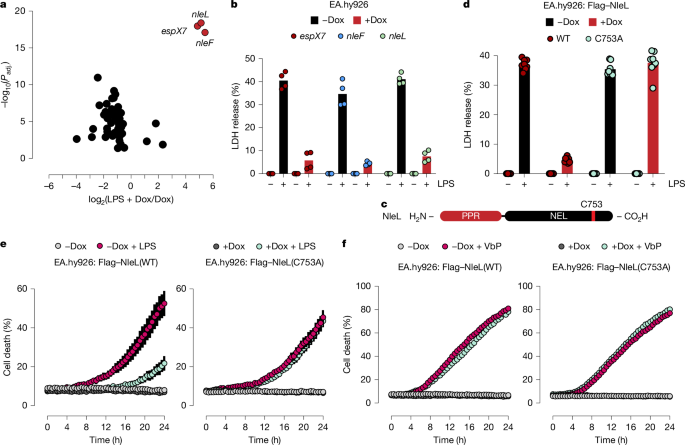
For LPS screens, EA.hy926 containing the E. coli effector library were seeded into six 15-cm plates (1.5 × 10⁶ cells per plate). E. coli effectors were induced with 250 ng ml−1 doxycycline for 48 h. For each plate, cells were lifted with TrypLE Express (Thermo Fisher Scientific), washed with PBS, resuspended in 110 µl Buffer R (Neon, Thermo Fisher Scientific) and electroporated (three plates with and three plates without 7 µg LPS) using the Neon Transfection System 100 µl kit. Electroporated cells were washed with PBS and plated in six-well dishes containing fresh DMEM. Electroporated control cells were passaged until LPS-electroporated cells recovered. After 11 days, genomic DNA was isolated from LPS-resistant and control cells using the Gentra Puregene Cell kit (QIAGEN). The barcoded regions were amplified by PCR and then sequenced by next-generation sequencing.
Next-generation sequencing and analysis
For submitted PCR amplicons, 40 ng DNA was used to generate sequencing libraries with the KAPA HyperPrep kit (Roche) that incorporated custom adapters and library amplification PCR primers from Integrated DNA Technologies. Amplicon libraries were quantified and the average library size was determined using the NGS Fragment kit in Fragment Analyzer (Agilent Technologies). Libraries were pooled and the Qubit dsDNA HS Assay kit (Thermo Fisher Scientific) was used to quantify the pool. Library pools were sequenced on a HiSeq 2500 (Illumina) to generate a minimum of three million paired-end 75-base-pair reads for each sample. A sample ORF matrix was generated by counting exact matches of ORF barcodes in the sample FASTQ files. The count matrix was normalized by library-size-based factors. Differentially enriched ORFs were identified using DESeq2 (ref. 44) by comparing LPS-treated cells with control cells.
Cell assays
For EA.hy926 cell death assays, 8 × 10³ cells per well were seeded into 96-well plates. The following day, cells were treated with 250 ng ml−1 doxycycline (Takara). After a further 24 h, cells were transfected with ultra-pure E. coli O111:B4 LPS (0.5 µg per well, InvivoGen) using Lipofectamine LTX transfection reagent (0.2 µl per well, Thermo Fisher Scientific), or treated with 25 µM Val-boroPro (Millipore) for 24 h. LDH release was measured by CytoTox Non-radioactive Cytotoxicity Assay (Promega). Cells were cultured with the membrane-impermeable nuclear dye YOYO-1 (Thermo Fisher Scientific) to determine the kinetics of cell death. Cells were imaged every 30 min for 24 h in an IncuCyte S3 (Essen BioScience, 10× objective). Nuclear-ID (Enzo) was added to cultures after the last time point to quantify total cell numbers. Image quantification was performed using Incucyte Base Analysis software. Results were plotted as the percentage of YOYO-1+ cells within the total population.
Immunoblotting and immunoprecipitation
Cells were washed with PBS and lysed in RIPA buffer (25 mM Tris HCl pH 7.6, 150 mM NaCl, 1% NP-40, 1% sodium deoxycholate and 0.1% SDS) supplemented with protease inhibitors (Halt, Thermo Fisher Scientific). Lysates were clarified by centrifugation at 20,000g for 30 min. For immunoprecipitation, soluble lysates were incubated with 20 µl Flag-M2–sepharose (MilliporeSigma), Rho-1D4–sepharose (Rho-1D4 Ab, University of British Columbia, coupled to cyanogen bromide-activated sepharose beads, GE Healthcare) or GST–sepharose (MilliporeSigma) for one hour at 4 °C. Beads were washed with lysis buffer, and captured proteins were eluted with 100 µg ml−1 3×Flag peptide (MilliporeSigma), 10 mM reduced glutathione peptide (MilliporeSigma) or 250 µM Rho-1D4 peptide (TETSQVAPA, Genscript) overnight at 4 °C.
Antibodies
Antibodies recognized actin (clone C4, MP Bio, 0.1 µg ml−1), β-tubulin (ab15568, abcam, 0.1 µg ml−1), Myc tag (9B11, Cell Signaling Technology, 1 µg ml−1), Flag epitope (M2-HRP, Sigma-Aldrich, 1 µg ml−1) ROCK1 (Cell Signaling Technology, 1 µg ml−1), ROCK2 (Cell Signaling Technology, 1 µg ml−1), phospho-MLC2 (Cell Signaling Technology, 1 µg ml−1), p66β (Bethyl, 1 µg ml−1), Rho-1D4 (Novus, 1 µg ml−1), ubiquitin (VU-1, LifeSensors, 1 µg ml−1), K11-linked polyubiquitin45, K48-linked polyubiquitin46 and K63-linked polyubiquitin46 (1 µg ml−1).
Identification of NleL substrates
Proteomic analyses were performed on EA.hy926 expressing doxycycline-inducible 3×Flag-NleL. Cells were treated with doxycycline for zero, one, two, four or six hours (in duplicate except for the one-hour treatment), and collected by scraping into 50 mM HEPES pH 8.5, 9 M urea, 150 mM NaCl and protease inhibitors (Roche). Lysates were rotated end-over-end at room temperature for one hour, and then centrifuged at 15,000g for 20 min. Soluble lysate containing 20 mg protein was reduced (5 mM dithiothreitol (DTT), 45 min at 37 °C), alkylated (15 mM iodoacetamide (IAA), 20 min at room temperature in the dark) and quenched (5 mM DTT, 15 min at room temperature in the dark). Proteins were pelleted by chloroform–methanol precipitation, resuspended in 8 M urea, 20 mM HEPES, pH 8.0, diluted to 4 M urea and digested for four hours at 37 °C with lysyl endopeptidase (Wako) at an enzyme-to-protein ratio of 1:100. The sample was diluted further to 1.3 M urea and subjected to overnight enzymatic digestion at 37 °C with sequencing-grade trypsin (Promega) at an enzyme-to-protein ratio of 1:50. The peptides were acidified with 20% trifluoroacetic acid (TFA, final concentration 1%), centrifuged at 18,000g for 15 min and desalted using a Sep-Pak C18 column (Waters).
Approximately 500 µg of eluted peptides from each treatment was lyophilized and reserved for global proteome abundance. The remaining eluted peptides were lyophilized and used for K-ε-GG analysis. For global proteome samples, 100 µg of peptides from each sample was dissolved in 20 mM HEPES pH 8.0 at 1 mg ml−1. Isobaric labelling was performed using TMT11-plex reagents (Thermo Fisher Scientific). Each unit (0.8 mg) of TMT reagent was allowed to reach room temperature immediately before use, pelleted in a benchtop centrifuge and resuspended with occasional vortexing in 41 µl anhydrous acetonitrile (ACN) before mixing with peptides (29% final ACN concentration). After incubation at room temperature for one hour, the reaction was quenched for 15 min with 20 µl of 5% hydroxylamine. Labelled peptides were combined in equimolar ratios and dried. The TMT-labelled sample was re-dissolved in 80 µl 0.1% TFA and centrifuged at 16,000g, and the supernatant was processed further. Offline high-pH reversed-phase fractionation was performed on a 1100 HPLC system (Agilent) using an ammonium formate buffer system. Peptides (400 µg) were loaded onto a 2.1 × 150 mm, 3.5-µm 300 Extend-C18 Zorbax column (Agilent) and separated over a 75-min gradient from 5% to 85% ACN into 96 fractions (flow rate = 200 µl per min). The fractions were concatenated into 24 fractions, mixing different parts of the gradient to produce samples that would be orthogonal to downstream low pH reversed-phase LC–MS/MS. Fractions were dried and desalted using C18 stage-tips as described47. Peptides were lyophilized and resuspended in buffer A (2% ACN and 0.1% formic acid) for LC–MS/MS analysis.
For quantification of K-ε-GG peptides, lyophilized peptides were reconstituted in 1× detergent containing IAP buffer (Cell Signaling Technology) for immunoaffinity enrichment. Enrichment for K-ε-GG peptides was performed at 4 °C on a MEA2 automated purification system (PhyNexus) using 1 ml PhyTips (PhyNexus) packed with 20 µl ProPlus resin coupled to 200 µg of anti-K-ε-GG (Cell Signaling Technology) antibody. PhyTip columns were equilibrated for two cycles (one cycle = aspiration and dispensing, 0.9 ml, 0.5 ml min−1) with 1 ml 1× IAP buffer before contact with peptides. PhyTip columns were incubated with peptides for 16 cycles of capture, followed by 6 cycles of wash, twice with 1 ml 1× IAP buffer and 4 times with 1 ml water. Captured peptides were eluted with 60 µl 0.15% TFA in eight cycles in which the volume aspirated or dispensed was adjusted to 60 µl. Enriched ubiquitylated peptides were prepared as described48. Labelled peptides were combined, dried and resolubilized in 0.15% TFA for high-pH reversed-phase fractionation using a commercially available kit (Thermo Fisher Scientific). Fractionation was performed with a modified elution scheme in which 11 fractions were collected (F1, 13.5% ACN; F2, 15% ACN; F3, 16.25% ACN; F4, 17.5 ACN; F5, 20% ACN; F6, 21.5% ACN; F7, 22.5% ACN; F8, 23.75% ACN; F9, 25% ACN; F10, 27.5% ACN; and F11, 30% ACN) and then combined into 6 fractions (F1 + F6, F2 + F7, F8, F3 + F9, F4 + F10 and F5 + F11). Peptides were lyophilized and resuspended in 10 µl buffer A for LC–MS/MS analysis.
Mass spectrometry
LC–MS/MS analysis was performed by injecting 5 µl of each fraction on an Orbitrap Lumos mass spectrometer (Thermo Fisher Scientific) coupled to a Dionex Ultimate 3000 RSLC (Thermo Fisher Scientific) using a 25-cm IonOpticks Aurora Series column (IonOpticks) with a gradient of 2% to 30% buffer B (98% ACN, 2% H2O with 0.1% FA, flow rate = 300 nl per min). All samples were analysed with a total run time of 180 min. The Orbitrap Lumos collected FTMS1 scans at 120,000 resolution with an AGC target of 1 × 10⁶ and a maximum injection time of 50 ms. FTMS2 scans on precursors with charge states of 3–6 were collected at 15,000 resolution with CID fragmentation at a normalized collision energy of 35%, an AGC target of 2 × 10⁴ (proteome) or 2 × 10⁵ (K-ε-GG) and a max injection time of 100 ms (proteome) or 200 ms (K-ε-GG). Synchronous precursor selection (SPS) MS3 scans were analysed in the Orbitrap at 50,000 resolution with the top eight most intense ions in the MS2 spectrum subjected to HCD fragmentation at a normalized collision energy of 55%, an AGC target of 2 × 10⁵ and a max injection time of 100 ms (proteome) or 350 ms (K-ε-GG).
MS data were searched using Mascot against a concatenated target–decoy human database (downloaded August 2017) containing common contaminant sequences, and the protein sequence of E. coli NleL ligase with a precursor mass tolerance of 50 ppm, 0.8 Da fragment ion tolerance and tryptic specificity up to 2 (proteome) or 3 missed cleavages (K-ε-GG). For global proteome analysis, the following modifications were considered: carbamidomethyl cysteine (+57.0214), TMT-labelled N terminus (+229.1629) and TMT-labelled lysine (+229.1629) as static modifications, and oxidized methionine (+15.9949) and TMT-labelled tyrosine (+229.1629) as variable modifications. For analysis of K-ε-GG peptides, TMT-labelled diglycine-modified lysine (+343.2059) was also included as a variable modification. Peptide spectral matches for each run were filtered using linear discriminant analysis to an FDR of 2% and subsequently in aggregate to a protein-level FDR of 2%. TMT-MS3 quantification was performed using Mojave, and only peptide-spectrum matches (PSMs) that had isolation specificities greater than or equal to 0.5 were considered for the final dataset. The abundance of ubiquitylation on each peptide or each identified protein was estimated by using a model fitted with Tukey median polish summarization with imputation of missing values below a censoring threshold of 28. For each pairwise comparison, the change in abundance (log2 ‘fold’ values) and the results of an ANOVA test were reported. We used the implementation of these methods in MSstats v.3.16.0 (ref. 49). Data were further processed in R to produce figures.
Protein expression and purification
E. coli NleL S170-R782 WT/C357A constructs were expressed as N-terminal His fusion constructs in E. coli Rosetta 2 (Millipore). Bacterial cell pellets were frozen and stored at −80 °C. Cells were resuspended in lysis buffer (50 mM Tris pH 8.0, 200 mM NaCl, 5 % glycerol, 5 mM MgCl2, 1 mM TCEP or 2 mM 2-mercaptoethanol, plus protease inhibitors (Roche), DNase and lysozyme) and lysed by microfluidization, and the lysate was clarified by centrifugation at 20,000g for one hour. The soluble lysate was passed through a 2-µm filter. NTA Superflow resin (QUIAGEN) or TALON Superflow (GE Healthcare) were used for affinity purification. The resin was incubated with the clarified lysate at 4 °C for one hour and then washed with up to 2 l of wash buffer (50 mM Tris pH 8.0, 200 mM NaCl, 5 % glycerol and 1 mM TCEP or 2 mM 2-mercaptoethanol). Proteins were eluted in wash buffer supplemented with 250 mM imidazole pH 8.0 (Sigma). NleL proteins were concentrated and purified by size-exclusion chromatography using a Superdex 200 column (GE Healthcare) pre-equilibrated with 50 mM Tris pH 8.0, 300 mM NaCl, 5% glycerol and 1 mM TCEP. Pure-protein-containing fractions were pooled, concentrated and stored at −80 °C.
C-terminal 1D4-tagged human caspase-4 (full length 1–377), human ROCK1 (full length 1–1,354) and human ROCK2 (full length 1–1,388, kinase domain 1–409, PH domain 1,142–1,388) were purified from 293T cells. Cell pellets were resuspended in 10 mM HEPES pH 7.4, 150 mM NaCl, 10% glycerol, 1 mM MgCl2, 1 mM TCEP containing protease inhibitor cocktail (Halt) and benzonase. Lysates were clarified by centrifugation at 20,000g for 30 min at 4 °C. 1D4–sepharose was used for purification. Lysates were incubated with resin for one hour at 4 °C and washed three times with lysis buffer. Proteins were eluted with 25 μM 1D4 peptide in 10 mM HEPES pH 7.4, 150 mM NaCl, 10% glycerol, 1 mM MgCl2 and 1 mM TCEP.
In vitro ubiquitylation assays
Reactions contained 2.5 ng µl−1 human E1 enzyme (Boston Biochem), 0.125 µg µl−1 ubiquitin (Boston Biochem), 0.01 µg µl−1 Ube2D3 (Boston Biochem), 0.01 µg µl−1 NleL, 0.1 µg µl−1 human caspase-4, ROCK1 or ROCK2, 50 mM Tris pH 8.0, 50 mM NaCl, 5 mM MgCl2 and 0.1 mM DTT. Reactions were initiated with 5 mM ATP, incubated at 37 °C and quenched with LDS sample loading buffer (Thermo Fisher Scientific).
Statistics
P value calculations for the mass spectrometry analyses in Fig. 2a are described above. All other statistical analyses were performed using GraphPad Prism v.9 and v.10.4.2.
Reporting summary
Further information on research design is available in the Nature Portfolio Reporting Summary linked to this article.

