


General materials
Common reagents and chemicals were purchased from MilliporeSigma unless stated otherwise. The 2,4-dinitrochlorobenzene (CAS number 97-00-7), tert-butyl bromoacetate (CAS 5292-43-3), N-hydroxysuccinimide (CAS 6066-82-6), N,N′-dicyclohexylcarbodiimide (CAS 538-75-0), Celite 545 (CAS 68855-54-9), ethyl 2-bromoacetate (CAS 105-36-2) and 1-(2-aminoethyl)maleimide hydrochloride (CAS 134272-64-3) were purchased from MilliporeSigma. The 2-[2-(2-aminoethoxy)ethoxy]ethanol (CAS 86770-74-3), biotin-PEG3-amine (CAS 359860-27-8), 2-(furan-2-yl)-7H-pyrazolo[4,3-e][1,2,4]triazolo[1,5-c]pyrimidin-5-amine (CAS. 288-13-1) and 4-[3-(trifluoromethyl)-3H-diazirine-3-yl]benzylamine hydrochloride (CAS 1258874-29-1) were purchased from Ambeed. Triethylamine (CAS 121-44-8) was purchased from Thermo Fischer Scientific. Dithiothreitol (DTT, CAS 3483-12-3), isopropyl-β-thiogalactopyranoside (IPTG, CAS 367-93-1) and bovine serum albumin (BSA) were obtained from Gold Biotechnology. Alexa Fluor 594 C5 maleimide, biotin-PEG3-NHS ester (CAS 1253286-56-4), hydroxy-PEG10-tert-butyl ester (CAS 778596-26-2) and chloroacetamido-PEG4-NHS ester (CAS 1353011-95-6) were purchased from BroadPharm. Biotin maleimide (CAS 116919-18-7) was purchased from MilliporeSigma. Alexa Fluor 568 DBCO was purchased from Lumiprobe.
Oligonucleotide primers were purchased from MilliporeSigma. The gBlock gene fragments were purchased from Integrated DNA Technologies. PrimeSTAR HS DNA polymerase was purchased from Takara Bio. Gibson Assembly Master Mix and the restriction enzymes NheI, NotI and T7 DNA Ligase were purchased from New England Biolabs. DNA purification kits were purchased from Qiagen. PCR purification and gel extract columns were purchased from Thomas Scientific. All the plasmid sequencing was done by GENEWIZ or Plasmidsaurus. DH5α competent cells and One Shot Stbl3 chemically competent Escherichia coli cells were purchased from Thermo Fisher Scientific. SHuffle T7 competent E. coli cells were purchased from New England Biolabs. Plasmids for lentiviral preparations were obtained from Addgene.
Nickel nitrilotriacetic acid (Ni-NTA) resin was obtained from Thermo Fisher Scientific. MOPS-SDS running buffer was obtained from Boston Bioproducts. Criterion cassettes, acrylamide, ammonium persulfate, tetramethylethylenediamine and Econo-Pac 10DG columns were obtained from Bio-Rad. Nitrocellulose membrane (0.45 μm) for western blotting was purchased from Thermo Fisher Scientific. Empore solid-phase extraction stage tips were purchased from Thermo Fisher Scientific.
Primary antibodies were purchased from Santa Cruz Biotechnology, Abcam, Cell Signaling Technology, Thermo Fisher Scientific and MilliporeSigma. Secondary antibodies were purchased from LI-COR Biotechnology.
NeutrAvidin Rhodamine Red-X and Streptavidin-Alexa Fluor 546 conjugates were purchased from Thermo Fischer Scientific. Streptavidin–Saporin (Streptavidin-ZAP) was purchased from Advanced Targeting Systems.
Dulbecco’s Modified Eagle medium (Gibco), RPMI-1640 medium (Gibco), McCoy’s 5a medium modified (Gibco), F-12K medium (Gibco), Dulbecco’s phosphate-buffered saline (DPBS, Gibco), Penicillin-Streptomycin (5,000 U ml−1), trypsin-EDTA (0.25%), trypsin-EDTA (0.05%), Lipofectamine 3000 transfection reagent, l-glutamine (200 mM), puromycin dichloride (10 mg ml−1) and Falcon standard tissue culture dishes were purchased from Thermo Fisher Scientific. A mammary epithelial cell growth medium kit was purchased from MilliporeSigma. Fetal bovine serum (heat inactivated) was purchased from Bio-Techne. Doxycycline (hyclate) was purchased from StemCell Technologies. An XTT cell viability kit was purchased from Cell Signal Technologies. Hoechst 33342 solution was obtained from Invitrogen. Glass-bottom plates were purchased from Cellvis. QUANTI-Blue solution was purchased from InvivoGen.
Human cell lines K562EpCAMlow (wild type, CCL-243), K562HER2+, K562EGFR+, K562HER2+/EGFR+, K562HER2+/EpCAMhi and K562HER2+/EGFR+/EpCAMhi were gifts from D. Baker. Human cell lines MCF-10a (CRL-10317), MCF-7 (HTB-22), LoVo (CCL-229), A594 (CCL-185) were gifts from Y. Kang. Human cell line Sk-br-3 (HTB-30) was a gift from S. Lipkowitz. Human cell line OE19 (JROECL19) was purchased from MilliporeSigma. Human cell lines HCT-116 (CCL-247) and A431 (CRL-1555) were purchased from ATCC. Human cell line HEK-Blue IL-1β was purchased from Invivogen. The PiggyBac transposase plasmid was a gift from C. Kadoch.
Coomassie-stained SDS–PAGE gels and western blots were imaged on an Odyssey system (LI-COR). See Supplementary Fig. 1 for uncropped source data. Densitometry measurements were performed using FIJI (National Institutes of Health)39. Molecular graphics and analyses were performed with PyMOL v.2.5, developed by Schrödinger. Graph plots and statistical analysis were made in GraphPad Prism v.9.2.0 (121).
High-performance liquid chromatography
Analytical-scale reverse-phase high-performance liquid chromatography (RP-HPLC) was done on an Agilent 1100 series or an Agilent 1260 Infinity system equipped with a C18 Vydac column (5 mM, 4.6 × 150 mm) at a flow rate of 1 ml min−1. Semi-preparative RP-HPLC was done on an Agilent 1260 Infinity system equipped with a Waters XBridge BEH C18 column (5 mM, 10 × 250 mm) at a flow rate of 4 ml min−1. Preparative-scale RP-HPLC was done on a Waters prep LC system consisting of a Waters 2545 binary gradient module and a Waters 2489 ultraviolet (UV)-visible detector equipped with a C18 Vydac column (10 mM, 22 × 250 mm). The HPLC solvents were H2O with 0.1% TFA (solvent A) and 90% acetonitrile in water with 0.1% trifluoroacetic acid (TFA) (solvent B). Applied solvent gradients are specified in detail in the relevant sections.
Mass spectrometry
Proteins and peptides were characterized by electrospray ionization mass spectrometry (ESI-MS) on a Bruker Daltonics MicroTOF-Q II mass spectrometer by direct injection after isolation by RP-HPLC.
Peptide synthesis
The CXCR4 antagonist peptide ligand BTK140 was synthesized manually using a standard Fmoc solid-phase peptide synthesis method on a 0.2 mmol scale using H-Rink Amide resin (ChemMatrix). The solid-phase synthesis cycle included Fmoc deprotection at room temperature for 20 min with 20% v/v piperidine in dimethylformamide (DMF) containing 0.1 M 1-hydroxybenzotriazole hydrate and coupling at room temperature for 30 min using 5 equivalents of Fmoc protected amino acid in DMF with 5 equivalents of hexafluorophosphate azabenzotriazole tetramethyl uronium (HATU) and 10 equivalents of N,N-diisopropylethylamine (DIPEA). All couplings were performed twice. For non-proteogenic amino acids and for coupling of the Arg–Arg junction, the coupling step was performed with 3 equivalents of the specific Fmoc protected amino acid in DMF with 3 equivalents of (7-azabenzotriazol-1-yloxy)tripyrrolidinophosphonium hexafluorophosphate (PyAOP) and 10 equivalents of DIPEA for 3 h (if the coupling step was done once) or 2 × 2 h (if double couplings were done). D-Lys(Dde) deprotection was done on resin at room temperature for 30 min by adding 2% v/v hydrazine in DMF under N2 agitation. Two successive coupling steps were done at room temperature for 1 h with 5 equivalents of azido-PEG3-acid, or alternatively azido-PEG10-acid, in DMF with 5 equivalents of HATU and 10 equivalents of DIPEA. Deprotection of Cys(Acm) was done on resin using either thallium triflate or in solution phase with I2. Final peptide cleavage and side-chain deprotection was done at room temperature for 3 h using a cleavage cocktail of 95% v/v TFA, 2.5% v/v triisopropyl silane, 2.5% v/v H2O. The peptide was pelleted by adding ice-cold diethyl ether and subsequent centrifugation at 4,000g for 10 min at 4 °C. The crude peptide was then dissolved in aqueous acetonitrile 0.1% v/v TFA and purified by preparative RP-HPLC using aqueous 0.1% v/v TFA as solvent A and 90% v/v acetonitrile, 0.1% v/v TFA as solvent B, with a gradient of 0–73% over 40 min. Pure fractions were identified by analytical RP-HPLC and ESI-TOF MS, and pooled and lyophilized.
Peptide conjugation
To BTK140-PEG3-azide (370 µg, 123 nmol) dissolved in 1 ml MeCN we added a slight excess of AF568-DBCO (124 nmol) dissolved in DMSO to 1 mM, and the reaction was left overnight at room temperature away from light. The crude mixture was analysed by RP-HPLC and diluted with 9 ml of solvent A (aqueous 0.1% v/v TFA) on full conversion to BTK-AF568, which was further purified by preparatory-scale RP-HPLC (0–73% solvent B for 40 min). The collected product fractions were combined and lyophilized away from light. The peptide was redissolved in 100 mM NaH2PO4 (pH 7.2), 150 mM NaCl, 1 mM EDTA and 10% v/v glycerol to a final concentration of 100 µM when used for cell-phenotyping experiments.
Chemical synthesis
Synthetic protocols of SCH58261 and its maleimide functionalization, the azido-PEG10-acid linker, the iridium photocatalyst and its chloroalkane functionalization, and the biotin-phenol and biotin-diazirine probes are provided in the Supplementary Methods.
DNA cloning
All bacterial expression vectors were based on a pET backbone vector with a gene for kanamycin resistance. DNA fragments amplified by PCR were inserted into a gene cassette using Gibson Assembly. The gene cassette included an upstream T7 promoter under regulation of a lac operator, an ATG start codon in frame with an N-terminal His6-SUMO fusion tag when specified and ended with a TAA stop codon and a T7-terminator sequence.
Site-directed mutagenesis (including missense substitutions, insertions and deletions), as well as amplifications of gene inserts and plasmid backbones, was done using PCR. To a solution of 10 µl of 1 ng µl−1 plasmid, 1 µM forward primer and 1 µM reverse primer we added 10 µl 2× PrimeSTAR DNA polymerase master mix. The mixture was used in a PCR reaction. The completed PCR reaction was restriction digested with 20 units of DpnI for 1 h at 37 °C before the PCR amplicon was isolated by a general PCR clean-up protocol. The purified PCR amplicon was then used in a Gibson assembly reaction (see below). Alternatively, full plasmid amplicons from site-directed mutagenesis were used directly in heat-shock transformations of chemically competent E. coli DH5α cells, which were plated on LB-agar plates supplemented with 50 µg ml−1 kanamycin. Single colonies were picked, grown and the plasmid isolated before being verified by Sanger sequencing.
DNA components prepared by PCR using primers designed to have 15–20 base pair overlaps were used in Gibson Assembly reactions. Gibson Assembly reactions were set up by mixing 2 µl of DNA fragments (100 ng plasmid backbone amplicon, 3–5 molar excess gene insert amplicon) with 2 µl 2× NEBuilder HiFi DNA Assembly master mix. The reaction was incubated for 15 min at 50 °C, cooled and thereafter used in a heat-shock transformation of chemically competent E. coli DH5α, which was plated on LB-agar plates supplemented with 50 µg ml−1 kanamycin. Single colonies were picked, grown and the plasmid isolated before being verified by Sanger sequencing.
The PiggyBac transposon plasmids used in the generation of stable cell lines were generated by standard restriction cloning. Gene fragments containing the desired transgene sequence were synthesized to contain NheI and NotI restriction sites. Separate restriction digest reactions with NheI and NotI were prepared for the plasmid backbone and the two gene inserts encoding SPHA-Flag-CXCR4-GFP and SPHA-Flag-ADORA2A-mCherry. Reactions were done for 1 h at 37 °C and the digest products isolated. The linearized plasmid backbone was mixed with either of the digested gene inserts and T7 DNA ligase and the reactions incubated for 1 h at 37 °C. The ligation reactions where then used to transform One Shot Stbl3 chemically competent E. coli cells, which were plated on LB-agar plates supplemented with ampicillin (100 µg ml−1). Single colonies were picked, grown and the plasmid isolated before being verified by either Sanger sequencing or full plasmid sequencing.
Recombinant protein expression and purification
Chemically competent E. coli BL21(DE3) cells were heat-shock transformed with a pET vector carrying the gene cassette for the protein of interest. Cells were grown overnight at 37 °C in 8 ml LB medium supplemented with 50 µg ml−1 kanamycin. This overnight culture was used to inoculate an expression culture of 1 l LB medium supplemented with 50 µg ml−1 kanamycin. In general, the expression culture was incubated at 37 °C until it reached an optical density at 600 nm (OD600) of 0.4, after which it was cooled for 20 min at 18 °C. Protein expression was then induced by the addition of 0.1 ml 1 M IPTG and the culture was left overnight at 18 °C. For expression of full-length NrdJ-1, used in the crystallography study and for any SpyTag003 and stand-alone DARPin constructs, the expression culture was incubated at 37 °C until it reached an OD600 of 0.6. The expression was then induced by the addition of 0.1 ml 1 M IPTG and the culture was left for 4 h at 37 °C. In all cases, cells were collected by centrifugation at 3,500g at 18 °C for 20 min and suspended in lysis buffer containing 20 ml 50 mM NaH2PO4 (pH 8.0), 300 mM NaCl, 20 mM imidazole, supplemented with 1 mM DTT and 1 mM phenylmethylsulfonyl fluoride (PMSF). Cell suspensions were then either stored at −20 °C until further use or used directly. Soluble protein was extracted by subjecting the cell suspension to sonication using a duty cycle of 20 s on, 30 s off at 30% amplitude while cooled on an ice bath, after which a cleared lysate was produced by centrifugation at 35,000g at 4 °C for 20 min. The cleared lysate was passed through a pre-equilibrated Ni2+-nitrilotriacetic acid (NTA) column (2 ml resin slurry per litre of culture) and the flow-through discarded. The column was then washed with 50 ml lysis buffer, before the protein was eluted using 6 ml lysis buffer supplemented with 250 mM imidazole. His6–SUMO tagged proteins were treated overnight with His6–Ulp1 protease while being dialysed against lysis buffer supplemented with 1 mM DTT. The dialysed sample was then passed through a pre-equilibrated Ni2+-NTA column to remove any cleaved His6–SUMO tag and His6–Ulp1 protease. The flow-through and an additional 6 ml lysis buffer passed through the column was collected, combined and concentrated to 0.5 ml. The concentrated sample was filtered through a 0.22 μm spin filter. Size-exclusion chromatography was done at 4 °C with a flow rate of 0.5 ml min−1 on an ÄKTA Fast Performance liquid chromatography (GE Healthcare) system using a Superdex 200 10/300 GL (Cytiva Life Sciences) column with 100 mM NaH2PO4 (pH 7.2), 150 mM NaCl, 1 mM EDTA and 1 mM DTT as the eluent. Pure fractions were identified by SDS–PAGE, validated by analytical RP-HPLC and the protein mass was confirmed by ESI-TOF MS. Pure fractions were supplemented with 10% v/v glycerol, aliquoted and flash-frozen in liquid nitrogen before being stored at −80 °C until further use. Analytical data for all proteins is shown in Supplementary Fig. 3, Extended Data Fig. 9 and Supplementary Table 1. The fully annotated amino acid sequences of overexpressed constructs used in this study are given in Supplementary Table 9.
SHuffle T7 competent E. coli cells were used for the cytosolic expression of His6–SUMO–anti-HER2scFv–SpyN. Chemically competent cells were heat-shock transformed with a pET vector carrying the gene cassette for the protein of interest. Cells were grown overnight at 37 °C in 8 ml LB medium supplemented with 50 µg ml−1 kanamycin. This overnight culture was used to inoculate an expression culture of 1 l LB medium supplemented with 50 µg ml−1 kanamycin. The culture was incubated at 37 °C until it reached an OD600 of 0.4, after which it was cooled for 30 min at 16 °C. Protein expression was then induced by the addition of 0.3 ml 1 M IPTG and the culture was expressed overnight at 16 °C. Cells were collected and the protein purified from the soluble fraction as mentioned above.
Western blotting
Samples were run on an SDS–PAGE gel. For western blotting, the gel was used for a transfer reaction onto a nitrocellulose membrane, which was subsequently blocked with TBS-T (25 mM Tris, 150 mM NaCl, 0.1% v/v Tween-20, pH 7.7) supplemented with 4% w/v skimmed-milk powder for 1 h at room temperature. The membrane was washed 3 times for 5 min with TBS-T and incubated with primary antibodies at specified dilution (Supplementary Table 10) on an orbital shaker for 1 h at room temperature or alternatively overnight at 4 °C. After washing 3 times for 5 min with TBS-T, the IRDye secondary antibody or alternatively IRDye Streptavidin was applied for 30 min to 1 h at room temperature, before imaging on a Li-Cor Odyssey imager (Li-Cor).
X-ray crystallography
Crystallography studies used a fused version of NrdJ-1 containing C1A and N145A inactivating mutations and SGG and SEI as N- and C-terminal extein sequences, respectively. The protein was dialysed against a buffer containing 25 mM HEPES (pH 7.5), 150 mM NaCl, then concentrated to 40 mg ml−1, and finally flash-frozen as aliquots in liquid nitrogen before being stored at −80 °C for further use. Initial crystallization conditions were established using a SaltRx HT screen (Hampton Research) with a Phoenix crystallization robot (Art Robbins). Crystals were grown at 4 °C by the sitting-drop vapour-diffusion method. A focused screen was centred on conditions with increasing concentrations of sodium formate at various pH values. Optimal crystals were obtained after one week using a solution of 4.5 M sodium formate (pH 7.0). Diffraction data were obtained at the National Synchrotron Light Source II (Brookhaven National Laboratory), beamline 17-ID-1. The data were processed using the XDS package40. The phase information was determined by molecular replacement using PHASER in the CCP4 suite41 and using an in silico AlphaFold2 (refs. 42,43) model of full-length NrdJ-1 as input. Iterative rounds of model building in Coot44 and refinements in PHENIX Refine (v.1.17_3644)45 were performed to obtain the final structure. Data collection and refinement statistics are displayed in Supplementary Table 2.
Protein conjugation reactions
Purified protein containing a C-terminal cysteine (SpyTag003-Cys, SpyTag003D117A-Cys, anti-HER2-Cys DARPin, anti-EGFR-Cys DARPin, anti-EpCAM-Cys DARPin, anti-CEACAM6-Cys single-domain antibody and SpyC-Cys) or catalytic cysteine (anti-HER2-SpyN-eNrdJ-1Ncage) was reduced with 1 mM DTT for 20 min on ice to prepare it for conjugation chemistry. The sample was washed with buffer (100 mM NaH2PO4 (pH 7.2), 150 mM NaCl, 1 mM EDTA) using spin-filtration to remove small-molecule thiols. The reduced protein was either flash-frozen in liquid nitrogen and stored at −80 °C for later use or used directly in conjugation reactions as described in the following sections.
The reduced protein was mixed with a molar excess of the required alkylating agent (iodoacetamide, Alexa Fluor 594 maleimide, Alexa Fluor 568 maleimide, Alexa Fluor 488 maleimide, biotin-maleimide, DBCO-maleimide or SCH58261-maleimide) and incubated for 20 min at room temperature in the dark. Reactions were monitored by RP-HPLC and ESI-TOF MS and quenched with 1 mM DTT when completed. The reaction mixture was then passed over an Econo-Pac 10DG column using 100 mM NaH2PO4 (pH 7.2), 150 mM NaCl, 1 mM EDTA, 10% v/v glycerol as the eluent. The product was characterized by RP-HPLC and ESI-TOF MS, flash-frozen and stored at −80 °C. Analytical data for protein conjugations are provided in Supplementary Fig. 3 and Supplementary Table 1, and for the SpyC-anti-A2A conjugate in Supplementary Fig. 21 and Supplementary Table 1.
SpyC-DBCO was generated by reacting SpyC-Cys with DBCO-maleimide according to the protocol described above and used subsequently in a strain-promoted alkyne-azide cyclo-addition reaction with the synthetically prepared CXCR4 antagonist peptide BTK140 functionalized with an azide. SpyC-DBCO (1.7 mg, 94 nmol) was reacted with BTK-PEG10-azide (4.4 mg, 133 nmol) in 100 µl of 100 mM NaH2PO4 (pH 7.2), 150 mM NaCl, 1 mM EDTA, 10% v/v glycerol. The reaction was incubated at 4 °C and monitored by RP-HPLC and ESI-TOF MS. When full conversion was observed, the reaction was washed with buffer (100 mM NaH2PO4 (pH 7.2), 150 mM NaCl, 1 mM EDTA, 10% v/v glycerol) by spin filtration to remove excess peptide and then finally concentrated to 1 ml. Size-exclusion chromatography was done at 4 °C at a flow rate of 0.5 ml min−1 on an ÄKTA Fast Performance liquid chromatography (GE Healthcare) system using a Superdex 200 10/300 GL (Cytiva Life Sciences) column with 100 mM NaH2PO4 (pH 7.2), 150 mM NaCl, 1 mM EDTA, 10% v/v glycerol as the eluent. Pure fractions were identified by SDS–PAGE, validated by analytical RP-HPLC and the protein mass was confirmed by ESI-TOF MS. Pure fractions were flash-frozen in liquid nitrogen before being stored at −80 °C until further use. Analytical data for the final SpyC–anti-CXCR4 conjugate are provided in Supplementary Fig. 21 and Supplementary Table 1.
Anti-CEACAM6–AF594 was prepared by reacting anti-CEACAM6–SpyCatcher003 (0.33 mg, 12.3 nmol) with SpyTag003–AF594 (0.2 mg, 12.5 nmol) in 100 µl of 100 mM NaH2PO4 (pH 7.2), 150 mM NaCl, 1 mM EDTA, 10% v/v glycerol. The reaction was incubated away from light at room temperature and monitored by RP-HPLC and ESI-TOF MS. When full conversion was observed, the reaction was washed with buffer (100 mM NaH2PO4 (pH 7.2), 150 mM NaCl, 1 mM EDTA, 10% v/v glycerol) by spin filtration to remove excess peptide and then finally concentrated to reach 100 µM of the conjugate. The product was validated by RP-HPLC and ESI-TOF MS, flash-frozen and stored at −80 °C.
SpyTag003-HaloTag13 was used in reactions with the iridium catalyst functionalized with a chloroalkane linker (Ir-PEG4-C6H12Cl). Specifically, one equivalents of SpyTag003-HaloTag13 (585 µg, 15 nmol) was reacted with three equivalents of Ir-PEG4-C6H12Cl (62 µg, 50 nmol) in 100 mM NaH2PO4 (pH 7.2), 150 mM NaCl, 1 mM EDTA, 1 mM DTT for 1 h at room temperature. The reaction was monitored by RP-HPLC. When all the protein had been consumed to generate the SpyTag003–HaloTag13-Ir conjugate (referred to as SpyTag003-Ir), the reaction was washed in 100 mM NaH2PO4 (pH 7.2), 150 mM NaCl, 1 mM EDTA, 1 mM DTT by spin filtration to remove excess Ir-PEG4-C6H12Cl. The conjugate was then aliquoted, flash-frozen and stored at −80 °C.
Rapamycin-induced protein trans-splicing reactions
Screening for the optimal split site within SpyCatcher003 was done in splicing buffer (100 mM NaH2PO4 (pH 7.2), 150 mM NaCl, 1 mM EDTA, 1 mM DTT, 10% v/v glycerol) by combining complementary protein chimeras Flag-SpyN1−x-NpuNcage-FKBP and FRB-NpuCcage-SpyCy-113–Myc (1 µM of each), with x and y denoting the last and first residue of the two fragments (the split site). When indicated, samples were supplemented with SpyTag003 or conjugates thereof (2 µM) and either rapamycin (a final concentration of 10 µM from a 50 µM DMSO stock) or TEV protease (10 units). Reaction mixtures were incubated for 24 h at 37 °C before being analysed by SDS–PAGE or western blotting.
Screening for the optimal split site in IL-1β was done in splicing buffer (100 mM NaH2PO4 (pH 7.2), 150 mM NaCl, 1 mM EDTA, 1 mM DTT, 10% v/v glycerol) by combining complementary protein chimeras Flag-IL-1βN1−x-eNrdJ-1Ncage-FKBP and FRB-eNrdJ-1Ccage-IL-1βCy−153–Myc (1 µM of each), with x and y denoting the last and first residue of the two fragments (the split site). When indicated, samples were supplemented with rapamycin (final concentration of 10 µM from a 50 µM DMSO stock). Reaction mixtures were incubated at 37 °C before being analysed by SDS–PAGE or western blotting.
Generation of stable cell lines
To generate stable cell lines expressing CXCR4- and ADORA2A-related constructs, low-passage OE19 cells were transfected with a PiggyBac transposon plasmid encoding for the desired transgene under the control of a doxycycline-inducible promoter and a PiggyBac transposase plasmid (2:1 ratio). Lipofectamine 3000 transfection reagent was used for the transfection according to the manufacturer’s instructions. The transfected cells were allowed to recover in RPMI-1640 supplemented with 2 mM l-glutamine, 10% v/v FBS, 100 U ml−1 penicillin/streptomycin for 30 h after transfection. The cells were then cultured for 5 days in RPMI-1640 supplemented with 2 mM l-glutamine, 10% v/v FBS, 100 U ml−1 penicillin/streptomycin and 1 µg ml−1 puromycin. Transfected OE19 cells that survived puromycin selection were further expanded and maintained in RPMI-1640 supplemented with 2 mM l-glutamine, 10% v/v FBS, 100 U ml−1 penicillin/streptomycin and 1 µg ml−1 puromycin, with cultures being discarded after 30 passage cycles. Transgene expression was achieved by supplementing the culture with 400 ng ml−1 doxycycline for 24 h. Protein expression was confirmed by western blot, immunofluorescence microscopy and flow cytometry. The primary structures of the CXCR4- and ADORA2A-related constructs are given in Supplementary Table 11.
Lenti-X 293 T cells (Takara Bio, 632180) were cultured in DMEM supplemented with 10% (v/v) FBS and 100 U ml−1 penicillin/streptomycin in 6-well plates to approximately 70% confluency. The cells were then transfected in culture medium without penicillin/streptomycin using Lipofectamine 2000 with: a transfer plasmid encoding the genes for HER2Δ-eGFP and blasticidin resistance (4 µg); the envelope plasmid pMD2.G (1.2 µg); and the packaging plasmid psPAX2 (3.6 µg). After 24 h, the culture was aspirated and DMEM supplemented with 10% (v/v) heat FBS and 100 U ml−1 penicillin/streptomycin added. Lentivirus was collected the following day by isolating and filtering (0.45 µm) the culture supernatant. The lentivirus preparation was stored at −80 °C until further use. Wild-type HeLa cells were cultured in DMEM supplemented with 10% (v/v) FBS and 100 U ml−1 penicillin/streptomycin to a confluency of 50% in a 6-well plate. Then, 1 ml of the produced lentivirus preparation was added along with 1 ml of fresh medium and further supplemented with 4 µg ml−1 polybrene. After 24 h, an extra 1 ml of virus was added to the HeLa cells. The following day, the medium was changed and the cells were allowed to recover for another 24 h. The day after that, selection was initiated by adding 1 µg ml−1 blasticidin. After several passages, the cells were sorted by fluorescence-activated cell sorting on a BD FACSymphony A3 Cell Analyzer using the eGFP signal for gating to isolate the HeLaeGFP+ population. The primary structure of HER2Δ-eGFP is given in Supplementary Table 11.
Mammalian cell culture
Mammalian cell lines were cultured in media as detailed in the Supplementary Table 12 in an incubator at 37 °C and 5% CO2. All cell lines were regularly tested free of mycoplasma.
Confocal microscopy
Suspension cell lines
The specific cell line or mixture was treated as specified in the relevant section. After treatment, cells were suspended in DBPS, 1% w/v BSA, 2 mM CaCl2 supplemented with Hoechst 33342 (10 µg ml−1) and incubated for 30 min at room temperature before being washed twice in buffer. The cells were then transferred to a glass-bottom plate and allowed to settle before being imaged using 40× magnification on a Nikon A1/HD25 microscope (Nikon Instruments). Processing of fluorescence microscopy images was done using FIJI (National Institutes of Health)39.
Adherent cell lines
The specific cell line was plated on a glass-bottom plate, cultured and then treated as specified in the relevant section. After treatment, DBPS, 1% w/v BSA, 2 mM CaCl2 supplemented with Hoechst 33342 (10 µg ml−1) was added to the plate and the adherent cells incubated for 30 min at room temperature before being washed twice in buffer. The cells were then imaged as described above.
Flow cytometry
Cell lines were suspended as 1,000,000 cells per ml in cold DBPS, 1% w/v BSA, 2 mM CaCl2 (supplemented with 50 mM EDTA for adherent cell cultures), filtered through a cell strainer and kept on ice. Flow cytometry data acquisition was obtained on a BD LSR II flow cytometer and the results were analysed using FlowJo 10.8.1. Single-colour controls were included for compensation adjustments. Examples for the gating strategy used for flow cytometry analysis of mixed K562 populations are given in Supplementary Figs. 8–11. Examples for the gating strategy used for flow cytometry analysis of mixed mammary populations are given in Supplementary Figs. 14–16.
Cell surface labelling using SMART-SpyCatcher
Suspension cell lines
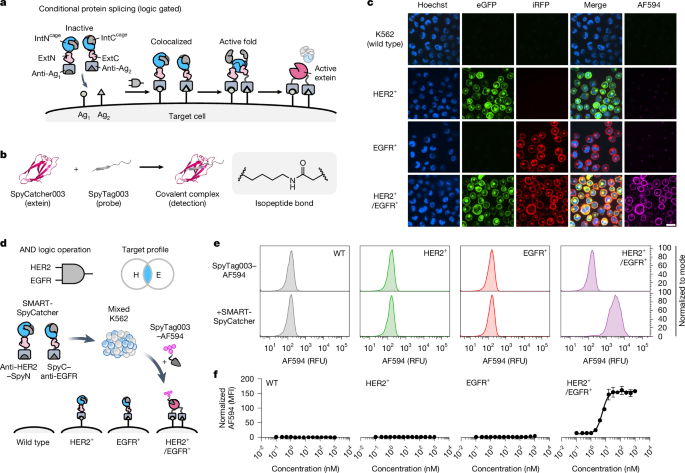
Individually cultured K562 cell lines were spun down and counted to estimate the cell concentration. Then approximately 200,000 cells of an individual K562 cell culture were isolated, washed twice with a buffer containing DPBS, 1% w/v BSA and 2 mM CaCl2 and then suspended in 0.4 ml of the same buffer or in an appropriate medium. To this sample was added the specified SMART-SpyCatcher system at the stated concentration by adding each individual component (SpyN and SpyC) from stock solutions dissolved in 100 mM NaH2PO4 (pH 7.2), 150 mM NaCl, 1 mM EDTA and 1 mM DTT. The sample was then incubated for 2 h at 37 °C in 5% CO2 to allow for cell-surface receptor binding and protein trans-splicing. The specified SpyTag003 conjugate was then added (100 nM final concentration) and the SpyTag003–SpyCatcher003 reaction was allowed to proceed in the dark at room temperature for 20 min. The cells were then washed twice with cold DPBS, 1% w/v BSA, 2 mM CaCl2 and incubated on ice until further analysis by confocal microscopy or flow cytometry. Samples subjected to SDS–PAGE or western blotting were washed twice with DPBS alone to remove excess BSA. Control experiments examining the mechanism of action in Extended Data Fig. 3a–c included the following steps before the addition of SpyTag003–AF594: first, addition of competing DARPins (500 nM) blocking SMART-SpyCatcher binding; second, addition of the Cys1-alkylated eNrdJ-1Ncage component, unable to perform protein trans-splicing; or third, pre-addition of unlabelled SpyTag003 (500 nM) to block the reaction with SpyTag003–AF594. In reactions with SpyTag003D117A–AF594, the mutation D117A disables the formation of an isopeptide bond with SpyCatcher003.
Adherent cell lines
Individually cultured adherent cell lines were lifted using trypsin, washed with complete medium and counted to estimate the cell concentration. Then 200,000 cells were seeded in 24-well plates and allowed to attach and recover for 24 h in complete media. The assay protocol for SMART-SpyCatcher actuation and SpyTag003 recruitment followed that outlined above for the suspension cell lines. After treatment, the adherent cells were washed twice with DPBS, 1% w/v BSA, 2 mM CaCl2 and then lifted with a non-enzymatic solution of DPBS, 1% w/v BSA, 50 mM EDTA and incubated on ice before analysis by flow cytometry. For SDS–PAGE or western blotting, cells were lifted as described and then washed with DPBS alone to remove excess BSA.
Mixed-population experiments using SMART-SpyCatcher
Suspension cell lines
Two distinct mixed populations of K562 cell lines were generated (K562 expresses low endogenous levels of EpCAM):
-
Mixed K562 population 1
-
Mixed K562 population 2
The mixed populations were generated by combining the specified four cell lines (50,000 cells each) in a reaction tube. The SMART-SpyCatcher system (SpyN and SpyC) was then added at the specified concentration and the sample was incubated for 2 h at 37 °C and 5% CO2 to allow for cell-surface receptor binding and protein trans-splicing. In experiments involving NOT gating, the decoy was added at 100 nM just before the addition of SMART-SpyCatcher. The required SpyTag003 conjugate was then added (100 nM final concentration) and the SpyTag003–SpyCatcher003 reaction was allowed to proceed in the dark at room temperature for 20 min. The cells were then washed twice with cold DPBS, 1% w/v BSA, 2 mM CaCl2 and incubated on ice until further analysis by confocal microscopy or flow cytometry. When appropriate for data representation, the individual data sets from the two distinct mixed populations were combined into one common bar graph.
Adherent cell lines
The three adherent cell lines MCF-10a, MCF7 and Sk-br-3 were cultured individually. Each cell line was lifted with a non-enzymatic solution of DPBS, 1% w/v BSA, 50 mM EDTA and counted to estimate the cell concentrations. MCF-10a was then mixed in equal numbers with either MCF-7 or Sk-br-3, and the two mixed mammary populations washed with either complete DMEM medium (MCF-10a + MCF-7) or complete McCoy’s 5a Medium Modified medium (MCF-10a + Sk-br-3) before being aliquoted at 200,000 cells per well in a 24-well plate. The cells were incubated for 6 h at 37 °C and 5% CO2. The assay protocol for SMART-SpyCatcher actuation and SpyTag003 recruitment follows that outlined above for the suspension cell lines. After treatment, the adherent cells were washed twice with DPBS, 1% w/v BSA, 2 mM CaCl2 and then lifted with a non-enzymatic solution of DPBS, 1% w/v BSA, 50 mM EDTA and incubated on ice before analysis by flow cytometry.
Cell antigen phenotyping
Suspension cell lines
Individually cultured K562 cell lines were spun down and counted to estimate the cell concentration. Then approximately 200,000 cells of an individual K562 cell culture were isolated, washed with DBPS, 1% w/v BSA, 2 mM CaCl2 and incubated for 30 min at room temperature in the same buffer supplemented with 100 nM Alexa Fluor 594 DARPin conjugate targeting the antigen EpCAM. The cells were washed twice with DBPS, 1% w/v BSA, 2 mM CaCl2 and incubated on ice until further analysis by flow cytometry.
Adherent cell lines
Plated cells were lifted with trypsin, washed with complete medium and counted to estimate the cell concentration. Then 200,000 cells were seeded in a 24-well plate format and allowed to recover and attach for 24 h in complete media. The cells were then washed with DBPS, 1% w/v BSA, 2 mM CaCl2 and incubated for 30 min at room temperature in the same buffer supplemented with 100 nM Alexa Fluor 594 DARPin conjugate targeting one of the three antigens HER2, EGFR or EpCAM, or alternatively 100 nM Alexa Fluor 594 single-domain antibody conjugate targeting CEACAM6. The doxycycline-inducible cell lines OE19CXCR4DOX and OE19A2ADOX were incubated with 100 nM of the synthetic conjugates BTK140-PEG3-AF568 or SCH58261-AF488 respectively. The cells were washed twice with DBPS, 1% w/v BSA, 2 mM CaCl2 before being lifted with a non-enzymatic solution of DPBS, 1% w/v BSA, 50 mM EDTA and incubated on ice until further analysis by flow cytometry.
NeutrAvidin Rhodamine Red-X recruitment assay
The cell sample was prepared following the assay protocol detailed for single population or mixed populations of suspension cells described above. After incubation with SMART-SpyCatcher (SpyN and SpyC each at 100 nM final concentration) for 2 h, SpyTag003 labelled with biotin (SpyTag003-Biotin, 100 nM) was added to the cells and the SpyTag003–SpyCatcher003 reaction allowed to proceed for 20 min at room temperature in the dark. The cells were then washed twice with cold DPBS, 1% w/v BSA, 2 mM CaCl2 and then incubated with NeutrAvidin Rhodamine Red-X (1:500) for 30 min. The cells were then washed with DBPS, 1% w/v BSA, 2 mM CaCl2 before being imaged by confocal microscopy or analysed by flow cytometry. For the experiment studying the intake of NeutrAvidin Rhodamine Red-X, the sample was imaged immediately and after an extra incubation period of 4 h at the specified temperature.
Cell-depletion assay
Mixed K562 population depletion
The sample was prepared following the assay protocol detailed for mixed populations of suspension cells described above. After incubation with SMART-SpyCatcher (SpyN and SpyC each at 100 nM final concentration) for 2 h, SpyTag003 labelled with biotin (SpyTag003-biotin, 100 nM) was added to the cells and the SpyTag003–SpyCatcher003 reaction allowed to proceed for 30 min at room temperature. The cells were washed with complete RPMI-1640 medium. Cells were then aliquoted into a 96-well plate (12,500 cells per well) and an extra 100 μl of complete RPMI-1640 media containing Streptavidin–Saporin (20 nM final concentration) was added. The cells were then cultured for 72 h for the single-dose regimen. For the two-dose regimen, the cells were cultured for 24 h before being subjected to the treatment described above a second time and then cultured for an extra 72 h. Samples were then analysed by flow cytometry.
Subpopulation percentages obtained from the flow cytometry analysis were normalized using the following formula: percentage viability = X1/(X0 × (WT1/WT0)) × 100, where X0 is the percentage of the specific subpopulation in the negative untreated sample, X1 is the percentage of the specific subpopulation, the relevant sample, WT0 is the percentage of the wild-type subpopulation in the negative untreated sample, and WT1 is the percentage of the wild-type subpopulation in the relevant sample. The derived percentage is taken to be the viability of the specified subpopulation.
Single A431 population depletion
For the A431 cell-depletion assay, the cultured cells were lifted with trypsin, counted and then seeded at 5,000 cells per well in a 96-well plate before further culturing for 24 h at 37 °C and 5% CO2. The cells were then washed with DPBS, 1% w/v BSA, 2 mM CaCl2 and incubated with the indicated SMART-SpyCatcher (SpyN and SpyC, each at 100 nM final concentration) for 2 h at 37 °C and 5% CO2. SpyTag003-biotin (100 nM) was added and the sample was incubated for 30 min at room temperature. The cells were gently washed with complete DMEM medium before being suspended in 200 μl DMEM medium containing 20 nM Streptavidin–Saporin conjugate as indicated. The cells were cultured for 24 h at 37 °C and 5% CO2 before the complete treatment described above was repeated to give a two-dose regimen. Finally, the cells were cultured for an extra 72 h. Each well was then washed twice with complete DMEM medium and 200 μl of complete DMEM medium added. An XTT cell viability assay was used to quantify the metabolic activity of each sample according to the protocol prescribed by the manufacturer. The conversion of XTT to formazan was measured on a SpectraMax iD5 Multi-Mode Microplate Reader (Molecular Devices) using well-scan mode at 465 nm at room temperature. The obtained absorbance values were normalized to the negative untreated control.
Protein proximity labelling
APEX2 proximity labelling
The cell sample, prepared following the assay protocol detailed for single populations, was treated with the SMART-SpyCatcher reactants (SpyN and SpyC each at 100 nM final concentration) for 2 h. The cells were then incubated with SpyTag003-APEX2 (300 nM) for 30 min at room temperature before being washed twice with DPBS. To initiate APEX proximity labelling, the cells were treated with 1 ml DPBS containing biotin-phenol (250 µM final concentration) followed by the addition of 10 µl of freshly prepared DPBS containing 100 mM H2O2, and the reaction was allowed to proceed at room temperature under gentle swirling for the indicated time. The reaction was quenched by the addition of 200 µl DPBS, 10 mM sodium ascorbate and 5 mM Trolox, and the cells washed twice with 1 ml of the same buffer. The cells were lifted (when necessary) by the addition of 1 ml DPBS, 50 mM EDTA, pelleted and suspended in 200–500 µl 50 mM Tris-HCl (pH 8.0), 150 mM NaCl, 1% v/v NP-40, 0.5% w/v sodium deoxycholate, 0.1% w/v sodium dodecyl sulfate supplemented with 1× Halt Protease Inhibitor Cocktail and 1 mM PMSF, then sonicated briefly and centrifuged for 20 min at 15,000g at 4 °C. The supernatant was isolated and analysed by SDS–PAGE/western blotting.
AND-gated μMap photocatalytic proximity labelling
For the mixed-cell experiment, the mixed K562 population 1 was prepared as described above in DPBS, 1% w/v BSA, 2 mM CaCl2. The cells were incubated with the SMART-SpyCatcher (100 nM, eNrdJ-1cage variant) in 1 ml DPBS, 1% w/v BSA, 2 mM CaCl2 for 2 h at 37 °C, 5% CO2. SpyTag003-Ir was added to a final concentration of 200 nM in DPBS and the cells were incubated for 30 min at room temperature. The cells were washed twice with DPBS before incubation in DPBS supplemented with 250 µM biotin-diazirine for 5 min at room temperature. The cell sample was then irradiated using a Kessil PR160L lamp (LED 440 nm) for 5 or 10 min. The cells were washed again twice with DPBS and then treated with Streptavidin–Alexa Fluor 546 (1:2,000 v/v ratio) and incubated for 30 min. Finally, the cells were washed twice with DPBS and analysed by flow cytometry.
Cell experiments using SMART-IL-1β
On-cell splicing and release
OE19 cells were cultured to full confluency on a 12-well plate and washed twice with DBPS supplemented with 1% w/v BSA and 2 mM CaCl2. Alternatively, one million cultured K562 cells were collected and washed twice with DBPS, 1% w/v BSA, 2 mM CaCl2. In both cases, the cells were incubated with each SMART-IL-1β fragment (at the specified concentration) in 0.5 ml with DBPS, 1% w/v BSA and 2 mM CaCl2 for 2 h at 37 °C and 5% CO2. The supernatant was then withdrawn, cleared of any cell debris by centrifugation and used further.
IL-1β stimulation of HeLa cultures
HeLa cells were cultured to about 30–50% confluency in a 24-well glass-bottom plate. The supernatant from OE19 or K562 cultures, prepared as described above, was applied to the cell culture with an additional 500 µl fresh DMEM supplemented with 10% v/v FBS, 100 U ml−1 penicillin/streptomycin for 30 min at 37 °C at 5% CO2. The cells were then washed with DBPS before being fixed by incubation in 0.5 ml 5% v/v formaldehyde for 10 min at room temperature. Excess formaldehyde was quenched by the addition of 0.5 ml 150 mM glycine followed by washes with DPBS. The cells were subsequently permeabilized by incubation with 0.5 ml DPBS and 0.5% v/v Triton X-100. The fixed and permeabilized cell sample was then washed and blocked for 1 h at room temperature by the addition of DPBS, 4% w/v BSA and 0.1% v/v Tween-20, and then washed with DPBS, 4% w/v BSA and 0.1% v/v Tween-20. The cell sample was thereafter treated first with rabbit anti-NF-κB (p65) antibody in DPBS and 1% w/v BSA for 1 h at room temperature, washed and then incubated with goat anti-rabbit dye conjugate and Hoechst (1:2,000 dilution) in DPBS and 1% w/v BSA for 30 min in the buffer. Finally, the cell sample was subjected to immunofluorescence microscopy.
HEK-Blue IL-1β cell assay
Cultured HEK-Blue IL-1β cells were gently lifted by trypsinization, counted and plated as 100,000 cells per well in a 24-well plate, after which they were allowed to recover overnight. After aspiration, 500 µl supernatant from OE19 or K562 cultures, prepared as described above, was added with an additional 500 µl of fresh medium without Normocin/Zeocin. The cell cultures were then incubated for 24 h at 37 °C and 5% CO2. From each of the treated HEK-Blue IL-1β cell cultures, 50 µl supernatant was transferred to a 96-well plate. To each well we added 150 µL QUANTI-Blue solution, after which the plate was incubated for 30 min at 37 °C. SEAP levels were then determined using a plate reader measuring the absorbance at 630 nm.
Mixed cells K562 and HEK-Blue
One million K562 cells and 100,000 HEK-Blue IL-1β cells were collected, mixed and washed and suspended in 0.5 ml DPBS, 1% w/v BSA and 2 mM CaCl2. The cells were then co-incubated in a 12-well plate. SMART-IL-1β was added to the cell sample, which was further incubated for 2 h at 37 °C and 5% CO2. Then 500 µl RPMI medium supplemented with 5% FBS, 100 U ml−1 penicillin-streptomycin and 25 mM HEPES buffer was added and the cells were co-cultured for 24 h at 37 °C and 5% CO2. The SEAP assay was then done as described above.
Mixed cells OE19 and HeLaeGFP+
OE19 and HeLaeGFP+ cells were seeded in a 24-well glass-bottom plate in a 5:1 ratio and cultured in a mixture of 50% DMEM, 50% RPMI media supplemented with 2 mM l-glutamine, 10% w/v FBS and 100 U ml−1 penicillin-streptomycin. When nearly confluent, the cells were washed with DPBS, 1% w/v BSA and 2 mM CaCl2 and incubated with SMART-IL-1β for 2 h at 37 °C and 5% CO2. The cells were then washed, fixed, permeabilized and analysed by fluorescence microscopy as described above.
Statistics and reproducibility
All statistical analyses were done in GraphPad Prism v.9.2.0. P-values were determined by either two-sided t-test or one-way ANOVA followed by Dunnett’s test, as listed in the figure legends. The statistical significances of differences (NS, not significant; *P < 0.05, **P < 0.01, ***P < 0.001, ****P < 0.0001) are specified throughout the figures and legends. Heatmaps were generated using GraphPad Prism v.9.2.0. All experiments analysed by SDS–PAGE/western blotting and/or flow cytometry were repeated at least 2–3 times (independent biological replicates). All experiments analysed by microscopy were repeated at least twice (independent biological replicates). All results were reproducible.
Reporting summary
Further information on research design is available in the Nature Portfolio Reporting Summary linked to this article.

