


Toyota has sold more than 3 million Highlanders since the model’s introduction in 2000, when it was one of the first unibody midsize crossovers to hit the market. In 2005, the first-generation Highlander became the first Toyota SUV to get a hybrid powertrain, at a time when most other automakers weren’t even touching electrification for Prius-like cars. The current fourth-gen Highlander has been around since 2019 and remains a global model, but in 2023 Toyota released the larger, U.S.-focused Grand Highlander SUV. With more space and more advanced hybrid powertrains, the Grand Highlander has quickly become the better seller of the two — Toyota sold almost three times more Grand Highlanders in the U.S. last year than it did regular Highlanders.
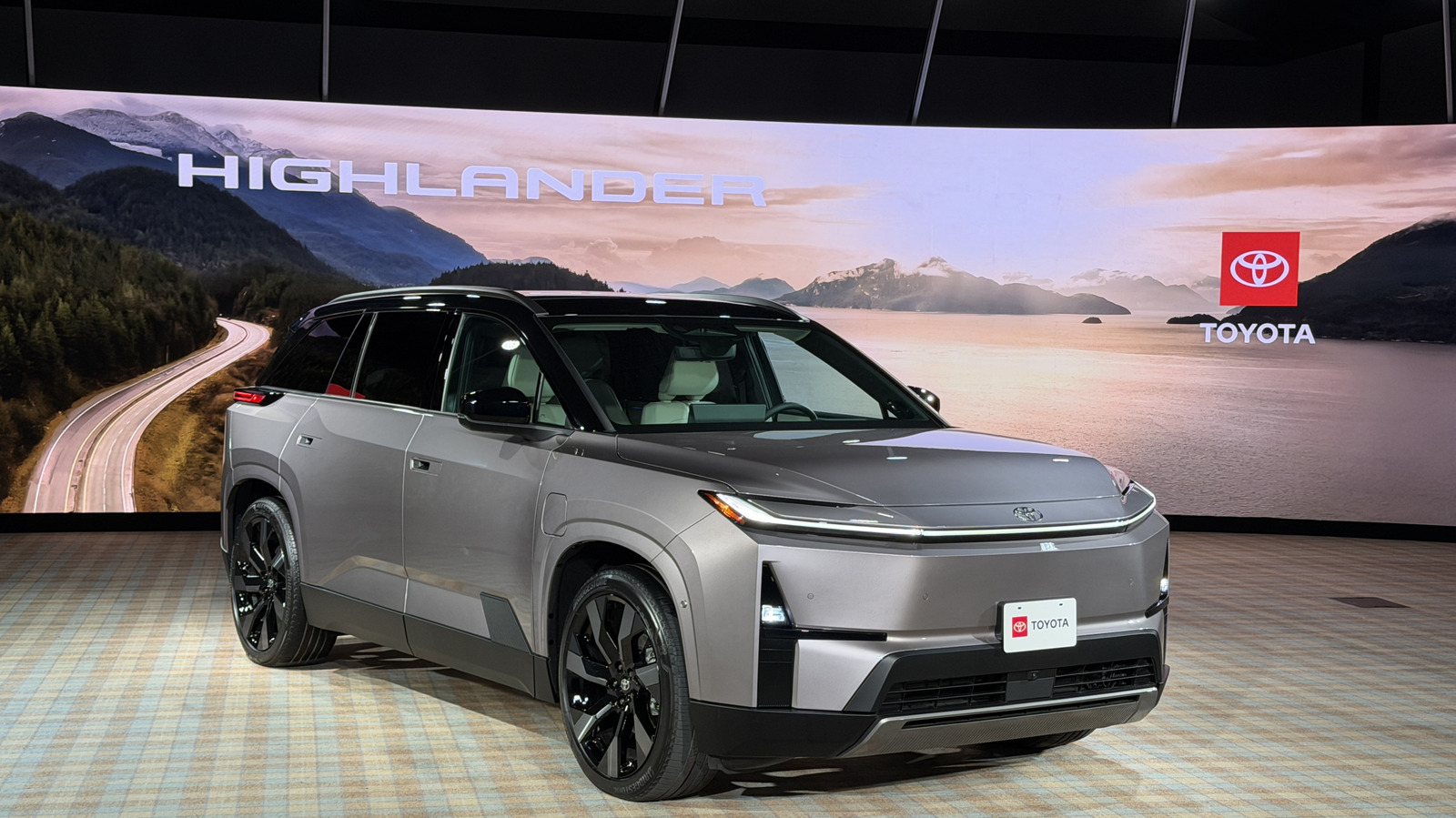
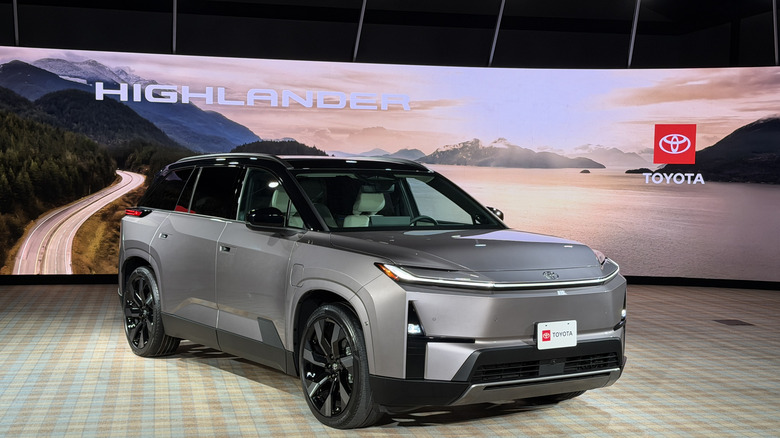
Ostensibly because of that, Toyota is going more radical with the fifth-gen Highlander, which just debuted during the first drive event for the bZ Woodland and C-HR. The 2027 Highlander will only be offered with a fully electric powertrain, and it seems like a solid entry into the still pretty sparse three-row EV field.
Full disclosure: Toyota invited me to drive to Ojai, California, and put me up in a hotel for a couple nights so I could see the Highlander EV and drive the bZ Woodland and C-HR.
Two battery packs, two power levels
Instead of the e-TNGA platform that underpins electric Toyotas like the bZ and C-HR, the Highlander rides on a modified version of the TNGA-K platform used by everything from the Camry, RAV4 and old Highlander to the Lexus ES and TX, and even the Century SUV. Toyota says the new Highlander’s TNGA-K setup has a number of enhancements to improve aerodynamics and reduce noise and vibration.
Toyota is launching the Highlander EV in two trim levels, with two different battery pack sizes and either front- or all-wheel drive. The base XLE has a 77.0-kWh battery sending electrons to a single motor up front that produces 221 horsepower and 198 pound-feet of torque, with Toyota estimating a 287-mile range (there are no EPA ratings yet). If you want all-wheel drive, Toyota adds a second motor to the rear axle that ups total output to a healthy 338 hp and 323 lb-ft, matching the facelifted bZ (though the bZ Woodland has 375 horses). The Toyota-estimated range drops to 270 miles. Going for an AWD Highlander also gets you off-road drive modes and crawl control.
 Daniel Golson / Jalopnik
If that’s not enough, a 95.8-kWh battery pack is optional on the XLE AWD and standard on the Limited, which is only offered with the dual-motor setup. Both of those Highlanders have a 320-mile range, according to Toyota. 19-inch wheels with aero caps are standard, but you can get the Limited with 22s; of course, Toyota isn’t saying what sort of range hit you’ll take if you do. The automaker also isn’t saying what sort of DC fast-charging speeds the Highlander will be able to handle — it’s likely the same 150 kW as Toyota’s other EVs — but it’ll have an NACS charge port and be able to go from 10% to 80% in around 30 minutes. (Toyota also hasn’t said if that figure is the same for both battery packs.) The Highlander is also the first Toyota in the U.S. with vehicle-to-load capability.
Lower and longer
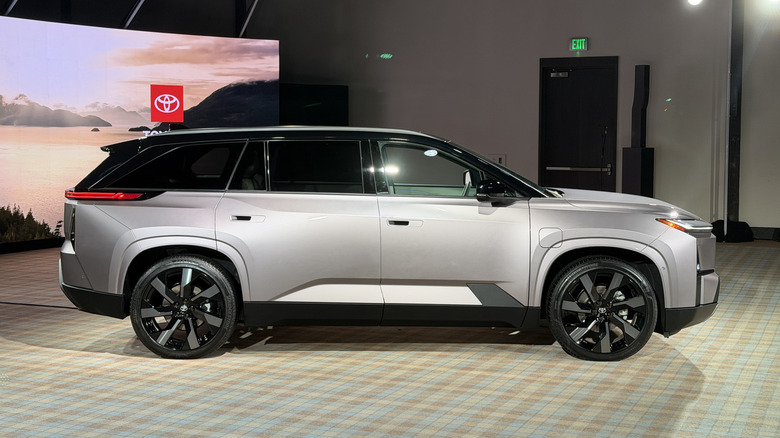
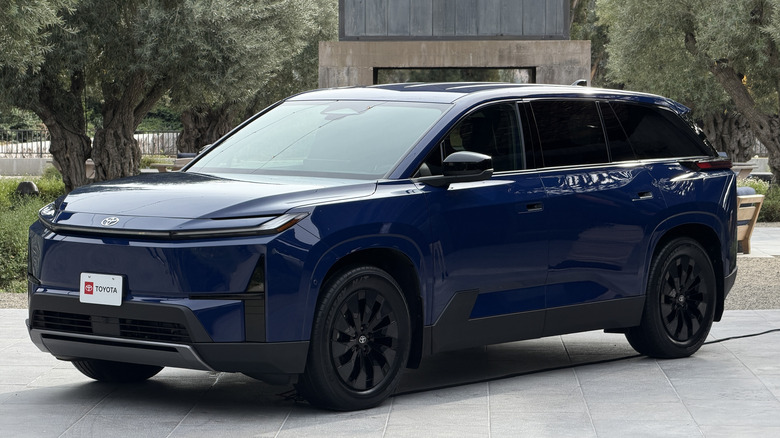
While its specs aren’t exactly exciting or segment-leading, the electric Highlander looks really good. In fact, I think this is the most interesting design on a normal person’s Toyota in a long time. Compared to the outgoing internal-combustion Highlander, the EV is 0.8 inch lower in height, 2.3 inches wider, and 3.9 inches longer overall. The wheelbase has been stretched by 7.9 inches, which will make the biggest difference to buyers. The Grand Highlander is a few inches larger overall, but the Highlander EV’s wheelbase is 4 inches longer.
Those tweaked dimensions, squared-off wheel arches and blockier proportions go a long way toward making the EV more interesting to look at than the old Highlander, but it’s the design details that Toyota really put effort into here. It’s got Toyota’s recent hammerhead signature front end look, with thin running lights that extend across the nose and the headlights themselves in small angular pods below.
 Daniel Golson / Jalopnik
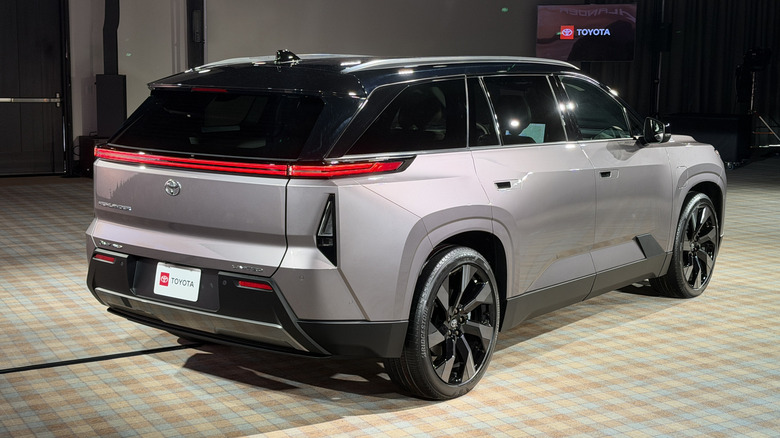
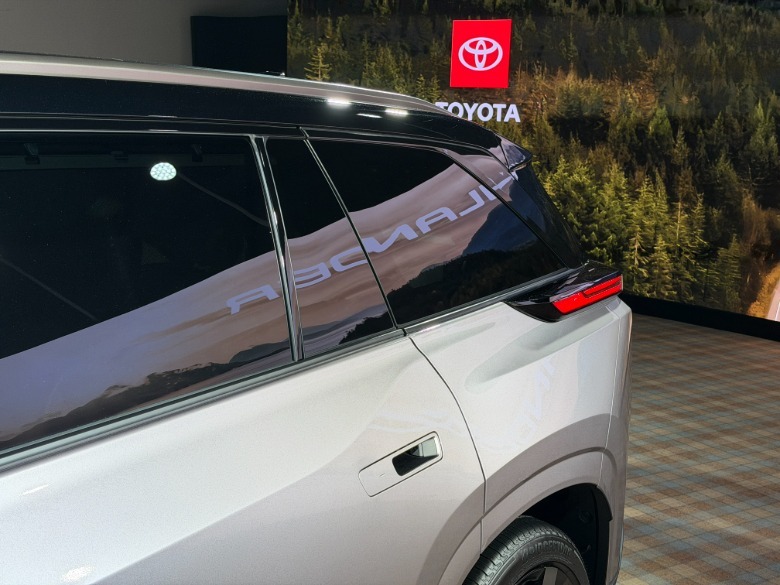
Walk around to the side of the Highlander and it starts getting weird, I think in a good way. The lower doors have a chamfered section with an angled fin coming off the lower cladding, and the flush door handles have button-actuated electronic latches like on new Lexus SUVs. My favorite element is the rear fender treatment, with horizontal character lines that flow into the thin wraparound taillight. It makes the Highlander look downright muscular. At the rear, the turn signals are housed in triangular pieces that inform the lines in the tailgate and bumper. It’s angular and more futuristic than other new Toyotas, but still handsome and clean.
It’s kinda weird inside, which is good
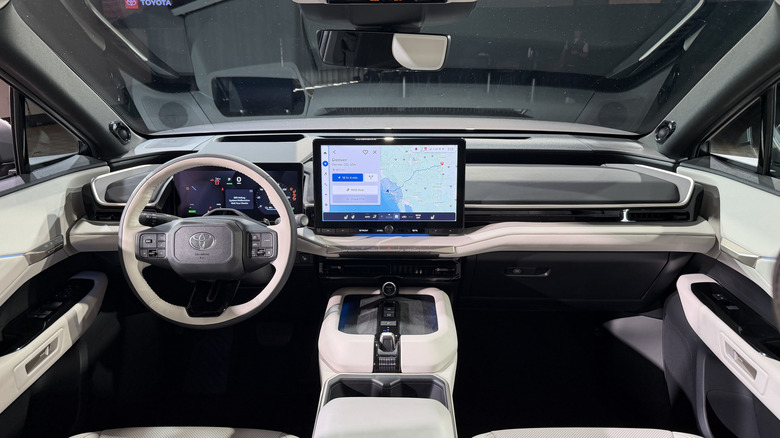
It’s successfully weird inside, too. The dashboard has a multi-tier wing-like design with more visual flair than Toyota’s bZ (and certainly more than the old Highlander). You get a 12.3-inch digital gauge cluster and a 14-inch touchscreen running Toyota’s great new infotainment system, below which is a row of some physical buttons that have a nice click to them. The tall center console has a pair of angled wireless charging pads that are bisected by some additional controls and the stubby shifter; the cupholders are pretty big, and there’s a lot of storage space under the center armrest.
 Daniel Golson / Jalopnik
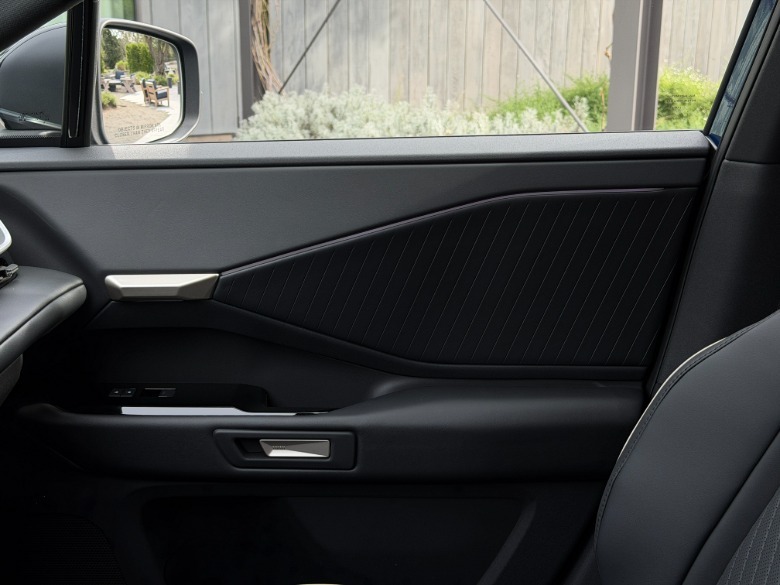
The Highlander I got to poke around before the reveal was clearly a pre-production model, so I’m not going to make any build quality judgements, but there’s a nice mix of soft-touch materials and finishes. My favorite detail are the strange door three-dimensional door cards, which have ambient lighting strips that lead to a peak that’s capped off by metal details (and the seat memory controls for the driver). It’s a design that feels very un-Toyota in a good way. Depending on the trim level and color scheme, the seats and door panels have different perforation and stitching patterns, including a cool lined motif.
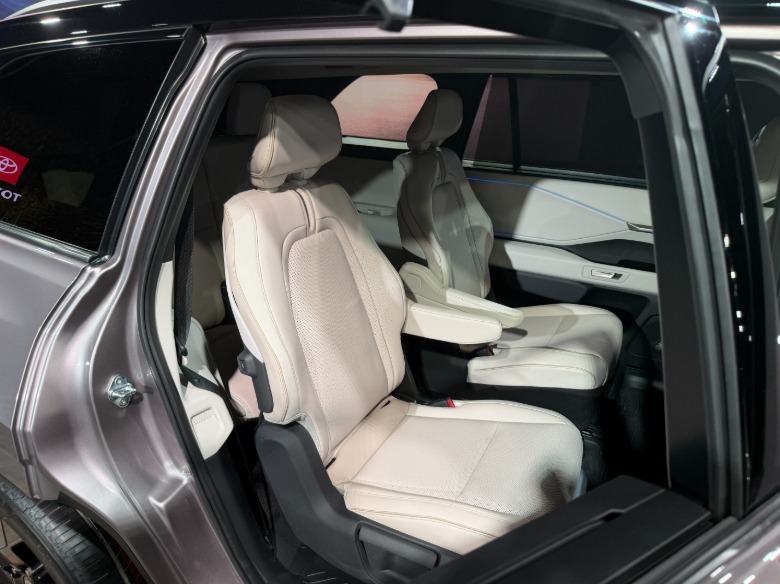 Daniel Golson/Jalopnik
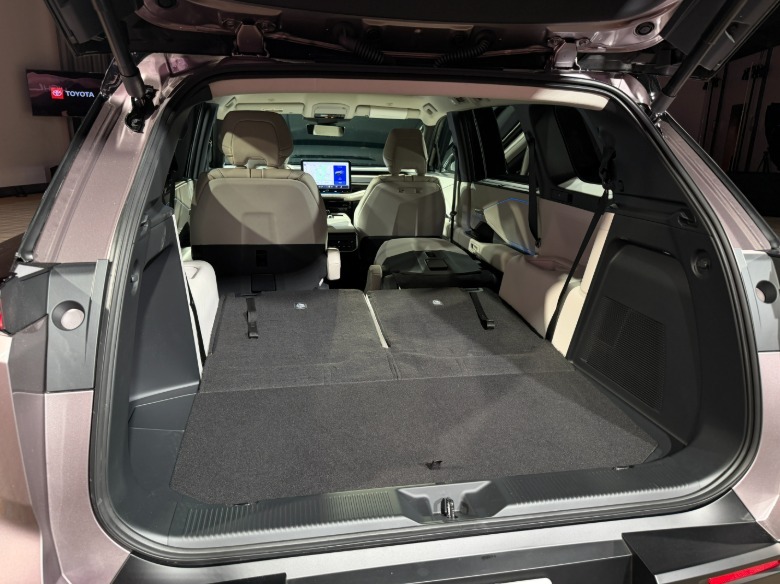
With all three rows of seats up the Highlander EV has 15.9 cubic feet of cargo space, just a tenth of a cube less than a Highlander hybrid. Fold the second row flat and that grows to 45.6 cubic feet, a few cubes less than the hybrid; Toyota hasn’t given cargo figures with the second-row seats folded, which don’t go perfectly flat. They do easily slide fore and aft, and there’s a dedicated button that slides them forward and folds the seatback. The third row has a pair of seats, and on almost every version of the new Highlander the second-row seats are a pair of captain’s chairs, though a three-across bench is available. With the captain’s chairs you get a console in between with storage space and cupholders.
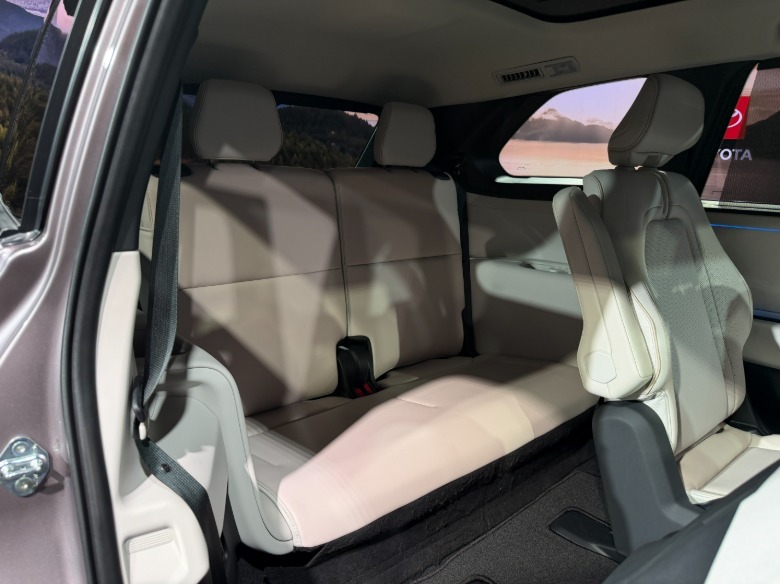 Daniel Golson/Jalopnik
The floor is nearly flat aside from a slightly raised section in the second row, making it easy to move into the back, and the cabin seems very spacious and airy in general, especially with the optional panoramic glass roof. It’s easy for my 5’9″ self to get in and out of the third row, and the second-row chairs seem comfortable. The driving position is nice too, and it doesn’t have the strange gauge cluster and steering wheel setup used in the bZ. Paddle shifters are used to adjust the levels of regenerative braking.
We don’t know how much it’ll be yet
Opening the Highlander’s trim levels with XLE means it gets a lot of features as standard. The full-width front LED running light, front acoustic glass, heated front seats and a heated steering wheel, a 6-speaker sound system, 64-color ambient lighting, a built-in dashcam, SofTex synthetic leather upholstery, lots of USB-C ports, second-row climate controls, a hands-free power tailgate, and wireless Apple CarPlay and Android Auto. Standard safety features include automated emergency braking with pedestrian detection, adaptive cruise control with lane centering, lane departure warning with steering assist, road sign detection and automatic high beams.
Move up to the Limited and you get ventilated front seats and heated second-row seats, a head-up display, memory for the side mirrors, rear sunshades, traffic jam assist, automatic lane changes, front cross-traffic alert, advanced parking assist and a 360-degree camera system. An 11-speaker JBL sound system is offered on the XLE AWD and Limited, and you can get the LImited with two-tone paint and 22-inch wheels.
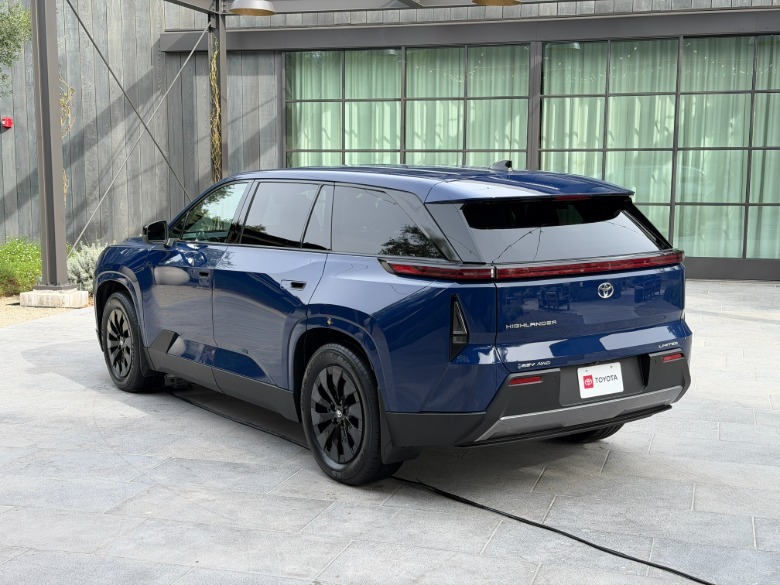 Daniel Golson/Jalopnik
We don’t yet know how much the 2027 Highlander will cost, but if I had to guess it’ll come in somewhere around $50,000-$55,000 for the base front-wheel-drive XLE. Toyota says the Highlander will be assembled at its plant in Georgetown, Kentucky, and the batteries will be produced at its new $13.9-billion manufacturing facility in Liberty, North Carolina. The electric Highlander will go on sale in late 2026.

